
Entity drift is what happens when your website, review profiles, social bios and press coverage describe your company differently. AI engines lower their confidence in who you are, then give a hedged answer or name a competitor they are surer about.
Key Takeaways
- AI engines resolve every description of you into one entity, then score how confident they are in it.
- Entity drift lowers that confidence. The usual result is a vague answer or no mention at all.
- It lives on four surfaces: your site, review profiles, social bios and earned coverage. Most companies actively manage only the first.
- You can diagnose it in ten minutes by asking ChatGPT and Perplexity to describe your company.
- The fix is mostly a decision: pick one category description and use it everywhere.
Entity drift: Inconsistency in how a company is described across the surfaces an AI engine reads. It lowers the engine’s confidence in the company, which leads to hedged answers or omission.
Why Does Entity Drift Need Its Own Name?
Most companies working on AI visibility try to add signals: more content, more mentions, more schema. A quieter problem often sits underneath. The signals they already have disagree with each other.
“Inconsistent messaging” sounds like a brand problem you fix when you get around to it. Entity drift is a technical problem with a measurable cost.
AI systems resolve your company into an entity, a record with attributes and relationships, and attach a confidence level to it.
When your signals agree, confidence is high and you get named clearly. When they conflict, confidence drops, and a low confidence entity gets vague language or gets left out.
How Does Entity Drift Happen?
Nobody decides to describe their company four different ways. It builds up through the normal operation of a growing business.
- A repositioning updates the homepage, but not the G2 category, which still says what you were two years ago.
- The LinkedIn tagline was written by whoever filled in the company page form in 2023.
- Press coverage described you under an old positioning. Those articles still rank and still get crawled.
- A product launch added a new category to your story, and the review profiles never caught up.
Each change is reasonable on its own. Together they create entity drift: four surfaces, each sensible, collectively contradictory. Because no single person owns all four, no one sees it.
Where Does Entity Drift Show Up?
Four surfaces describe your company: your site, your review profiles, your social bios and your earned coverage.
Most companies put their effort into the first and assume the rest follow.
| Surface | Who controls it | How often it gets updated |
|---|---|---|
| Your website | You | Constantly |
| Review profiles (G2, Capterra) | Partly you, partly customers | Rarely, and the category is often years old |
| Social bios (LinkedIn, X) | You | Usually written once and forgotten |
| Earned coverage (press, podcasts, roundups) | Other people | Never, once published |
The review profile deserves special attention. Engines treat review platforms as authoritative, and the category label there was chosen from a fixed list, often years ago.
It is also where your customers describe you in their own words. In my experience, most companies have never read that language closely.
What Does an AI Engine Do With Conflicting Descriptions?
It lowers its confidence in all of them.
An engine answering “what does this company do” reconciles everything it has crawled about you into one entity, maps your category and competitors, and scores how sure it is.
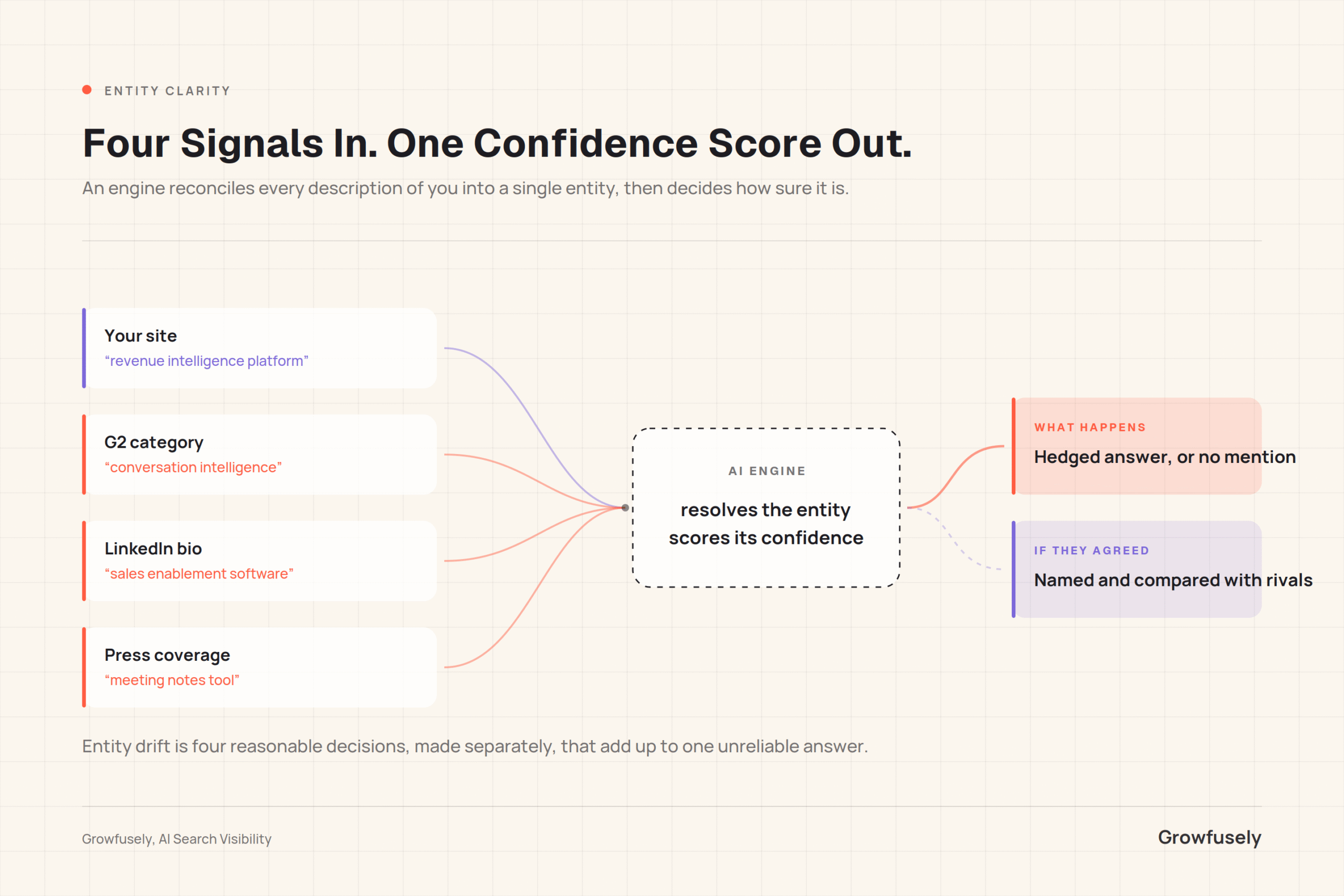
Four signals in, one confidence score out.
Say your homepage says revenue intelligence platform, G2 files you under conversation intelligence, and LinkedIn says sales enablement software.
The engine sees three competing claims about one company, and becomes less sure any of them is right.
Here is what that sounds like in practice:
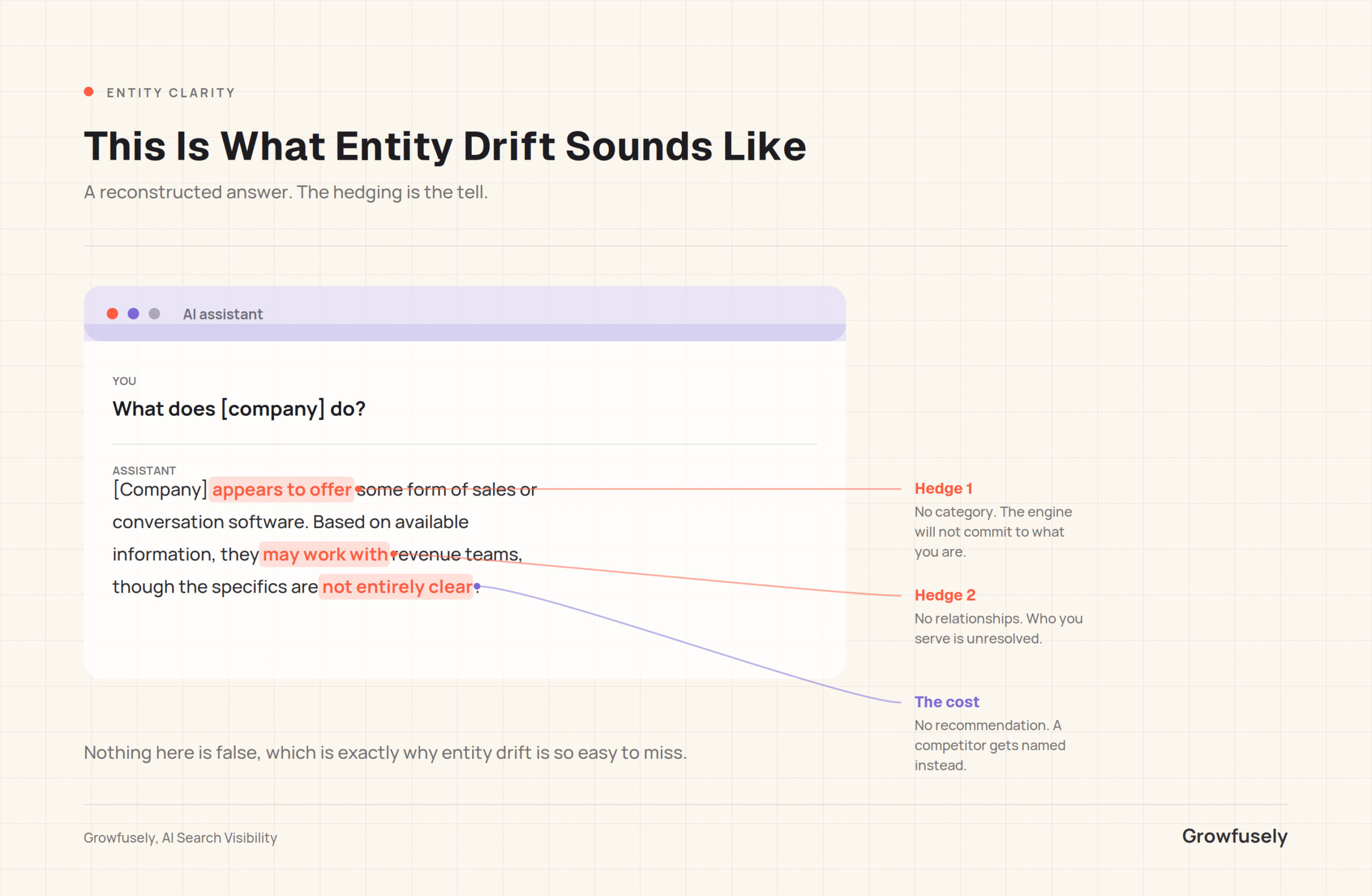
A reconstructed answer. The hedging is the tell.
Nothing in that answer is false. Entity drift rarely makes AI say something wrong about you. More often, it makes AI say very little.
Think of a librarian asked for a book by an author whose name is spelled four ways across four catalog records. The book exists. The librarian hesitates because the records may not point to the same author, and recommends a book they can vouch for instead.
What Does Entity Drift Look Like at a Real Company?
Take a Series B company I will leave unnamed. In one browsing session, a visitor saw three different descriptions above the fold:
- The hero headline: an AI powered platform for modern revenue teams.
- The meta description: revenue intelligence software.
- The G2 profile linked in the footer: conversation intelligence.
Off site, the LinkedIn tagline read sales enablement software. That makes four descriptions of one company.
To a person, that is one company wearing four hats. To an engine scoring its confidence, it is four competing answers to “what category is this?” This company had plenty of content. The content just could not agree on what the company was.
How Do You Diagnose Entity Drift in Ten Minutes?
- Ask both engines. Open ChatGPT and Perplexity and ask each what your company does. Note the exact words each uses for your category.
- Compare against your homepage. Read your own hero line and meta description. Does the engines’ language match?
- Check the surfaces you forgot. Your G2 category and your LinkedIn tagline.
You will see one of three outcomes:
- All four agree. No meaningful drift. Spend your effort elsewhere.
- The engines hedge, or use a category you do not recognize. They are echoing a surface you are not managing.
- The engines contradict each other. Advanced drift. Different engines have resolved you differently.
How Do You Fix Entity Drift?
- Pick one category description. One phrase for the most accurate thing you are. This is the hard part, because it forces an internal decision many companies avoid.
- Write it once. Create one canonical sentence that everything else comes from.
- Use it everywhere. Homepage, meta tags, product pages, G2 and Capterra, LinkedIn, directory listings and your press boilerplate.
- Retest in six weeks. Engines need time to recrawl. Ask them again and check whether the hedging has cleared.
How Much Does Entity Drift Cost You?
You cannot isolate it as a single variable. Anyone quoting a precise revenue figure for entity drift is guessing. AI visibility moves for many reasons at once.
What you can do is measure before and after. Screenshot how both engines describe you today, fix the drift, and screenshot again in six weeks.
If the hedging is gone and your category is stable across engines, the drift was costing you. That is the most honest measurement available, and it is enough.
It also helps to know where this sits. In my analysis of 1,739 AI citations, recommendations came mostly from independent content and comparison pages. Fixing entity drift makes sure the presence you already have gets credited to a company the engine can name with confidence.
What This Guide Does Not Cover
- How to earn new mentions. Entity drift is about making existing signals agree. Earning third party coverage is separate work.
- Technical access. If AI crawlers cannot reach your site at all, consistency will not help. The AI Crawler Directory covers that.
How to Cite This Term
Dholakiya, P. (2026). Entity Drift: Why AI Engines Hedge When They Describe Your Company. Growfusely. https://growfusely.com/blog/entity-drift/
If you use the term entity drift in your own writing, a link back to this page is appreciated.
Why Partner with Growfusely for Entity Clarity?
Fixing entity drift is simple to describe and tedious to carry out across every surface. That is why most companies start and never finish.
- An entity audit showing how both engines currently describe you, and which surfaces pull against your positioning.
- One canonical description, agreed internally and then rolled out across your site, review profiles, social bios and press boilerplate.
- Before and after measurement, so the work is judged on something you can see.
- Original research behind every recommendation, including studies on crawler access and llms.txt adoption.
If your AI answers are vague or missing, entity drift is the cheapest thing to rule out first. Schedule a call.
FAQs
What is entity drift?
Entity drift is inconsistency in how your company is described across the surfaces an AI engine reads: your site, review profiles, social bios and earned coverage. It lowers the engine’s confidence in your company, which leads to hedged answers or omission.
Is entity drift the same as inconsistent branding?
No. Inconsistent branding confuses people. Entity drift lowers the confidence score an AI system assigns your company, which changes whether you appear in answers at all.
How do I know if my company has entity drift?
Ask ChatGPT and Perplexity to describe your company, then compare their wording against your homepage, G2 category and LinkedIn tagline. If they disagree, or the engines hedge, you have it.
How long does it take to fix entity drift?
The decision and edits take days. Engines take about six weeks to recrawl before you can reliably measure the change.
Which surface causes the most entity drift?
Usually the ones nobody manages: the G2 or Capterra category, and older press coverage. Both carry weight with engines and both tend to lag your current positioning.
Read Next
- llms.txt adoption in B2B SaaS. What 510 companies publish for AI systems.
- The AI Crawler Directory. Every AI bot, what it does and what blocking it costs.
- What AI cites for B2B software. My analysis of 1,739 citations across ChatGPT and Perplexity.

Pratik Dholakiya is the Founder of Growfusely, a SaaS SEO and AI Search Visibility agency.
