
A few weeks ago, I ran a small experiment. I threw 18 B2B buying questions into some AI answering engines and noted down the sources of their answers. It gave me direction. The truth about 18 questions is that you can’t distinguish clearly between pattern and coincidence.
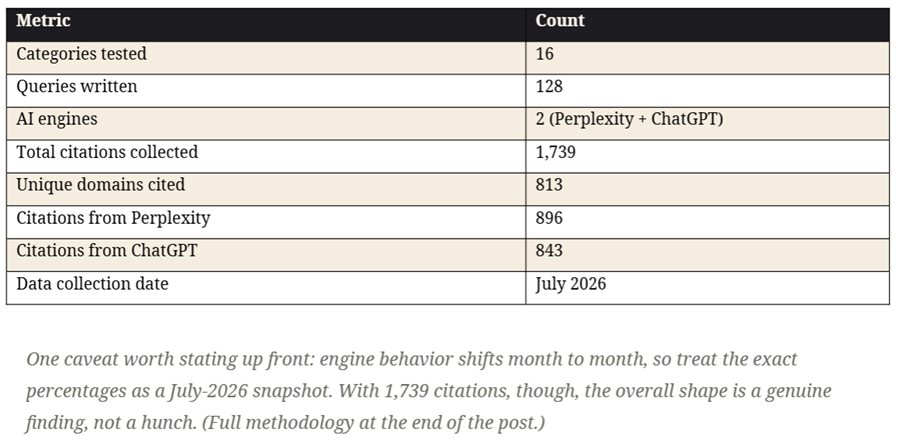
So, I decided to start again, but this time on a large enough scale to make it meaningful. This second round involved 128 questions, 16 different B2B SaaS categories, two different AI engines, and 1,739 unique citations altogether. With the same basic question: when a customer asks an AI “what is the best [category] software”, what are the true sources of the answer?
Up ahead, is the methodology, results (two of which surprised me), a detailed breakdown of the exact types of sources cited, and a real-world GEO/AEO/SEO playbook to implement.
How I did this (and why it’s more trustworthy than my first attempt)
I took 16 core B2B software categories: CRM, project management, marketing automation, DevOps, cybersecurity, HR, accounting, help desk, email marketing, business intelligence, e-signature, applicant tracking, expense management, video conferencing, password managers, and fintech.
For each, I wrote eight realistic buyer queries (“best X software 2026,” “top X tools,” “best X for small business,” “top X alternatives,” “best X for growing B2B companies,” “best enterprise X,” “most affordable X,” “best AI X”). That’s a total of 128 queries.
The big improvement here is scale and comparability. Every single search was performed in two of the best AI search engines available, Perplexity and ChatGPT, and every citation from both was logged.
This generated roughly seven citations per query per search engine, and importantly, it allowed for a head-to-head comparison of both search engines across identical queries.
Finding 1: Independent content dominates. Review sites barely register.
With 18 queries, it turned out that content sites and vendor self-published sites did all the heavy lifting. With 1,739 citations, this finding was only reinforced.
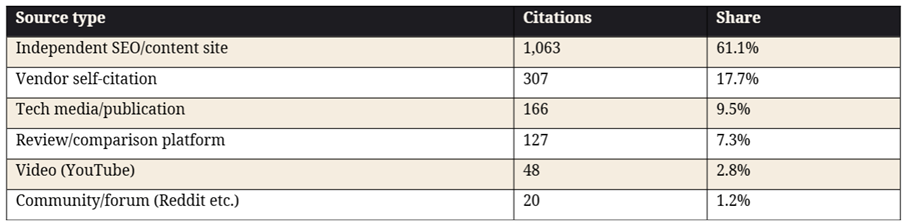
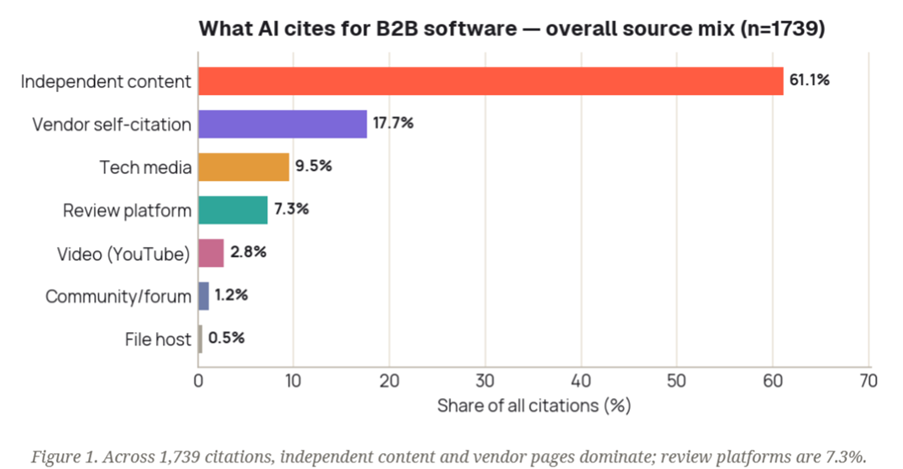
Read that review-platform line again: G2, Capterra, Gartner and every other review site combined were 7.3% of citations. Independent content plus vendors’ own pages made up nearly 79%.
This means, if you’ve built an AI-visibility strategy around getting more G2 reviews, you’ve focused on just 1% of the board. It also matches the major published benchmarking. SE Ranking discovered that review platforms are just 8.5% of Google AI Overview citations.
As you can see, all three methods gave up one answer.
Finding 2 (the one that surprised me): The two engines barely agree.
This is the kind of data you get when you compare multiple engines. For the same set of queries, both Perplexity and ChatGPT cite distinctly different sources.
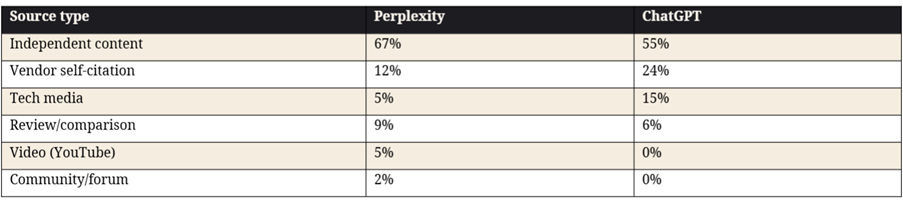
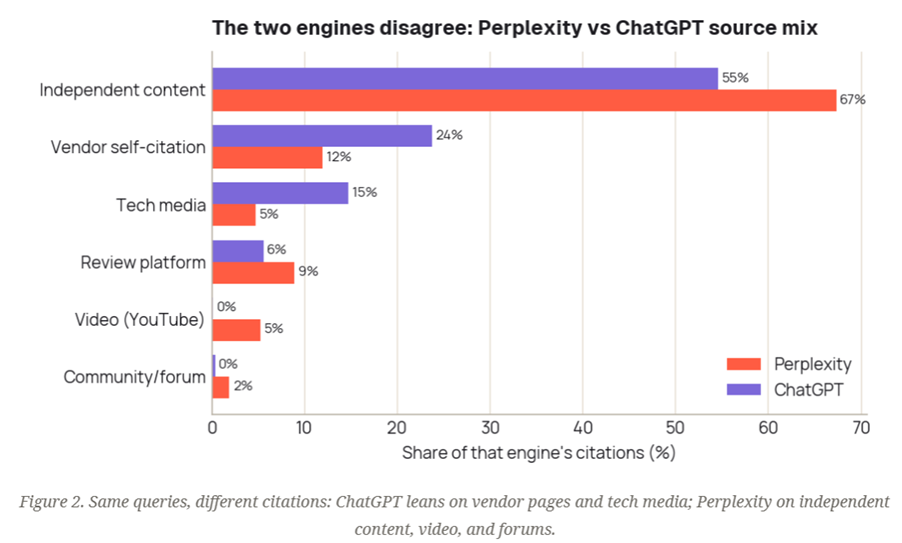
Here, three things stand out.
1. ChatGPT references vendor web pages twice as much as Perplexity (24% vs. 12%), and thrice more depends on technology media.
2. Perplexity is the only source to give meaningful references to YouTube and forums – 47 references to YouTube and 11 to Reddit, while ChatGPT gives almost none.
3. The content that earns you Perplexity citation does not earn you ChatGPT citation. A uni-dimensional “get cited by AI” approach fails one of them.
Finding 3: Reddit came back from the dead (on one engine)
While the 18-query study found zero Reddit citations and concluded that forums may not work for “best of” queries, it was only partially correct. Reddit was cited 11 times in seven categories, but by Perplexity only; whereas ChatGPT never made it.
The takeaway? Community content does influence AI answers for buying queries, but it is engine-specific. A Reddit strategy moves your Perplexity visibility and does almost nothing for ChatGPT. This nuance is invisible if you test only one engine, which is exactly why the small study got it wrong.
Finding 4: The “vendors self-cite like crazy” spike was mostly small-sample noise
My 18-query study said that 47% of project management citations were from vendors citing their own comparison pages. While that makes for a nice headline, at scale, however, the number turned out to be exaggerated.
Vendors do cite themselves, yet not to the extent of 47%, just consistently within 12-24%.
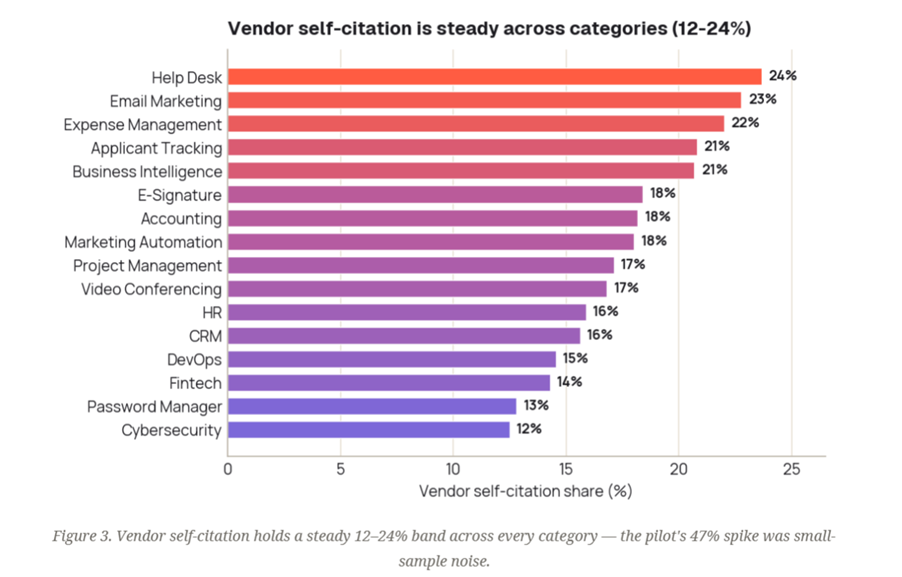
I’m calling this out because it’s the whole reason I re-ran the study.
The small sample size revealed a genuine pattern (vendors cite themselves, about 1 out of 6 cites), yet with questionable precision. At a large sample size, the signal will be more reliable, and the conclusion much more valuable: your own content, comparing yourself honestly, gets cited in all categories without fail.
Finding 5: A class of “AI-optimized” sites is quietly everywhere
In the small study, I flagged one peculiar domain showing up across unrelated categories. At scale, it’s a category of its own.
- worldmetrics.org appeared across eight unrelated categories
- toolradar.com sprung up across 10
- wifitalents.com, dupple.com and gitnux.org appeared across five-to-eight categories each
All of these appeared alongside a cluster of generic comparison domains (findbestcrm.com,
saasreviewers.net, top-5-solutions.com, reviewedstack.com) with no real brand or audience.
Fintech is a good example. Its most cited sources are wifitalents.com and gitnux.org, two websites that contain statistics content and which, most likely, have not been heard about by anyone in the industry.
If you notice the broad, structured “best X” and statistics, and content engineered to get cited, you will understand that this is machine-oriented content, and it is a cheesy move that any competitor can execute. This will not even show up in the rank tracker tool. You have to conduct searches and analyze citations to detect who shapes the content in your category.
How the mix shifts by category
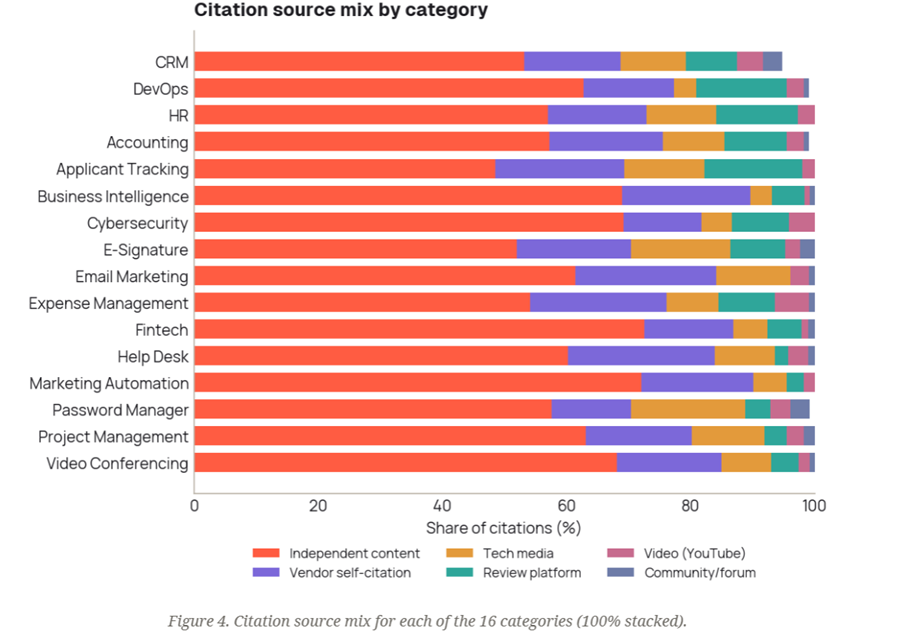
The overall averages hide real variation. Marketing automation, business intelligence, cybersecurity, and fintech are the most independent-content-heavy (68–73%). Applicant tracking, DevOps, and HR carry the most review-platform weight (13–16%).
The latter are categories with the most mature analyst ecosystems. It always helps to know what your category looks like before allocating a budget to it.
Which specific sites get cited most (the target list)
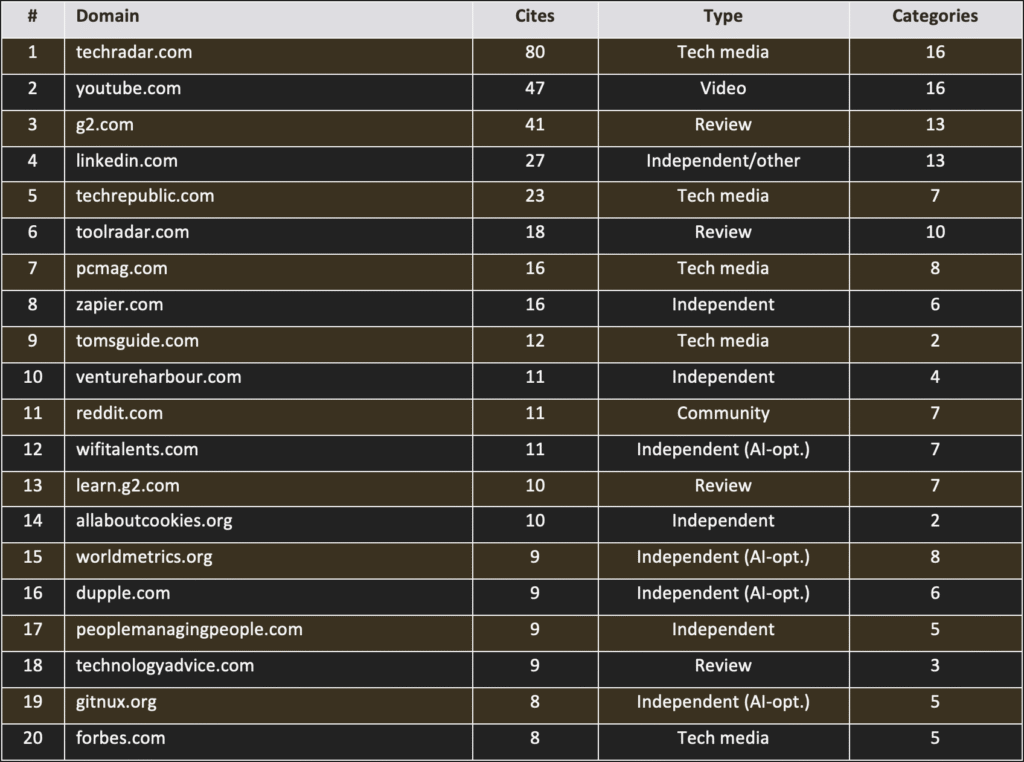
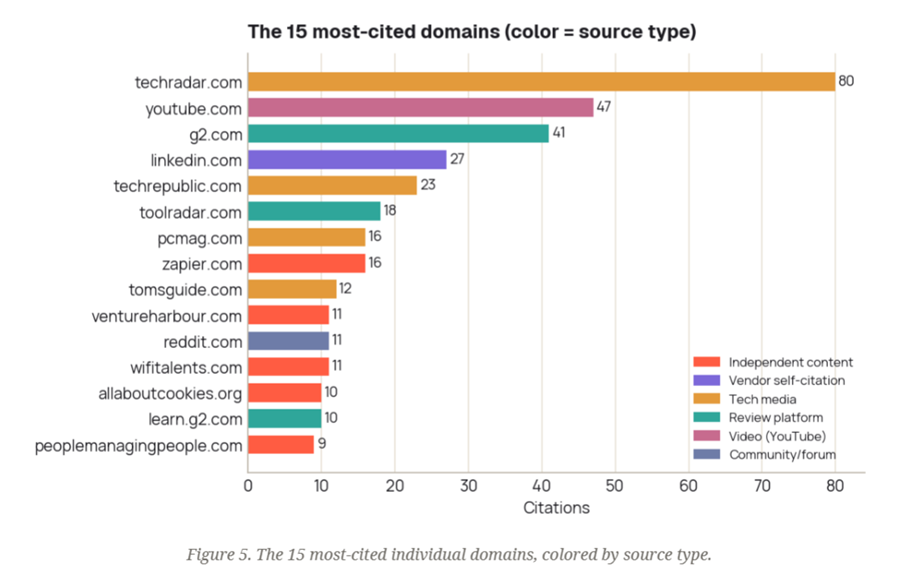
“What type of source wins” (independent content, in aggregate) is not the same question as “what sites should I go after.” There’s a short list of domains that gets referenced more than everything else put together. Here are the 20 most-cited domains across all 1,739 citations:
Below are four target lists organized into categories in terms of actions you can actually take:
1. Tech media worth earning coverage in (over-index on ChatGPT)
- TechRadar (80 citations, i.e., the single most-cited domain in the entire study)
- TechRepublic, PCMag, Tom’s Guide, Forbes, and for launches, the wires (PR Newswire, BusinessWire). If you do digital PR, these are the placements that pay off in AI citations.
2. Review platforms that actually matter (don’t chase all of them)
- Here, G2 is dominant (41 citations, 13 categories) and worth the effort.
- Next on the list: ToolRadar, TechnologyAdvice, Gartner, SoftwareAdvice, SourceForge, and SpotSaaS. Capterra and GetApp barely showed. Prioritize G2, and then one or two review sites that are strongest in your specific category.
3. The “AI-optimized” independent sites shaping categories (watch these)
- worldmetrics.org, wifitalents.com, gitnux.org, dupple.com, toolradar.com,
techjockey.com, trakkr.ai. These generic stats-and-comparison sites appear across 5–10 unrelated categories each. - You won’t out-authority them overnight, but you can study their structure and beat them with genuinely better, more specific comparison content.
4. Video and community (Perplexity-specific):
- YouTube (47 citations, all via Perplexity) and Reddit (11, all via Perplexity).
- If Perplexity visibility matters to you, a credible YouTube review presence and honest participation in the right subreddits are the levers. Also, know that they do nothing for ChatGPT.
What I’d actually do with this playbook
If you did only the first two, you’d be ahead of most B2B SaaS teams. Here’s how I’d translate all of this into a concrete program, in priority order of leverage.
1. Build a real comparison-content engine on your own domain
The single highest-leverage move entails independent content plus vendor self-citation, which makes 79% of all citations. Also, your own site is the one surface you fully control. Do the following to make the most of this:
Write the money pages: “Best [category] software 2026,” “[You] vs [Competitor],” “[Competitor] alternatives,” and “best [category] for [segment].” These four templates map directly to how buyers phrase queries.
Structure for extraction: Lead with a direct one-paragraph answer. Follow up with a comparison table (name, best-for, pricing, key feature), and then per-tool detail. AI engines lift structured, table-driven content far more readily than prose.
Include yourself honestly, alongside real competitors: An assembled listicle can get ignored by engines and readers. However, a fair comparison that includes you does get cited, which is
the entire mechanism behind the 18% vendor self-citation number.
Add the freshness and trust signals: This includes the current year in the title, a visible “last updated” date, real pricing, and Product/Review/FAQ schema markup.
Cover every buyer intent: “Best,” “alternatives,” “affordable,” “enterprise,” “for small business,” “with AI,” and so on. Each is a distinct query with distinct citations.
2. Split your earned-media strategy by engine
Because the engines diverge, one PR approach is leaving half your visibility on the table:
For ChatGPT visibility: Prioritize tech-media coverage (TechRadar, PCMag, Tom’s Guide, TechRepublic) and your own pages. ChatGPT over-indexes on both, especially digital PR and product-roundups.
For Perplexity visibility: Add YouTube reviews (your own and third-party) and a genuine Reddit presence in your category’s subreddits. Perplexity is the only engine rewarding these.
3. Get on the review platforms that matter
Appearing on G2 is a must as it is the dominant review domain and spans the most categories. Thereafter, consider getting on the one or two review sites strongest in your category (Gartner and SoftwareAdvice skew to mature categories like HR, cybersecurity, and applicant tracking). However, bear in mind that review platforms are only 7% of citations. Don’t allot them your entire GEO budget.
4. Pursue the high-frequency domains directly
A placement in TechRadar, PCMag, or the right YouTube channel is much more valuable due to the specific citation frequency of these domains. Even a single TechRadar feature can echo throughout your category.
5. Monitor the AI-optimized long tail in your space
Run your category searches and note the worldmetrics/wifitalents/toolradar-like sites that get cited. Figure out whether you should out-perform them with superior content structure, get featured on those sites, or (in the case of statistic-type sites) become the source of their citations.
6. Measure it, quarterly
Run your “best [category]” and “[category] alternatives” queries through both Perplexity and ChatGPT every quarter. Track whether you are cited, on which engine, and via which source type. Remember, because engine behavior keeps changing, you’ll benefit from treating this as an ongoing scoreboard rather than a one-time audit.
What your AEO/GEO/SEO strategy should look like, based on this data
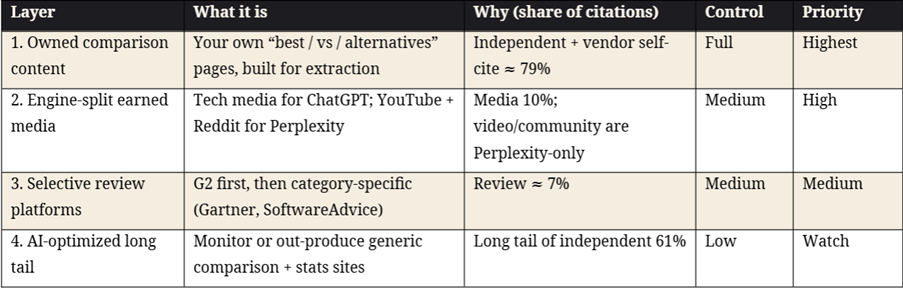
Pulling it together, the data points to a four-layer model. Think of it as priority tiers: the top layers are higher-leverage and more controllable; the lower layers are supporting. Budget top-down.
A few principles that follow directly from the numbers:
- Own content is the foundation, not an afterthought. Nearly four in five citations are independent content or vendor pages. If you build one capability this year, make sure it’s a comparison-content engine.
- There is no single “AI” to optimize for. ChatGPT and Perplexity reward different things. Your strategy needs a ChatGPT track (own pages + tech media) and a Perplexity track (add video + community).
- Reviews are table stakes, not a strategy. Keep G2 current; don’t expect it to carry your visibility. It’s only 7% of the picture.
- Structure beats volume. The content that gets cited is not necessarily the one with a high word count. Rather, it is purposefully structured for extraction: direct answers, comparison tables, and schema.
- Treat GEO as measured and iterative. Run the queries, read the citations, and adjust accordingly. The category leaders will keep changing, but your scoreboard shouldn’t be a guess.
Where I’d start
If you take one lesson from the bigger study over the small one, it’s this: stop treating “get cited by AI” as a single task. It’s at least two. One is for the ChatGPT family of engines with your own pages and tech news websites. And the other is for Perplexity that values video and community along with your own articles.
The only thing that both have in common is structured comparative content, and this is something that most SaaS businesses lack.
So, this week, run your category’s “best of” and “alternatives” queries through both Perplexity and ChatGPT, write down who’s cited, and start the one comparison page you’ve been putting off.
If you need help conducting an audit or building your content machine, we can help with that here at Growfusely. Book a discovery call and we’ll run your categories and show you what your buyers are actually seeing.
____________________________________________________________________________
Methodology: 1,739 citations across 128 queries (16 categories × 8 phrasings), collected July 2026. Queries were run programmatically through the Perplexity Sonar API and the OpenAI web-search API; the “ChatGPT” figures throughout refer to results from OpenAI’s web-search API, a programmatic proxy for ChatGPT-family behavior rather than the consumer ChatGPT product. Citations counted at the domain level, one per unique domain per query per engine. Domain types assigned by an automated classifier (dictionary + vendor-self-citation detection against each answer’s recommended tools), validated at ~97% agreement against hand-labeling; a small share of long-tail domains carry residual classification error. Cross-referenced against SE Ranking’s published analysis of AI Overview citations. Treat exact percentages as a July-2026 snapshot.

Pratik Dholakiya is the Founder of Growfusely, a SaaS SEO and AI Search Visibility agency.
