A lot of marketers are still talking about AI search optimization like it is just a new layer of hacks.
Things like FAQ schema. Answer blocks. LLM-friendly formatting. A few prompt-shaped tweaks. And maybe an llms.txt file for good measure.
Google has now been unusually clear that this is the wrong place to start. In its new Search Central guidance, Google says the best practices for SEO still apply to generative AI search, its AI features are rooted in core Search ranking and quality systems, and from Google Search’s perspective, optimizing for generative AI search is still SEO.
It also says there are no extra requirements to appear in AI Overviews or AI Mode, and no special optimizations required beyond the fundamentals.
So the bigger miss is not formatting. It is clarity.
Most brands do not have an AI search problem first. They have a positioning problem, a content problem, and an authority problem. AI surfaces simply make those weaknesses easier to notice.
What AI search optimization actually is
AI search optimization is the work of making a brand more visible, more accurately represented, and more likely to be cited or recommended across AI-driven discovery surfaces like ChatGPT, Perplexity, Gemini, Claude, Google AI Overviews, and AI Mode. The real goal is not just traffic. It is getting your brand into the answer set before a buyer ever clicks through.
A lot of teams still frame this as an SEO-adjacent experiment. That framing undersells what is changing. Buyers are no longer discovering categories, vendors, and points of view only through ranked links. A growing share of that work now happens inside synthesized answers.
Why this matters now: AI search is becoming part of B2B discovery
Gartner said in March 2026 that 67% of B2B buyers prefer a rep-free experience, and 45% reported using AI during a recent purchase. In other words, AI-assisted discovery is no longer an early-adopter behavior sitting at the edge of the funnel. It is already part of how many buying journeys happen.
Adobe’s Q2 2026 AI traffic report points in the same direction for tech and software. In Q1 2026, AI-driven visit share to tech/software sites grew 63% year over year. In March 2026, AI-referred visits in that category had 30% higher engagement, 40% lower bounce rates, 40% more time spent, and 23% more pages viewed than non-AI traffic.
Adobe also found that 47% of consumers were already using AI to understand, troubleshoot, or make decisions about tech/software products and services, and 61% said they intended to do so in the near future.
Simply put, search is not disappearing. It’s expanding. And so is the path to discovery.
The big mistake: treating AI search optimization as separate from SEO
One of the biggest strategic mistakes right now is treating AI search optimization as if it sits in a separate bucket from SEO.
Google’s current documentation cuts against that idea pretty directly. It says the same foundational SEO best practices apply to AI features, including crawlability, internal linking, textual clarity, strong page experience, and structured data that matches what is visible on the page. It also says you do not need special machine-readable files, special schema, or AI-specific rewrites to appear in AI Overviews or AI Mode.
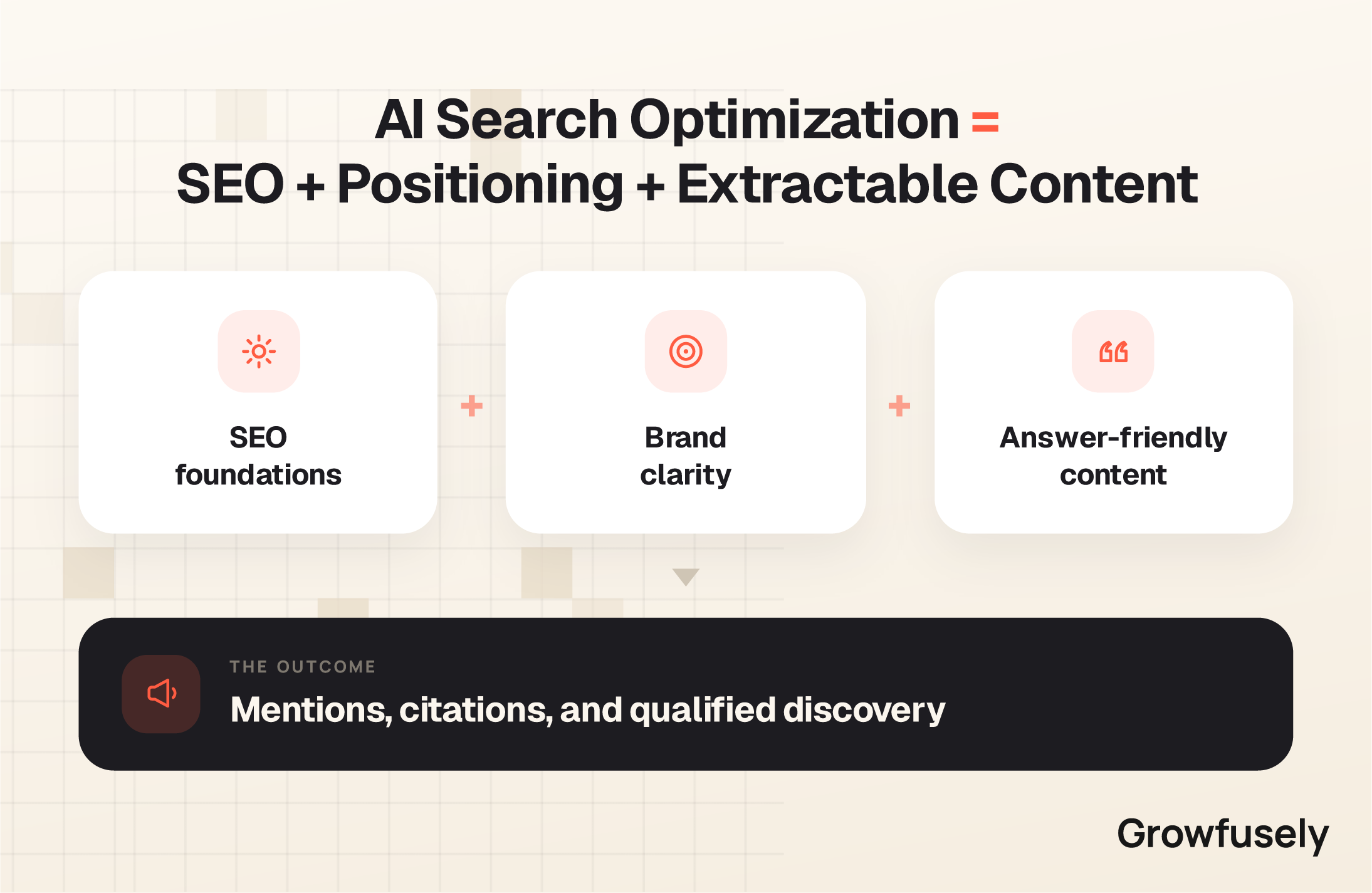
A more useful lens is this: AI search optimization is upgraded SEO. Same foundations, higher standards. The work still starts with retrieval, crawlability, structure, authority, and content quality.
AI surfaces just put more pressure on whether your brand and content are easy to interpret, easy to trust, and worth citing.
What actually drives AI visibility
Here are five things that actually matter for AI visibility.
1) Brand and entity clarity
A surprising number of B2B sites still do a weak job of telling the market what they are.
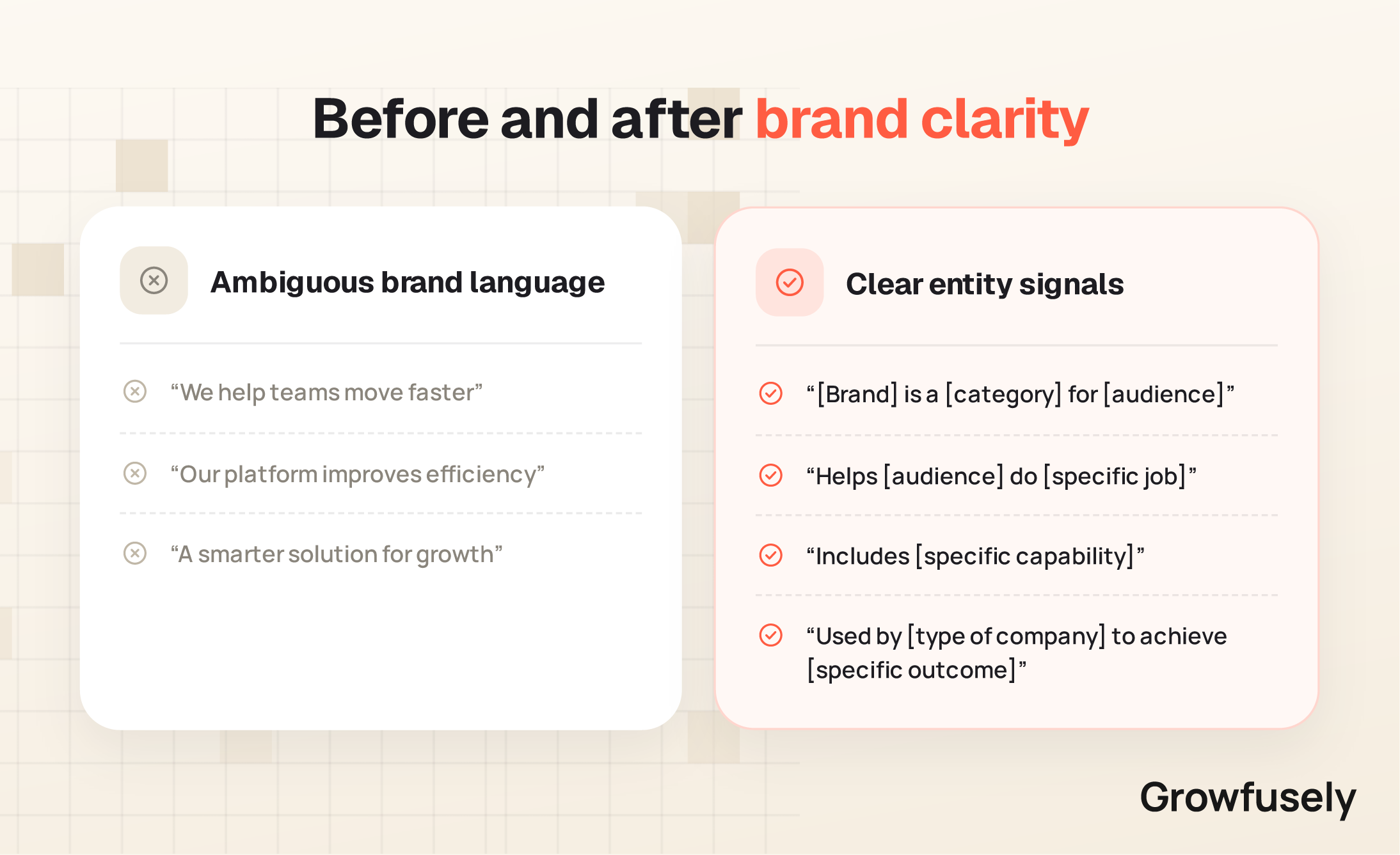
They lean on foggy language like “we help teams move faster” or “our platform improves efficiency.” That copy may feel polished, but it leaves a lot unsaid. It does not clearly tell a search engine, an AI system, or even a buyer what category the company belongs to, who it serves, what it helps them do, and where it fits.
In practice, brands that earn stronger AI visibility tend to be much easier to classify. Their homepage, core pages, LinkedIn presence, review profiles, and third-party mentions all reinforce the same category signals.
And consistency matters more now because AI systems are not just reading your site. Google says AI features can use query fan-out to issue multiple related searches and surface a wider, more diverse set of helpful links than classic web search. Weak or inconsistent signals do not stay contained to one page. They follow the brand across the web.
2) Narrative clarity
AI systems do not just retrieve facts. They synthesize narratives.
That raises the bar on messaging. A brand needs more than a category label. It needs a clean throughline connecting buyer problem, solution category, and point of view.
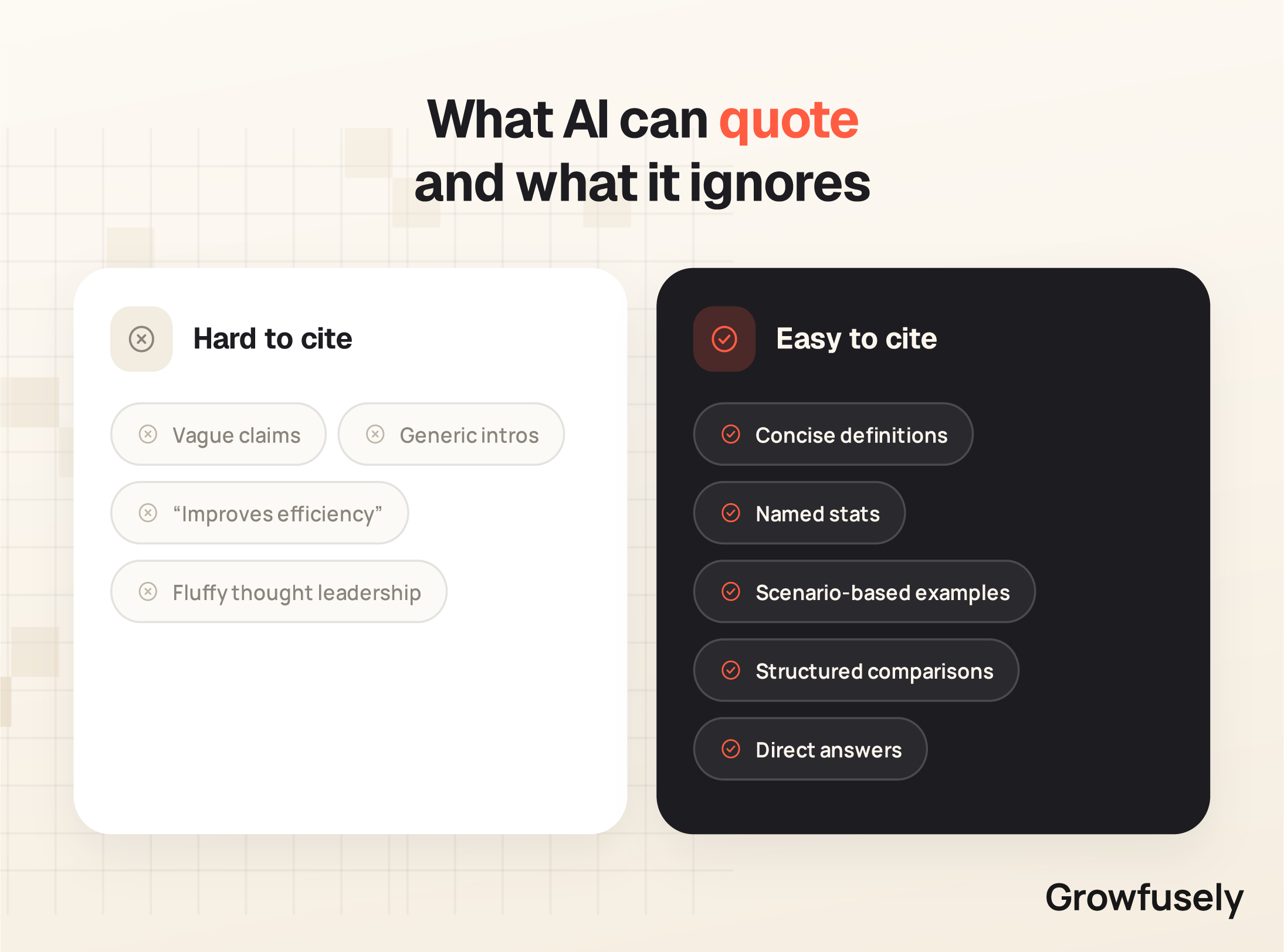
Vague claims like “accelerate growth” and “unlock efficiency” rarely travel well because they could belong to almost anyone. Specific, extractable claims work better because they give machines and buyers something firmer to summarize.
Google’s latest guidance leans in the same direction. It explicitly recommends unique point of view, non-commodity content, and content that is organized in a way that helps readers follow it. Generic summaries and recycled framing are exactly what AI systems can already produce on their own.
3) Content that is easy to extract and trust
People are overfocusing on the “easy to extract” part and underweighting the “worth trusting” part.
Yes, answer-first structure helps. Yes, clean headings, summaries, FAQs, comparisons, and tables make content easier to parse. None of that is controversial.
Where teams get it wrong is assuming structure alone is the play.
Google’s new guide explicitly says there is no need to chunk content into tiny pieces, no need to rewrite content just for AI systems, and no need to create special markup files. What it does emphasize is helpful, reliable, people-first content, along with technical clarity and strong page experience.
The stronger pattern is simple: extractable content wins more when it is also grounded. Clear definitions, named evidence, first-hand observations, and sharp examples give AI systems something more defensible to quote.
4) Coverage across the buyer journey
A lot of brands still publish like it is 2019.
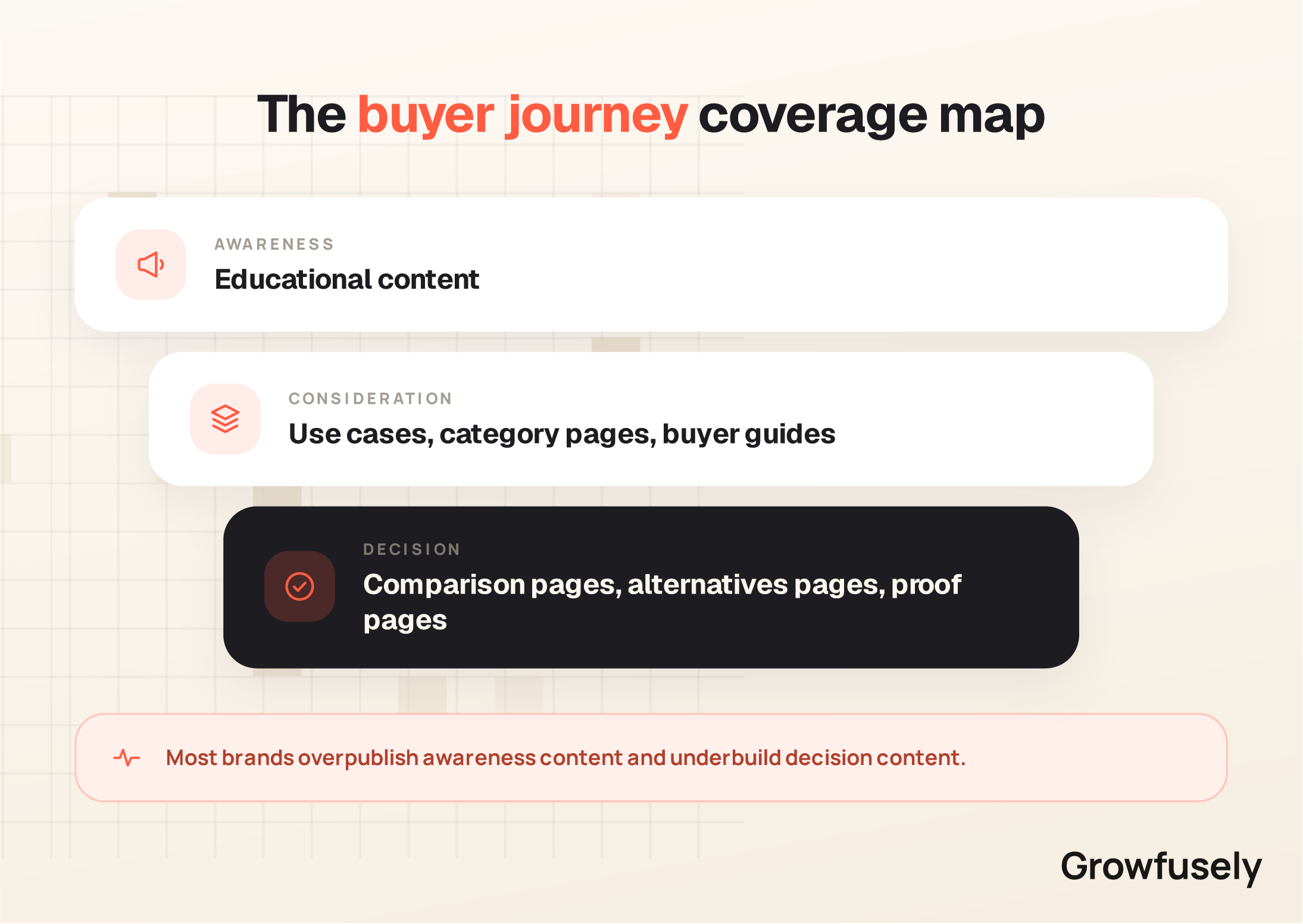
They overbuild awareness-stage blog content and underbuild the commercial and decision-stage assets that actually shape shortlist creation.
That approach leaves a gap right where AI tools are increasingly useful: comparison, evaluation, and decision support. Adobe’s March 2026 data found that 21% of consumers reported making a tech/software purchase with the help of AI, while Google says AI Mode is especially useful for nuanced exploration, reasoning, and complex comparisons.
For B2B brands, that changes what a complete content system looks like. Category pages, use-case pages, alternatives pages, comparisons, buyer guides, proof-led pages, and founder/expert content are all pulling more weight now. Visibility that stops at awareness is no longer enough.
5) Evidence and specificity
Generic content has become easier to ignore.
That was already true in traditional search. AI search makes the gap more obvious.
Google’s own wording is useful here: create valuable, non-commodity content. In its official guide, Google contrasts generic content like “7 Tips for First-Time Homebuyers” with specific, experience-shaped content that brings unique expert context and first-hand judgment.
We see the same pattern in our own work. The growth rarely comes from cosmetic tweaks alone. It usually comes from the compound effect of clearer structure, sharper content, stronger authority, and credible mentions.
On our site, you can see examples like Mind the Graph, where our work is tied to 217% qualified traffic growth and more than 2x referring domains in a testimonial, JetOctopus doubling organic traffic within six months, WhatFix earning 249 backlinks in 18 months, and Document360 strengthening its position through 20+ organic PR stories.
Those are not “AI search hacks.” They are the result of doing the hard parts of organic visibility well.
A simple model for thinking about AI search optimization
A huge branded framework is simply not necessary here. A much cleaner model is:
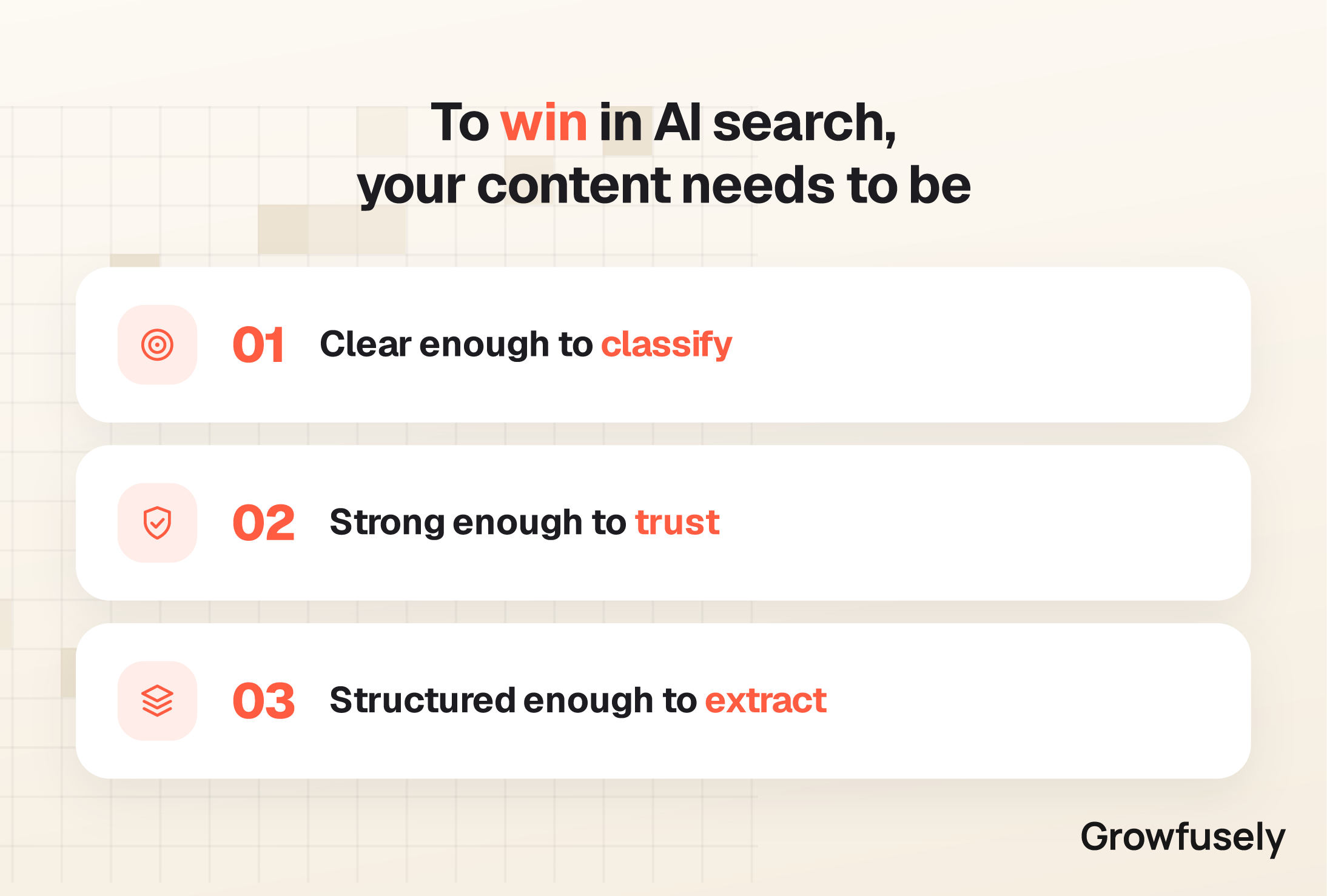
→ Clear enough to classify. → Strong enough to trust. → Structured enough to extract.
That is the basic bar. Or, even shorter:
Findable. Understandable. Referenceable.
Everything else sits underneath those three ideas.
What brands should stop doing
A few habits need to go.
Stop treating schema as the whole strategy.
Stop publishing vague “AI SEO” thought pieces with no real point of view.
Stop relying on inconsistent brand language across channels.
Stop assuming rankings automatically translate into citations.
Stop measuring success only through clicks.
Google has already done some mythbusting here. Its official guide says you can ignore special AI text files, llms.txt-style workarounds, chunking for the sake of chunking, rewriting content just for AI systems, chasing inauthentic mentions, and overfocusing on structured data as if it were the strategy itself.
How we’d prioritize AI search optimization if we were starting today
The order of optimization matters more than most teams think:
Start by fixing homepage and category positioning.
Then align brand language across your key properties.
Then strengthen high-intent commercial pages.
Then improve answer-first structure on the content that already matters.
Then add more evidence, more first-hand specificity, and more reasons to trust what the page is saying.
Measurement comes after all of that. Not before.
Google now reports AI-feature traffic within Search Console’s broader web search reporting, and it says clicks from search results pages with AI Overviews tend to be higher quality.
Good measurement matters, but the early win is not a dashboard. The early win is becoming easier to understand and easier to cite.
Wrapping Up
AI search optimization is not a separate discipline in the way the market is trying to package it.
Google has now said the quiet part out loud: generative AI search is still search, the same SEO foundations still matter, and most of the supposed “AEO/GEO hacks” are distractions.
The brands that will win here are not the ones chasing every new acronym. They are the ones building stronger search foundations, cleaner positioning, more reference-worthy content, and more credible authority signals across the web.
That is how we are thinking about it at Growfusely too: modern SEO as the foundation, AI search visibility as the surface, and both built together for B2B brands that care about durable organic growth.
If your team is reworking its content and SEO system for the AI search era, that is exactly the kind of problem we like working on. Let’s connect to get the ball rolling.


 About Growfusely
 White LabelMake us your (hidden) helping hand in delivering high-quality work to your SaaS clients.
 TeamCheck out the faces (and their backstories) behind our brand.
 Partner With UsJoin forces with us and earn a recurring monthly commission.
 Careers We're HiringJoin our growing team of passionate content marketing geeks.
 SEO & AI Search VisibilityBoost your search engine rankings with a blend of compelling content and technical tweaks.
 Content Strategy & ProductionFuel your brand awareness and user acquisition with strategic content creation and distribution.
 Authority & CitationsEarn relevant, high-quality backlinks from top websites in and around your niche.
 SaaS InfographicsLearn battle-tested best practices on all things SaaS marketing — visually.
 SaaS InterviewsRead our tête-à-têtes with SaaS marketing experts on achieving content-driven organic growth.