
The B2B marketing domain is experiencing a strange phenomenon.
The global search volume is forever growing. Google processes around 16.4 billion searches each day, meaning people are searching, researching, and querying more than ever.
And yet, between 2024 and 2025, 73% of B2B websites experienced a significant decline in traffic (an average 34% year-over-year decline).
Growing search volume. Declining traffic.
What’s the reason for this gap?
Part of it is structural.
In 2025, 60% of Google searches were zero-click – without a single click to a website (up from 58% in 2024). Buyers are either getting answers directly on the results page or they are bypassing traditional search entirely.
The latter points to research inside ChatGPT, Perplexity, or LinkedIn.
The intent is very much alive.
The buyer journey is still on.
But it is moving to surfaces that most B2B marketing teams aren’t measuring, let alone optimizing for.
SEO hasn’t stopped working. The surface where discovery happens has quietly shifted while teams continue to optimize search surfaces of the past.
At Growfusely, we’ve been tracking this closely across the brands we work with. What we keep seeing isn’t a failure of execution. It’s a failure of the frame.
The brands losing ground aren’t failing at SEO. They are only investing in SEO while the buyer research process has expanded beyond this channel.
This article isn’t an argument about SEO being obsolete. It throws light on how online visibility has outgrown a single channel.
B2B brands winning in this scenario are the ones building a broader, more integrated approach to being found wherever their buyers are.
TL;DR
- Global search volume is growing, but 73% of B2B websites lost organic traffic in 2024-25. The gap exists because discovery has moved, not because SEO has failed.
- SEO isn’t dead. Rankings, technical foundations, and content quality still matter. But SEO now covers one part of a much wider discovery landscape.
- B2B buyers move across six ecosystems before engaging a vendor: Google, ChatGPT, Perplexity, LinkedIn, Reddit, and YouTube. Each has its own trust signals. Presence in only one or two of them means invisibility in the rest.
- Traffic and discoverability are not the same thing. 94% of B2B buyers use LLMs during their purchase journey, but most of that research never shows up in your analytics.
- Optimizing only for measurable traffic means optimizing for the tail end of a journey that already happened somewhere else.
- Three mindset shifts matter: ranking → retrieval, traffic → presence, domain authority → distributed authority.
- The brands winning right now aren’t choosing between SEO and everything else. They are using SEO as the foundation and building a full discoverability stack on top of it.
SEO Isn’t Dead
Before I go deeper into why visibility is becoming bigger than SEO, I want to get this out of the way.
SEO isn’t dead.
Anyone telling you to abandon your keyword strategy, stop working on your backlink profile, or pause your technical audits in favor of an AI-first playbook is pointing you in the wrong direction.
Your website ranking still rules. The first organic result in Google’s SERP still captures an average CTR of 27.6%, dropping to 15.8% for position two and 11% for position three.
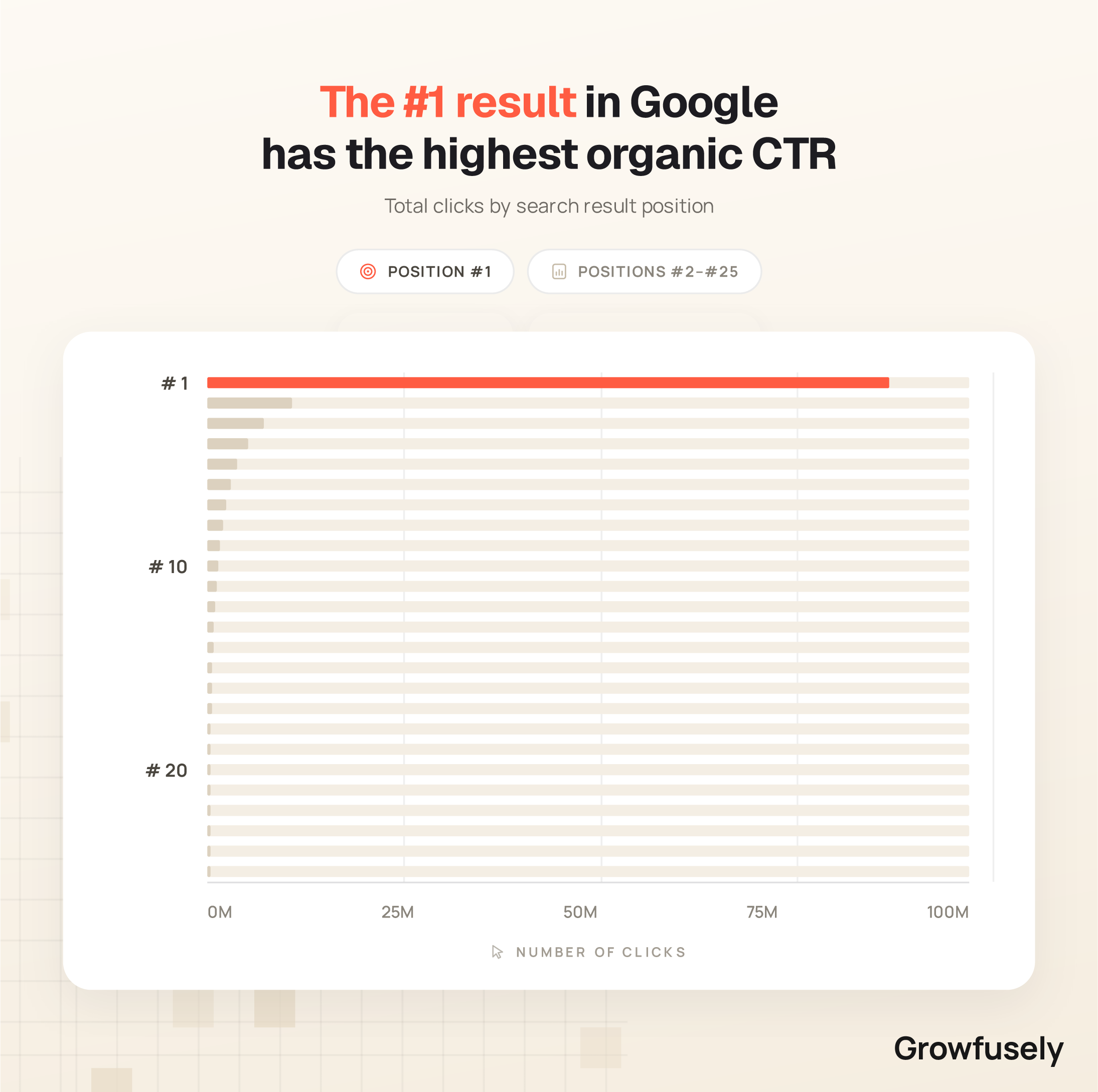
Such a compounding advantage cannot disappear because of the evolving AI trend. Technical foundations like site speed, crawlability, schema markup, and internal linking still determine whether your content gets indexed and surfaced at all.
Here are some numbers for you:
- For B2B websites, SEO delivers outstanding results: 748% ROI, drives 76% of all trackable B2B website traffic, and generates 44.6% of total B2B revenue.
- HubSpot research confirms that SEO is among the top marketing channels for ROI for B2B brands, followed by paid social.
The craft matters, and so does the discipline.
What’s changed is the perimeter of discoverability.
For most of the last decade, SEO was fundamental to the visibility of B2B brands. This was because Google was where buyers went to research.
The new buyer research process:
- Buyers ask AI tools for a quick synthesis
- They check Reddit to see what real practitioners have to say
- They look up the company founder on LinkedIn before deciding whether to trust the brand
- They watch an explainer video on YouTube to understand how a product category actually works
Each of these touchpoints shapes the next one, and businesses must leverage them to drive high-intent traffic.
A recent study found that 85% of B2B buyers are ready with a “Day One List” of preferred vendors, even before they speak to a sales representative. This list is developed using AI-assisted conversations, peer communities, and social platforms.
If your brand doesn’t show up in these spaces, it doesn’t make it to the list, regardless of where you rank in the SERP.
So, SEO is essential, but it’s merely a part of a discovery ecosystem that has widened.
Visibility must be treated as a whole game; buyers must be served at every touchpoint that precedes the search.
SEO is the floor. Discoverability is the building, the foundation of which now needs to support a broader surface area than a Google ranking alone.
Where Are Your Buyers Looking Right Now
Buyers now are moving fluidly across several channels, often in a single research session, and each move shapes what happens next.
Each of the touchpoints carries its own logic, trust signals, and version of authority. And right now, most B2B brands are only visible in one or two of them.
Here’s what’s happening across each touchpoint.
1. Google
Google is still where the majority of B2B research starts.
57% of buyers cite search engines as their primary early-research channel.
But even here, the dynamics have changed.
AI Overviews now appear in over 13% of all queries, and when they do, organic click-through rates drop by as much as 47% for informational searches.
Buyers are increasingly getting their answer without ever reaching a result.
Google remains essential, but it’s become a navigation layer more than a destination. Buyers identify options here, then go elsewhere to validate them.
2. ChatGPT
This is where a growing share of high-intent B2B research is migrating, and the numbers back that up.
ChatGPT now has over 900 million weekly active users globally and processes 2.5 billion prompts every day.
Moreover, 92% of Fortune 500 companies have already integrated ChatGPT into their workflows.
For B2B buyers specifically, it’s become a first-stop research tool: a place to ask “what are the best platforms for X” and get a synthesized answer rather than a list of links.
The critical point: AI search traffic converts at 14.2% compared to Google’s 2.8%. The buyers arriving via AI are further along, more certain of what they’re looking for, and arriving with a shortlist already forming.
If your brand isn’t in that answer, you are absent from a highly qualified research moment.
3. Perplexity
Perplexity occupies a specific and important niche: research-intensive, citation-required queries with synthesized answers and visible sources.
It processed 780 million queries in May 2025 alone and has grown its active user base.
For B2B buyers evaluating complex software or services, Perplexity is particularly relevant at the consideration stage. This is the moment when they are actively comparing options.
It favors brand domains for educational content and surfaces earned media heavily for consideration queries. If your category content is thin or your third-party citations are sparse, Perplexity is likely recommending your competitors.
4. LinkedIn
LinkedIn is no longer just a platform where B2B brands post content and hope someone notices. It’s an active discovery surface, and its search authority has grown accordingly.
LinkedIn Pulse content is cited by ChatGPT 105,000 times and appears in 164,000 Google AI Overview results, meaning thought leadership published natively on this channel has outsized AI discoverability on others.
50% of B2B buyers specifically use LinkedIn as a source when making purchasing decisions. And six in ten buyers say they discover new brands through creator content during early awareness, not company pages.
The brand matters, but the human voice behind the brand matters more. Buyers are looking for a perspective they can trust before they engage with a vendor.
LinkedIn is where they go to find it.
5. Reddit
Reddit has quietly become one of the most important trust validation layers in B2B discovery, and it’s backed by some solid research.
- A joint study by SurveyMonkey and Reddit, published in early 2026, surveyed over 1,200 U.S. business decision-makers. 83% of them complete self-directed research before ever speaking to a sales rep
- Among all channels, peer recommendations are their most trusted source. It was cited by 73% of decision-makers, ahead of vendor websites at 55%, search engines at 54%, review sites at 46%, and even AI chatbots at 39%
- 32% of software buyers specifically use Reddit to research products.
- Reddit content now appears in 42% of informational Google search queries and is one of ChatGPT’s most-cited sources
A brand present in relevant Reddit discussions isn’t just trusted by human buyers; it’s more likely to be surfaced by AI systems too.
6. YouTube
YouTube is the world’s second-largest search engine, and it’s a channel B2B buyers use throughout the research process.
70% of B2B buyers report watching videos across their entire sales journey for product walkthroughs, founder interviews, category explainers, and customer stories. This channel influences purchasing decisions and shows up later as direct traffic.
There’s a less obvious dimension here, too. YouTube video titles, descriptions, and transcripts are actively indexed and trained on by AI systems. A brand with consistent video content on relevant category topics is building AI retrieval signals, not just YouTube views.
The common thread across all six: buyers don’t pick one channel and stay (shown in this flowchart).
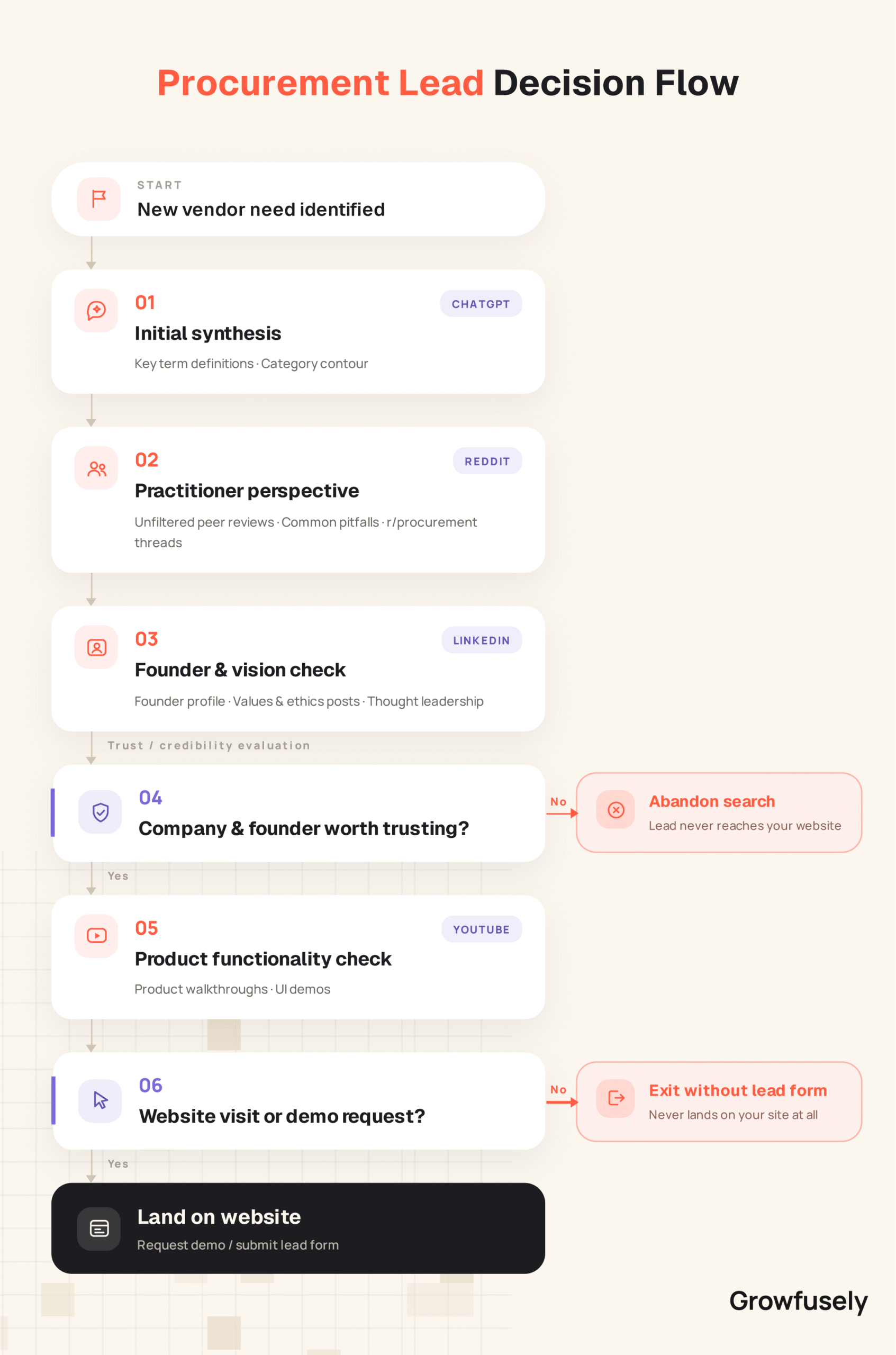
They move through these ecosystems in sequence, using each to answer a different question. Google tells them what exists. ChatGPT synthesizes the category. Perplexity validates the comparison. Reddit gives them the unfiltered peer view. LinkedIn tells them whether to trust the people behind the brand. YouTube shows them what using it actually looks like.
Traffic versus Discoverability: Not the Same
This is the distinction I find myself coming back to most often in conversations with B2B marketing teams. Trust me, it takes the longest to fully sink in.
Traffic is what your analytics can see.
Discoverability is what happens before the click.
We’ve seen by now that the buyer journey in 2026 doesn’t begin when someone lands on your website. It begins much earlier, in places your tracking tools were never designed to reach.
Your analytics registers that visit as direct traffic. It tells you nothing about the journey that produced it.
This is no longer an edge. 94% of B2B buyers now utilize large language models during their purchase journey, according to 6sense and Forrester research. This number has only increased since.
Standard attribution models now miss over 70% of the B2B buying journey, with 38% of sales pipelines left entirely unattributable.
Another research data makes the scale of this visible concretely. Direct traffic accounts for 72.1% of Gong’s visits, 71.6% of HubSpot’s, 71.1% of Outreach’s, and 64.5% of Salesforce’s.
These are companies with full-stack marketing teams, sophisticated attribution tools, and enormous content budgets. And still, the dominant share of traffic arriving at their doors comes through channels they cannot directly measure or attribute.
That’s not a tracking problem to be engineered away.
It’s a visibility issue, and it requires a different kind of response.
The practical implication is important: optimizing exclusively for measurable traffic means optimizing for the tail end of a journey that has already happened somewhere else.
By the time a buyer clicks through to your website, they have already formed a view of who you are and whether you are worth their time.
The research that produced that view happened in AI tools, community forums, social feeds, and private conversations that generated no UTM parameters and triggered no lead scoring events.
Discoverability is about having a presence at the beginning of that journey before intent ever becomes a tracked click. I;s working at that level of awareness and trust-building, not just conversion.
- AI answers
- Reddit threads
- LinkedIn feeds
- YouTube search results
The distinction that follows from this is one that most B2B marketing teams haven’t fully reckoned with yet:
A brand can hold the top position in Google search for its most important keywords and still be effectively invisible to a significant portion of its buyers.
Not because SEO has failed, but because those buyers never reached the SERP. The research happened upstream, in a channel the brand wasn’t present in. By the time the buyer arrived with a formed opinion, the brand wasn’t in the consideration set.
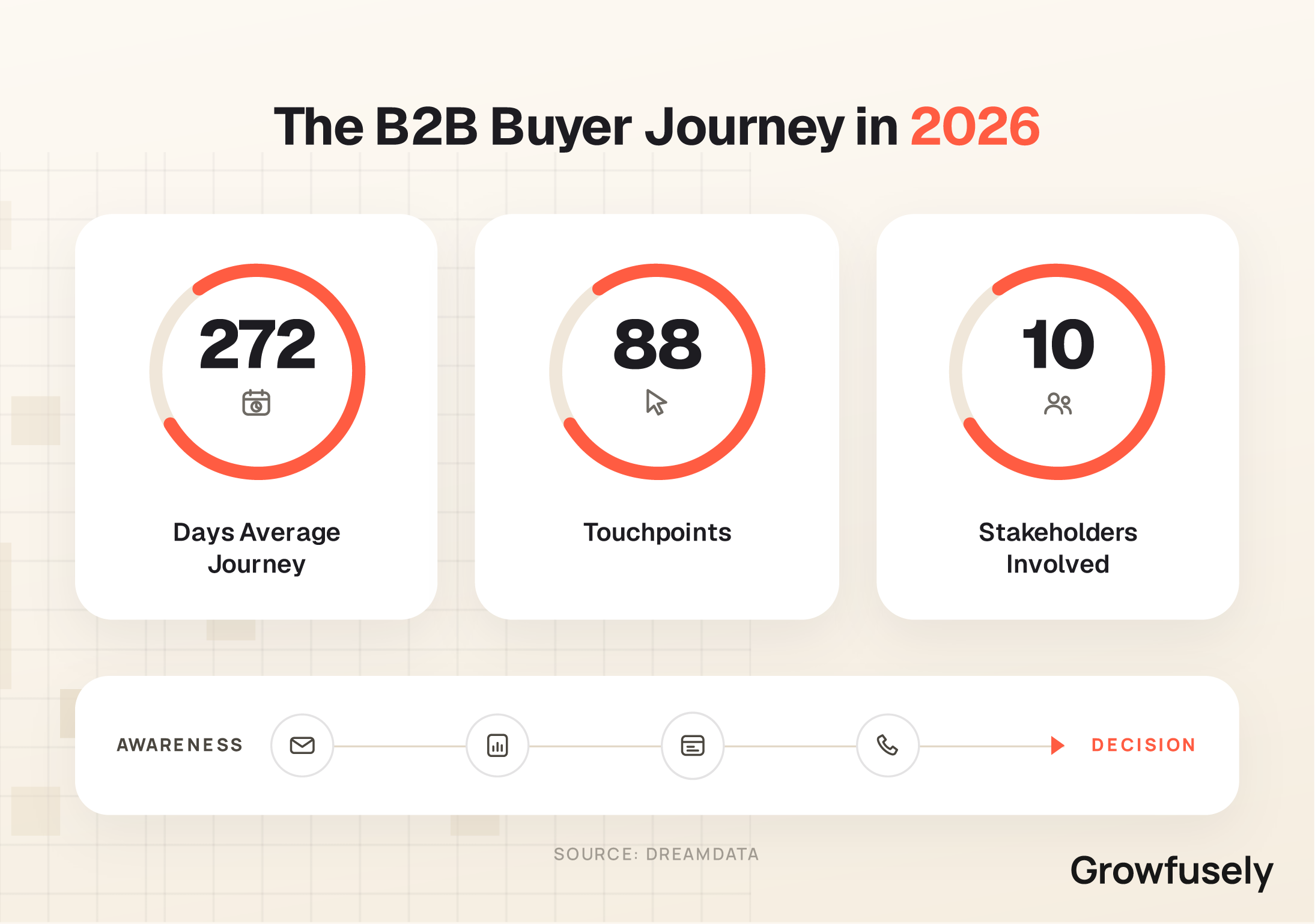
A recent report benchmarks put the average B2B buyer journey at 272 days across 88 touchpoints. Most of those touchpoints are invisible to standard analytics.
The brands building real pipeline durability are the ones showing up across the journey, not just at the moment a buyer finally decides to visit a website.
What This Means for Modern B2B Businesses
Let me be direct about what I am saying.
- Don’t abandon your SEO program
- Don’t stop measuring traffic
- The fundamentals of content marketing definitely apply
- The operating model needs to expand
For most B2B marketing teams, that expansion requires three specific mindset shifts.
1. From Ranking to Retrieval
The goal of search visibility used to be straightforward: rank well for the queries your buyers use, get the click, bring them into your funnel.
That objective still holds, but it describes only a portion of the discoverability challenge.
The more pressing question for most B2B brands today is whether they’re being retrieved by AI systems when buyers ask category-level questions.
And only 17% of AI search citations come from content ranking in the traditional top 10 organic results. The other 83% pull from content that ranks lower, or from entirely different sources that Google rankings don’t predict at all.
That’s the gap worth staring at.
A brand can be executing flawless SEO and still be absent from the AI answers its buyers are actually receiving.
Retrieval and ranking are related but aren’t the same problem, and they don’t respond to the same solutions.
The shift this requires is practical:
Brands must audit for retrieval gaps, not just ranking gaps.
Ask ChatGPT, Perplexity, and Google AI Mode the questions your buyers ask. See which brands appear. If yours doesn’t, that’s the visibility problem worth solving first.
2. From Traffic to Presence
This follows from the attribution problem we discussed earlier.
If 94% of B2B buyers are using LLMs during their purchase journey and over 70% of that journey is invisible to standard analytics, then optimizing exclusively for measurable traffic is optimizing for an increasingly small slice of what actually drives consideration.
Presence is a different objective.
- Showing up in AI answers
- Having a footprint in the communities where buyers do their peer validation
- Building the founder’s voice strong enough on LinkedIn that a buyer can get a sense of the company’s thinking before they ever visit the website
None of that generates a UTM parameter. Most of it doesn’t produce a trackable session.
But to remind you, the average B2B buyer journey spans 272 days and 88 touchpoints, the vast majority of which are invisible to attribution tools.
The brands building presence across that journey are the ones arriving at sales conversations with buyers already pre-sold.
3. From domain authority to distributed authority
This is perhaps the hardest shift for teams that have spent years building SEO strategies through domain authority and backlink profiles.
In AI search, the trust signals that determine citation and retrieval are different from the signals that determine Google rankings. Branded mentions correlate 3X more strongly with AI visibility than backlinks.
Domains with profiles on platforms like G2, Capterra, and Trustpilot are 3x more likely to be cited by ChatGPT.
And a Fullintel-UConn academic study presented in early 2026 found that 89% of AI-cited links across ChatGPT, Gemini, and Perplexity were earned media, not owned content.
Authority built only on your own domain increasingly stays there. The brands winning AI visibility have authority that radiates outward through press coverage, analyst citations, expert voices, review platform presence, and community participation.
That’s what AI systems use to decide whether a brand belongs in a given answer.
Digital PR is no longer just a channel for brand awareness or referral traffic. It’s a primary mechanism for building the external validation that AI systems rely on to determine credibility.
And executive thought leadership, a founder or senior leader consistently quoted across industry publications, builds entity association that makes the brand more citable over time, across both human readers and the AI systems that serve them.
Technical SEO remains critical throughout all of this. 73% of websites still have technical barriers that block AI crawler access. This means a significant proportion of B2B brands are invisible to AI retrieval systems, regardless of how good their content is.
Clean crawlability, schema markup, and structured data aren’t optional hygiene anymore. They are the floor that makes everything else possible.
Visibility Is the New Competitive Advantage
Here’s where I think this lands for most B2B marketing leaders right now.
The brands pulling ahead aren’t the ones that have chosen between SEO and everything else. They are the ones treating SEO as the technical and content foundation it is, and building broader discoverability infrastructure on top of it.
They are working across the channels where buyers are actually forming opinions, building shortlists, and deciding who makes it into the consideration set.
That’s the shift Growfusely has been building toward in our own work. We are an SaaS SEO Agency for B2B brands.
We aren’t just thinking about rankings.
- We are thinking about whether a brand shows up when a buyer asks an AI what the best solution in their category is
- Whether the founder’s perspective is visible enough to build trust before a sales conversation starts
- Whether the brand’s authority exists on its own domain or radiates outward across the sources AI systems actually cite.
The mechanics of discoverability have changed.
But the underlying goal is the same: be present, be trusted, and be found at every stage of the journey where your buyers are forming their views.
The question worth sitting with:
If your ideal buyer asked an AI what the best solution in your category is right now, would your brand be part of that answer?
If you aren’t sure, that’s the visibility gap worth closing.
Feels relatable? Book a strategy call with us now to up your content game and make your brand more discoverable.

Pratik Dholakiya is the Founder of Growfusely, a SaaS SEO and AI Search Visibility agency.
