
I scored 97 cybersecurity companies on four public signals that decide whether an AI engine can read their site. The category averages 80 out of 100. Six companies scored a perfect 100, and email security trails every other segment.
Key Takeaways
- Cybersecurity averages 80 out of 100, just behind fintech at 82.
- Six companies scored 100: Auth0, Cloudflare, Descope, Sumo Logic, WorkOS and Zscaler.
- 61% publish an llms.txt, ahead of the 52% B2B SaaS average.
- Only 10% publish llms-full.txt, the same gap I found in fintech.
- One company, Fortinet, blocks a citation crawler. Everyone else leaves them reachable.
AI readiness: How easily an AI engine can fetch, read and summarize a company’s website. In this study it covers structured data, meta tags, crawler access and llms.txt.
Why Does AI Readiness Matter for Security Vendors?
When a CISO asks Perplexity for the best EDR for a 500 person company, the tools an engine can read get named. The ones it cannot read are missing from the answer.
Security buyers research heavily before they ever speak to a vendor. That makes machine readability a commercial question, not a technical footnote.
How Did I Score Each Company?
I used four public signals that anyone can check. I weighted them by how well their effect is documented, not by how much attention they get.
| Signal | Points | What it does |
|---|---|---|
| Structured data (JSON-LD) | 30 | Lets an engine read your product, company and FAQs without guessing. The best documented of the four. |
| OG and meta tags | 25 | Controls how every engine and platform summarizes you. Cheap to fix and visible everywhere. |
| Citation crawlers reachable | 25 | robots.txt allows OAI-SearchBot and PerplexityBot. Pass or fail, and costly when you fail. |
| llms.txt | 20 | A curated map for AI systems. Twelve points for the basic file, twenty for the full version. |
Why llms.txt carries the least weight.
Google has said it does not use the file, and no major AI company has committed to reading it for search answers.
I keep it in the score because publishing one shows a company has thought about machine readability at all. I would not claim it drives citations, and my llms.txt study says so plainly.
What this score leaves out.
It measures whether an AI engine can read you. Whether an engine recommends you is a separate question.
In my analysis of 1,739 AI citations, recommendations came mostly from independent content and comparison pages. A company can score 100 here and still never be named in an answer. Think of this score as the floor.
How AI Ready Is Cybersecurity Overall?
On the basics, security is in good shape.
87% have complete OG and meta tags, 80% use structured data, and 99% leave citation crawlers reachable.
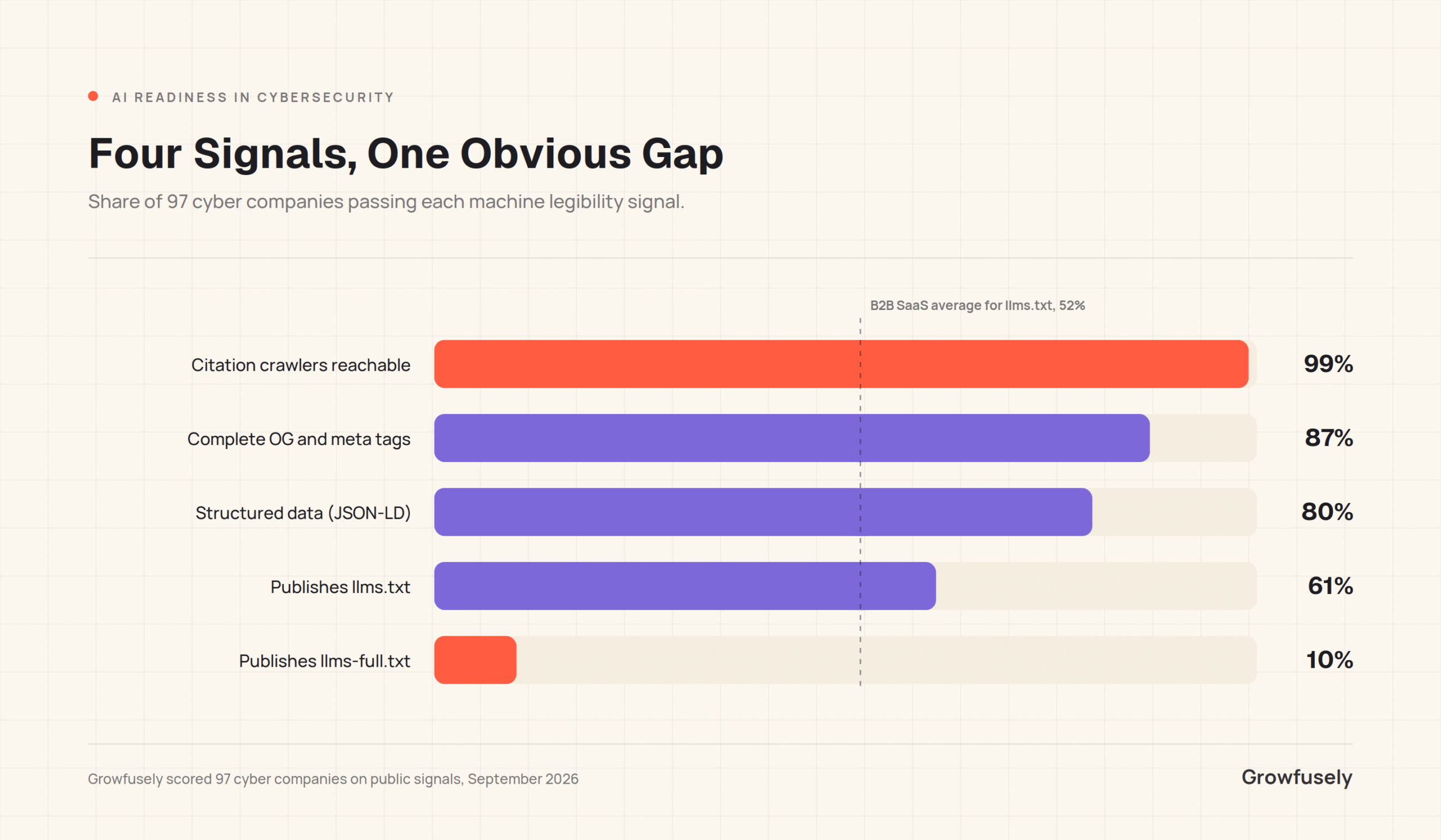
Share of 97 cybersecurity companies passing each machine legibility signal.
The gap is the same one fintech has. 61% publish an llms.txt, and only 10% publish the full version. That makes the full file the cheapest way to stand out.
Which Security Segments Are Most AI Ready?
SIEM and SOAR leads at 89, with identity and access management at 87 and vulnerability management at 84. These categories have heavy documentation and developer facing buyers.
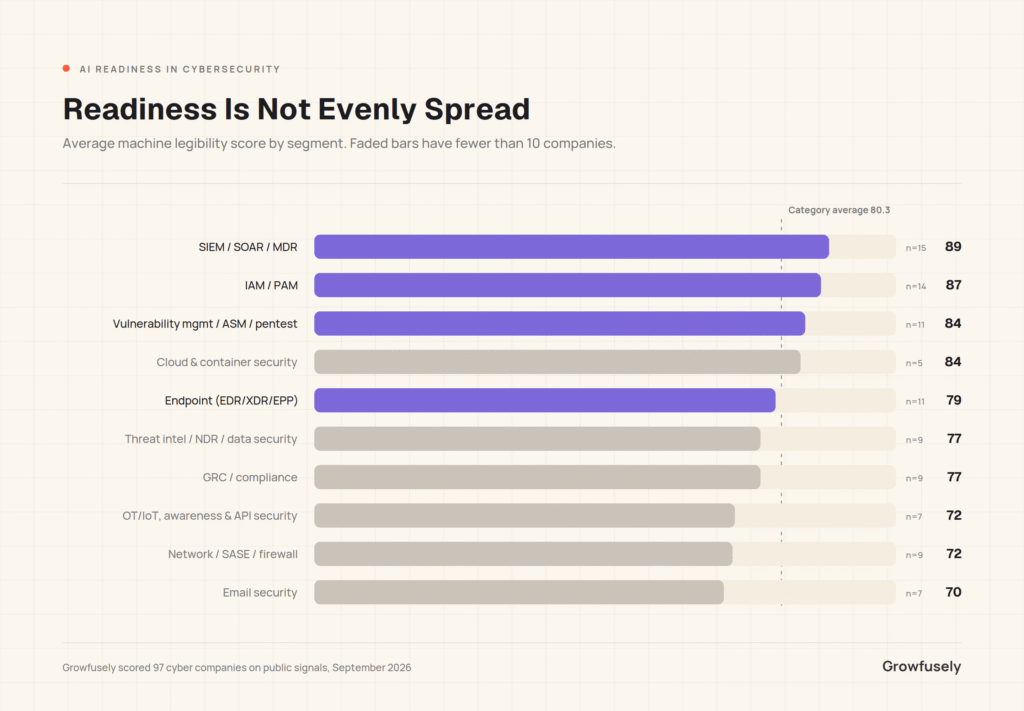
Average machine legibility score by cybersecurity segment.
Email security sits lowest at 70. Network security and OT/IoT security follow close behind at 72.
All three have fewer than ten companies in my sample, so read them as indicative. The direction still matches what I see elsewhere: the further a category sits from developers, the less machine readable it tends to be.
One interesting contrast: network security averages 72, yet two of the six perfect scorers, Cloudflare and Zscaler, come from that segment.
Which Security Companies Scored Highest?
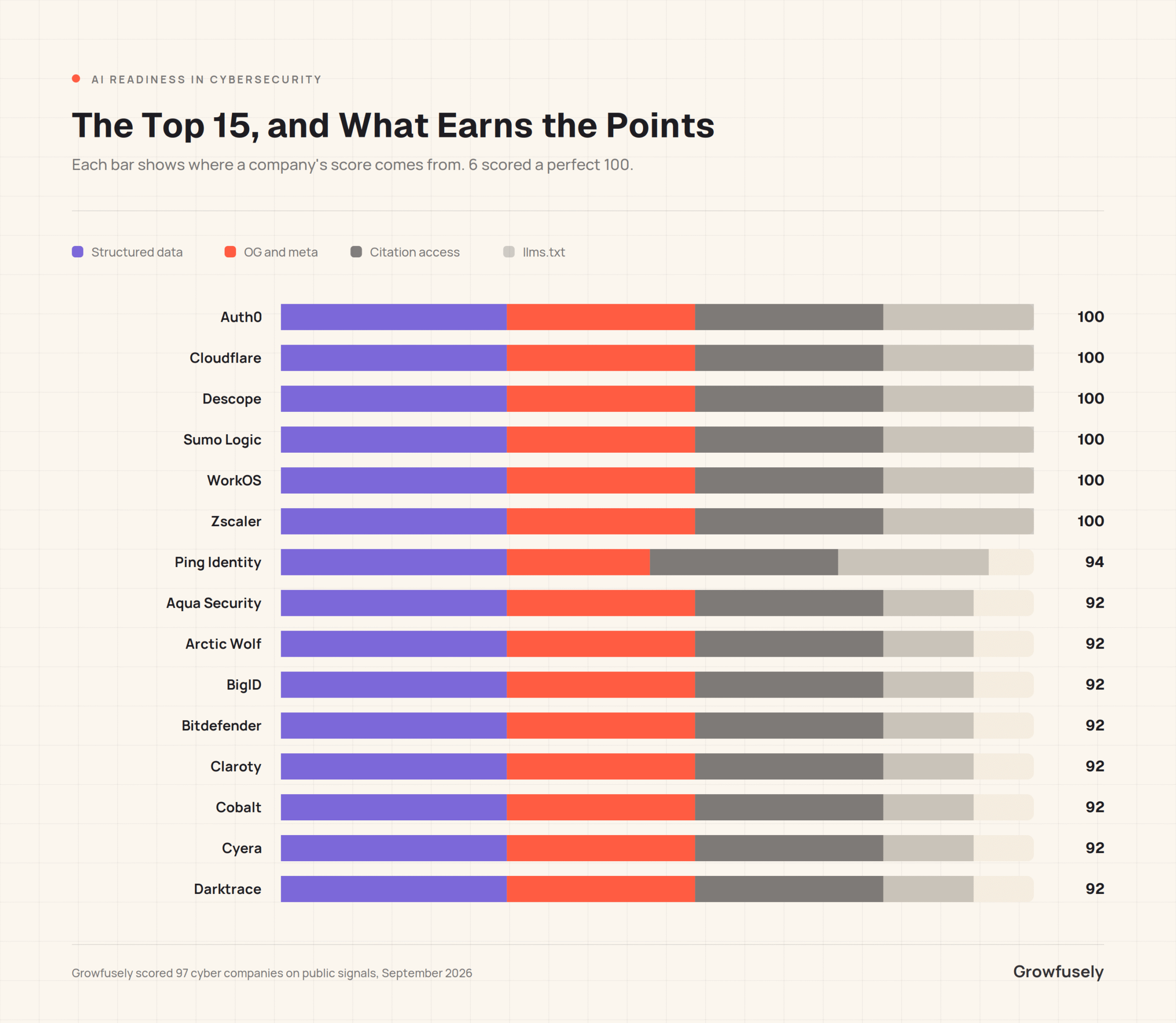
Each bar shows where a company’s score comes from.
Six companies did all four things, and three of them are in identity and access management: Auth0, Descope and WorkOS.
Ping Identity sits just behind at 94. Then eight companies cluster at 92, each missing only the full llms.txt file: Aqua Security, Arctic Wolf, BigID, Bitdefender, Claroty, Cobalt, Cyera and Darktrace.
For those eight brands, the distance to a perfect score is one file.
Which Security Company Blocks the Crawlers That Cite It?
Fortinet is the only company in this sample whose robots.txt keeps a citation crawler out.
It also appeared in my crawler study as one of five B2B SaaS sites with a sitewide Disallow rule.
That rule blocks Google as much as it blocks AI. I am not assuming it was deliberate, since blanket rules often come from a staging environment and then stay.
For a brand that buyers research heavily before contacting, it is an expensive rule to leave in place.
How Do You Score Your Own Site in Ten Minutes?
- Structured data, 30 points. View source on your homepage and search for “application/ld+json”. Full points for Organization or Product markup, plus FAQPage where you have FAQs.
- OG and meta, 25 points. Check your homepage for og:title, og:description, og:image and a meta description. Roughly six points each.
- Citation access, 25 points. Open yourdomain.com/robots.txt and confirm you do not disallow OAI-SearchBot or PerplexityBot. All or nothing.
- llms.txt, 20 points. Visit yourdomain.com/llms.txt and /llms-full.txt. Twelve points for the first, twenty if the full version exists.
Under 70, there are easy points on the table. Above 90, what is left sits outside this list: comparison content and third party mentions.
What Should Security Companies Do First?
- Publish llms.txt, and the full version. 39% of the category has no file, and 90% skipped the full one.
- Audit robots.txt properly. Security teams write restrictive rules for good reasons, and those rules outlive their purpose. Confirm OAI-SearchBot and PerplexityBot can reach you.
- Mark up the pages that matter. One in five security companies still has no structured data at all.
- Then move on to what drives recommendations. Comparison content and independent coverage decide whether you get named.
- Rescore every quarter. Rules change, sites get migrated, and AI search is still moving quickly.
What This Study Does Not Tell You
- Whether AI engines recommend these companies. The score measures readability only.
- How JavaScript heavy sites perform. I scored what a crawler sees without running JavaScript, which is how most AI crawlers read pages today.
- Anything about small segments with certainty. Segments with fewer than 10 companies are shown faded and should be read as indicative.
How I Ran This Study
I scored 101 cybersecurity companies across ten segments in September 2026. 97 were fully measurable. Four sit behind bot protection or redirect chains that block automated fetching.
Scores use four public checks weighted 30, 25, 25 and 20. Six of the ten segments contain fewer than ten companies and are shown as indicative.
How to Cite This Study
Dholakiya, P. (2026). AI Readiness in Cybersecurity: A Scored Analysis of 97 Company Websites. Growfusely. https://growfusely.com/blog/ai-ready-cybersecurity-companies/
You are welcome to use the charts with a link back to this page. If you want your own company’s full score breakdown, get in touch.
Why Partner with Growfusely for AI Search Visibility?
I would rather tell you which half of this matters than sell you all of it. Most security companies are close to clearing the readability bar already.
- A full readiness audit across robots.txt, schema, rendering and meta, with a prioritized fix list.
- Citation measurement across ChatGPT and Perplexity, so you can tell whether being readable turns into being recommended.
- Comparison and alternatives content, which my citation research shows drives recommendations.
- Original research behind every recommendation, including this study and my analysis of 1,739 AI citations.
If you want your own score and the fix list behind it, schedule a call.
FAQs
What does AI readiness mean?
It means an AI engine can fetch, read and summarize your site without guessing. Here it covers structured data, complete meta tags, reachable citation crawlers and an llms.txt file.
Which cybersecurity companies are most AI ready?
Six scored a perfect 100: Auth0, Cloudflare, Descope, Sumo Logic, WorkOS and Zscaler.
Does a high score mean AI will recommend us?
No. It means AI can read you. Recommendations depend on comparison content and third party mentions, which this score does not measure.
Should a security company block AI crawlers?
Blocking training bots like GPTBot is a legitimate decision. Blocking the search bots that fetch pages to cite you removes you from AI answers, which is rarely what anyone intended.
Why does email security score lowest?
My sample for that segment is seven companies, so treat it with care. Across both studies, categories further from developer buyers tend to invest less in machine readability.
Read Next
- The fintech companies most ready for AI search. The same scoring, applied to 95 fintech companies.
- I checked 442 B2B SaaS sites for AI crawler blocking.
- The AI Crawler Directory. Every AI bot and what blocking it costs.

Pratik Dholakiya is the Founder of Growfusely, a SaaS SEO and AI Search Visibility agency.
