
Most GEO work shows first results in 30 to 90 days on retrieval engines such as Perplexity and ChatGPT search, with steadier gains by 180 days. Crawler fixes and page formatting move the fastest. Third party mentions and changes to what models learn in training take the longest.
Your CEO wants to know when GEO will start showing results, and “about six months” isn’t an answer you can plan a budget around. The honest answer depends on two things: which kind of work you’re doing, and which kind of AI answer you’re trying to change.
Some AI answers come from a live web search, run at the moment the buyer asks. Others come from what a model learned in training, months before. A fix can reach the first kind within weeks and the second a year later. The ranges below are typical of our work at Growfusely, and your category and starting point will move them.
Key Takeaways
- GEO has several timelines, one per type of work, and a blended “6 months” estimate hides most of the useful detail.
- Retrieval engines such as Perplexity and ChatGPT search can reflect a change within weeks, because they read your pages when the buyer asks.
- Answers that come from model training change only when a new model is trained and released, which you can’t schedule.
- Crawler fixes are fast but rarely needed: only 21 of 442 B2B SaaS sites block any AI crawler.
- Third party mentions take the longest to earn, and they also tend to hold their value the longest.
How Long Does GEO Take for Each Type of Work?
Typically 1 to 4 weeks for crawler fixes, 2 to 8 weeks for page formatting, 1 to 3 months for new comparison content, and 2 to 6 months for third party mentions. Entity consistency work shows up on retrieval engines in 1 to 3 months and in training based answers much later.
| Type of work | What it changes | First signs (typical) | Steady results (typical) | Moves first on |
|---|---|---|---|---|
| Crawler access fixes | Lets citation bots read your pages | 1 to 4 weeks | 1 to 2 months | ChatGPT search, Perplexity |
| On page answer formatting | Makes pages easier to quote | 2 to 8 weeks | 2 to 4 months | Retrieval engines, AI Overviews on pages that already rank |
| New comparison content | Gives engines a page for “vs” and “alternatives” prompts | 1 to 3 months | 3 to 6 months | ChatGPT search, then Perplexity |
| Third party mentions | Puts you in independent sources engines trust | 2 to 6 months | 6 to 12 months | Retrieval engines; training much later |
| Entity consistency | Aligns how you’re described across the web | 1 to 3 months | Next model release | Retrieval engines |
These are ranges, and the gap between “first signs” and “steady” matters. First signs means you appear in some runs of a few prompts. Steady means you appear in most runs, month after month.
Why Do Perplexity and ChatGPT Search Move Faster Than Model Training?
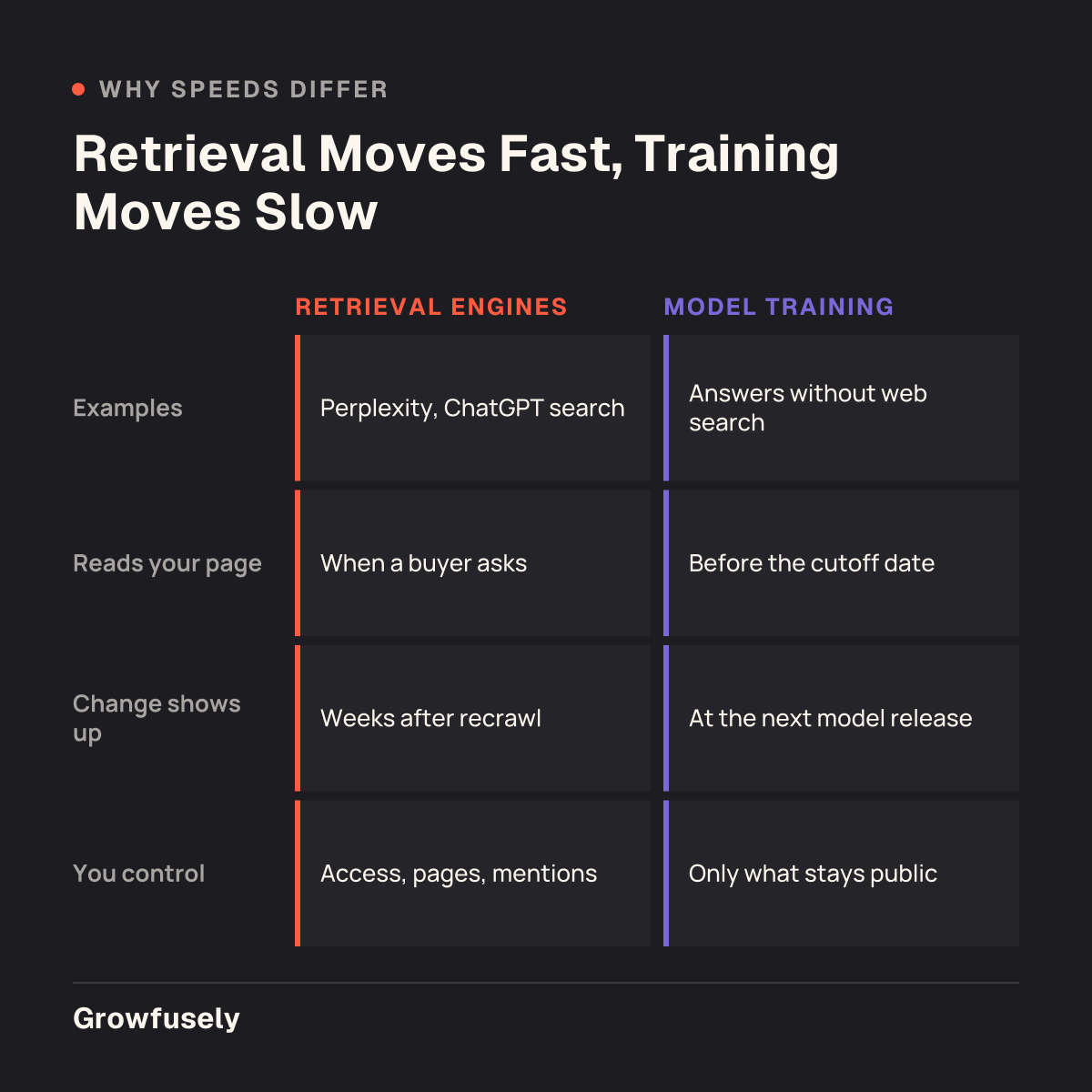
Retrieval engines search the web when a buyer asks, so they can use your updated page as soon as they’ve recrawled it. Model training happens in large batches, so a trained model only learns about your change at its next version.
Perplexity, ChatGPT search, Google AI Overviews and AI Mode all retrieve pages at question time. That’s why a fix can show up within weeks. Google says there are no special requirements for AI Overviews or AI Mode beyond being indexed and eligible for a snippet (Google), so those follow Google’s normal crawl speed.
When ChatGPT or another assistant answers without searching, it relies on training data collected before its cutoff date. Changing that answer means waiting for the next model. You can’t speed it up, and it’s one more reason to judge early GEO progress on retrieval engines.
We Unblocked AI Crawlers Last Week. When Will ChatGPT and Perplexity Notice?
The rule change itself applies fast. OpenAI says robots.txt changes take about 24 hours to reach its search systems. Citations follow once the bots have recrawled your important pages, typically 1 to 4 weeks.
Check which bots you unblocked. OpenAI runs separate crawlers for training and for search, and only the search bot affects ChatGPT search answers. Our AI crawler directory lists each bot and what blocking it costs.
The honest part: this is rarely the problem. In our crawler study, only 21 of 442 B2B SaaS sites blocked any AI crawler, and only one blocked the bots that cite it. Check it in an afternoon, and if access was already open, move on.
How Fast Does Reformatting Existing Pages Pay Off?
On pages that already rank, typically within 2 to 8 weeks on retrieval engines. Putting a direct answer under each heading, adding a table and tightening definitions helps engines lift a passage cleanly.
In my experience, the fastest wins come from pages that already rank on page one for a buyer question but are never cited. The engine is already finding them. It just can’t find a quotable answer inside them.
Pages that don’t rank gain much less from formatting alone. Retrieval engines still need to find the page first.
We Just Published Comparison Pages. Why Aren’t We Being Cited Yet?
New pages need to be crawled, indexed and trusted before engines cite them, which typically takes 1 to 3 months for first citations and 3 to 6 months to become steady. Two months of silence is normal.
Comparison and alternatives pages are among the few sources you fully control. In our study of 1,739 AI citations, vendors’ own pages, including comparison pages, made up 24% of ChatGPT’s citations and 12% of Perplexity’s. That’s one reason they show up on ChatGPT first: it cited vendor pages twice as often as Perplexity did.
Speed it up by linking the new pages from your existing high traffic pages and submitting them for indexing. Then be patient. Our guide to comparison content that gets cited covers what the page itself needs.
Why Do Third Party Mentions Take the Longest?
Because you have to earn them first. Guest articles, roundup placements and press coverage take weeks to pitch, write and publish, and each one only counts once engines have indexed it.
Typical timing is 2 to 6 months to first citations from a mention program, and 6 to 12 months for it to shift share of voice. Independent content was the largest source type in our study, so this is slow work aimed at the biggest pool of citations.
Mentions also keep working. A placement on a site that ranks for your category can be cited for years, and over time it’s the kind of public source future models get trained on.
When Does Entity Consistency Work Show Up?
On retrieval engines, typically 1 to 3 months after your site, profiles and listings all describe you the same way. In training based answers, at the next model release.
Entity work means one consistent description of your category, audience and core product across your site, LinkedIn, directories and partner pages. When those disagree, engines hedge or guess. That’s entity drift.
The fix itself is quick. Waiting for every page to be recrawled is the slow part, and some third party listings take months to update, so start with the ones you control.
What Should We Expect at 30, 90 and 180 Days?
At 30 days, fixes shipped and a baseline set. At 90 days, first citations on retrieval engines. At 180 days, steadier mention rates and early pipeline signals.
| Checkpoint | What should be done | What you should see | Still too early for |
|---|---|---|---|
| Day 30 | Baseline scorecard, crawler check, formatting on top pages, entity audit | Formatted pages appearing in some Perplexity or ChatGPT search runs | Share of voice changes |
| Day 90 | First comparison pages live, mention program underway, profiles aligned | First citations of new pages; fewer vague descriptions | Pipeline attribution |
| Day 180 | Comparison set complete, several third party placements live | Steadier mention rate and share of voice; buyers naming AI on forms | Changes in training based answers |
Track this with a monthly scorecard built on a fixed prompt set. Without a baseline from day one, you can’t tell what moved at day 90.
We’ve Been Doing GEO for Four Months and See Nothing. Should We Stop?
Check three things before you stop: whether you have a baseline, whether the work matched your gap, and whether your buyers’ prompts name vendors at all.
Without a baseline, “nothing” may really mean “not measured”. Run your prompt set now and compare it with what your sales team hears.
If the work was mostly formatting and your pages don’t rank, the gap is authority, and formatting can’t close it. Our post on whether you have a content or an authority problem helps you tell which. In my experience, that mismatch explains most four month stalls.
When your category’s prompts rarely name vendors, AI visibility matters less for you right now. Spend less on it and put the budget back into search and sales content.
What We’d Do in Your Situation
We’d spend the first week on the fast, cheap checks: crawler access, a baseline scorecard and formatting on the five pages that already rank but aren’t cited. Much of that is one time work. Your own team can do it with a checklist, and you don’t need a retainer for it.
Then we’d put the long work on the calendar early, because it takes longest: comparison pages for your top three competitors and a mention program aimed at the independent sites that rank for your category.
We wouldn’t promise anything about training based answers. Nobody controls when the next model ships. We also wouldn’t judge the program before day 90, or keep paying for it past day 180 if the scorecard hasn’t moved.
Why Partner with Growfusely for GEO Timelines You Can Plan Around?
We plan GEO by type of work, with a timeline for each, so you can tell your CEO what lands at 30, 90 and 180 days.
| What you need | What we do |
|---|---|
| A starting point | Baseline scorecard on your buyer prompts across engines |
| Fast fixes first | Crawler, formatting and entity checks in the first month |
| Long work started early | Comparison pages and a mention program from month one |
| Honest checkpoints | Day 30, 90 and 180 reviews against the baseline |
Our timelines draw on our work, and our analysis of 1,739 AI citations across 128 B2B software buying queries shows where those citations come from. Schedule a call and we’ll map which of these timelines applies to you.
FAQs
How Long Does GEO Take Compared with SEO?
The fast parts of GEO move quicker than SEO, because retrieval engines can cite a reformatted page within weeks. The slow parts move at about the same speed, since earning third party mentions works like link building. Overall, plan on 3 to 6 months for steady results. That’s typical, and it isn’t a guarantee.
How Long Does It Take to Get Cited by ChatGPT?
For ChatGPT search, first citations of a well formatted, indexed page typically arrive within 1 to 3 months. Answers ChatGPT gives without searching come from training data, and those change only when OpenAI releases a newer model. Measure progress on search answers first.
How Long Does It Take to Show Up in Perplexity?
Perplexity retrieves pages at question time, so changes to pages it already crawls can show up within weeks. Being cited for new pages typically takes 1 to 3 months. In our study, Perplexity leaned more on independent content than ChatGPT did, so third party mentions matter more there.
Can GEO Results Disappear?
Yes. Retrieval engines search again for every question, so a competitor’s new comparison page or a fresh roundup can replace you within weeks. Third party mentions and consistent entity descriptions tend to hold up better than any single page. Measure monthly so you see a drop early.
What Is a Realistic GEO Goal for the First 90 Days?
A baseline scorecard, crawler access confirmed, your top ranking pages reformatted, and first citations of those pages in some Perplexity or ChatGPT search runs. Share of voice and pipeline usually need 6 months or more to show a clear change.
Conclusion
So when your CEO asks how long GEO takes, answer with a timeline for each type of work. A single number hides too much. Crawler and formatting fixes land in weeks, comparison content in a few months, and third party mentions in six months or more. Training based answers move when the next model ships, and nobody controls that.
Set the baseline this week, put the 90 and 180 day reviews in the calendar, and judge the program against them. If you’d like a timeline built for your category, schedule a call.

Pratik Dholakiya is the Founder of Growfusely, a SaaS SEO and AI Search Visibility agency.
