
Usually you rank for terms your buyers don’t use when they’re ready to buy. The second most common cause is traffic landing on pages that were never built to convert. Sometimes it isn’t an SEO problem at all.
This is for the marketing lead or founder looking at a green SEO dashboard while sales sees nothing from organic search.
It’s a confusing spot, because every metric in the report looks healthy. That’s the trap. Rankings, sessions and impressions tell you that people found you. They don’t tell you whether those people could actually buy.
Key Takeaways
- Ranking for the wrong keywords is the most common cause, and it looks exactly like success in most SEO reports.
- High volume terms are often the least commercial, especially in B2B. A term with 90 monthly searches from operations leaders can be worth more than one with 9,000 from students.
- Check which pages your traffic lands on before anything else. If it’s almost all blog posts, the traffic is doing what it was built to do.
- Conversion, offer and product market fit problems can produce the same symptom, and more SEO won’t fix any of them.
- Buyers now do much of their research inside AI answers. If you’re missing there, they may arrive already decided, or never arrive at all.
We Rank Well but Get No Leads. Is That Even an SEO Problem?
Often it isn’t, and the fix depends entirely on the answer.
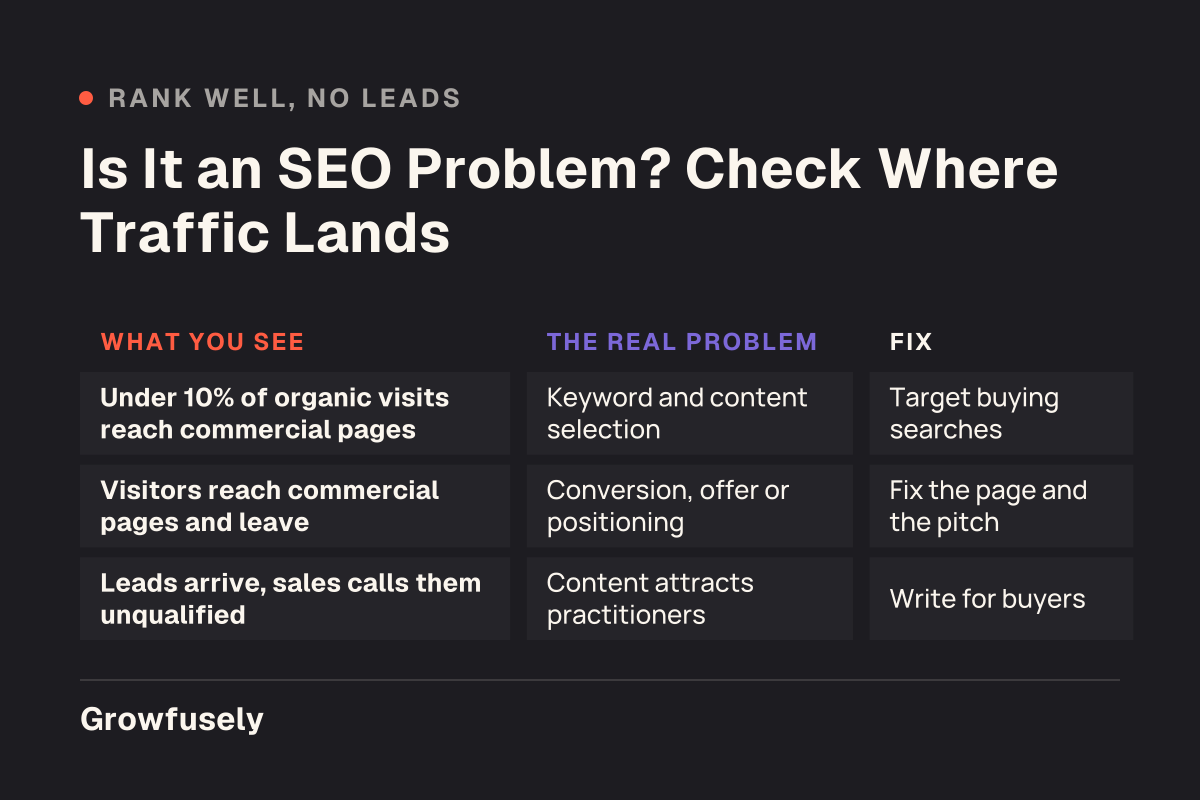
Start with one check: what share of last month’s organic sessions reached a page with a conversion path, such as pricing, a comparison page, a product page or a demo form?
If that share is under about 10%, you have an SEO problem, specifically a keyword and content selection problem.
If plenty of organic visitors reach those pages and still don’t convert, the problem sits after the click. That’s conversion, offer or positioning. More organic visitors reaching the same pricing page will leave the same way.
How Do I Tell If I’m Ranking for the Wrong Keywords?
Look at your top 20 queries and ask one question about each: could someone typing this buy from us within six months?
In most underperforming SEO programs, the honest answer for most of the list is no.
Those terms are educational or basic, written for people trying to learn how to do their job. They have volume because a large group searches for them, and most of that group will never buy.
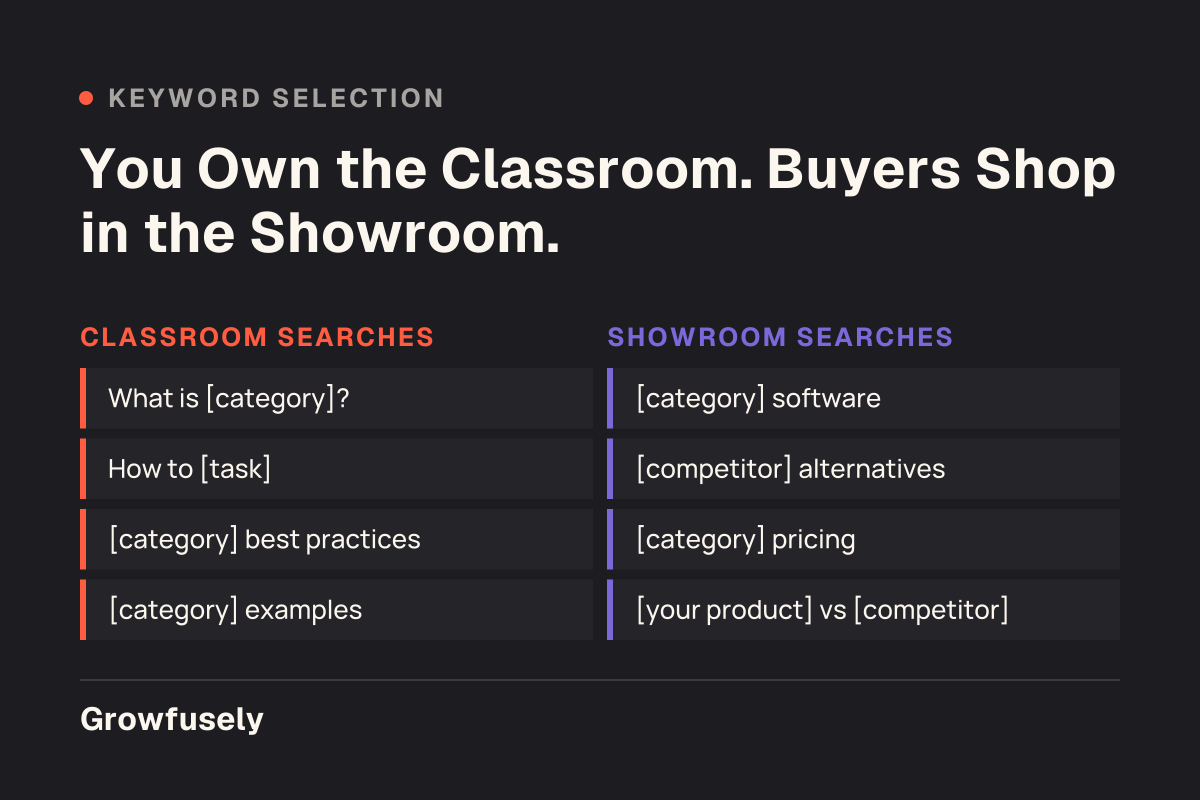
The pattern is easy to spot. Rankings for “what is [category]” and “how to [task]”, with nothing for “[category] software”, “[competitor] alternatives” or “[category] pricing”. You own the classroom and are missing from the showroom.
Why Does High Search Volume Mislead?
Keyword tools sort by volume, but buying intent often runs the other way, especially in B2B.
A term searched 90 times a month by people comparing vendors beats the term searched 9,000 times by people looking for a tutorial.
Standard keyword research surfaces the second and buries the first. A content plan built from that output targets the wrong end of the funnel with great discipline.
That’s how a program can be executed well and still produce nothing. The writing can be good but if you’re targeting the wrong searches, it won’t bring in buyers.
Where Do I Check First?
Work through these in order. Most sites find the answer in the first two rows.
| Symptom | Likely cause | Where to check first |
|---|---|---|
| Traffic lands almost entirely on blog posts, with little on product or pricing pages | Keyword selection is top of funnel only | Search Console Pages report, organic only. What share reaches commercial pages? |
| Strong rankings on informational terms, none for “[category] software” or “alternatives” | Commercial keyword gap | Search Console Queries. Filter for your category plus software, tools, alternatives, pricing |
| Traffic reaches commercial pages and doesn’t convert | Conversion or offer problem | Conversion rate on those pages, plus session recordings |
| High bounce and short time on page | The page answers a different question than the query asked | Read your top five landing pages against the queries sending them traffic |
| Everything above looks fine and leads still don’t appear | Buyers arrive already decided, or attribution hides organic’s role | Ask new customers how they first heard of you, then compare with analytics |
| Leads arrive but sales calls them unqualified | Content attracts practitioners instead of buyers | Ask sales to describe the last ten organic leads |
Could the Leads Be There and Just Missing from Our Attribution?
Yes, and it’s more common than most teams realise.
Considered purchases can take months to close, often six to eighteen in B2B, and the first touch rarely gets credit.
Someone reads your comparison page in March, does nothing measurable, and books a demo or asks for a quote in October after a branded search. Analytics records that as direct or branded traffic. The page that started the relationship looks like it did nothing.
One free check: ask your last ten customers how they first came across you. If several of them mention something you published, organic is doing more than your reports show. Then your problem becomes the measurement.
Our Rankings Held but Leads Dropped This Year. What Changed?
Buyers now do much of their evaluation inside AI answers, before they visit a vendor’s site.
In Growfusely’s analysis of 1,739 AI citations across 128 B2B software buying queries, independent content and vendors’ own comparison pages drove about 79% of the citations behind AI recommendations. When a buyer asks an AI engine which tools to shortlist, those sources can shape the answer. If you’re missing from them, you’re missing from that shortlist, even if you still rank well in search.
That creates a quieter version of the symptom. Rankings hold, some traffic arrives, and the buyers who would have converted already picked someone else.
The check is simple. Run your five most important buying queries through ChatGPT and Perplexity. If competitors appear and you don’t, that gap is costing you more than any ranking position.
When Is It Definitely Not an SEO Problem?
There are three situations where more SEO won’t help, and an agency should tell you that instead of simply just taking your money away.
- The conversion path is broken. Visitors reach commercial pages, read and leave. That’s a messaging and conversion problem.
- The offer doesn’t land. People understand what you do and still aren’t moved. That’s positioning, pricing or product, and content can’t cover for it.
- You’re still finding product market fit. If you’re still learning who buys and why, sales conversations will teach you faster and cheaper than organic search.
An honest SEO partner should tell you when one of these applies. We’ve turned down engagements on exactly this basis, because the alternative is taking a retainer for a year to prove something that was visible in week one.
What Would Fixing the Keyword Problem Involve?
If the diagnosis is keyword selection, the fix is narrower than most people expect.
- Find the 10 to 15 commercial queries your buyers use.
These are comparison, alternatives, use case and pricing phrasings, usually with modest volume. - Build or rebuild the pages that serve them.
Comparison pages, alternatives pages and use case pages written to help a buyer decide. - Link your existing blog content to those pages.
So the traffic you already have has somewhere commercial to go.
In my experience that’s usually a one quarter project. You rarely need a new twelve month program for it.
What I’d Do in Your Situation
I’d open the Search Console Pages report before the Queries report. Where traffic lands tells you more than what it ranks for, and it takes about ten minutes to see whether you have a top of the funnel problem.
Then I’d run your five most important buying queries through ChatGPT and Perplexity. That’s the fastest way to see whether a pipeline is being decided somewhere your analytics can’t reach.
What I wouldn’t do is propose a bigger content program. If you already have plenty of content aimed at the wrong stage, publishing more of it makes the problem bigger, and the retainer more expensive.
Why Partner with Growfusely for SEO That Produces Pipeline?
We diagnose before we propose. Sometimes the problem sits outside SEO, and we’d rather tell you that in the first call than bill you for a year.
- A diagnosis first, so you know which cause is yours before anyone scopes work.
- Commercial keyword strategy built on the terms buyers use when they’re ready to buy.
- AI search visibility measured, so you can see whether buyers are deciding somewhere your analytics can’t reach.
- Senior people doing the work, with no handoff after the contract is signed.
For JetOctopus, an enterprise SEO software company, our content strategy doubled organic traffic within six months.
Schedule a call and we’ll tell you which cause is yours, including when it’s one we can’t help with.
Read Next
- Why your organic traffic dropped, if the problem is losing visibility
- What AI engines cite for B2B software, the 1,739 citation study
- How to tell if your SEO agency is doing good work, if you already have one

Pratik Dholakiya is the Founder of Growfusely, a SaaS SEO and AI Search Visibility agency.
