
Comparison content helps a buyer choose between two named options: X vs Y pages, alternatives pages and approach comparisons. AI engines cite it because it answers buying questions directly. In our study of 1,739 AI citations for B2B software buying queries, independent content and vendors’ own pages made up about 79% of sources.
Ask ChatGPT “Vendor A or Vendor B for a 200 person company?” and it goes looking for a page that has already done the comparison. Most listicles haven’t. Ten tools with a paragraph each gives the buyer a menu, and picking from it is still their job.
This post covers the pages between the listicle and the product page: head to head pages, alternatives pages and approach comparisons. Our guide to building comparison pages and the comparison page checklist cover templates and components. Here I’m sticking to one question: what makes a comparison page worth citing?
Key Takeaways
- Independent content and vendors’ own pages made up about 79% of AI citations for B2B software buying queries in our July 2026 study.
- ChatGPT cited vendors’ own pages twice as often as Perplexity: 24% of its citations against 12%.
- A listicle answers “what are my options?” A comparison page answers “which one fits me?” AI engines need both, and most B2B sites only publish the first.
- Comparisons get cited when they say where the other option wins, date their pricing and link the source of every claim about a competitor.
- Approach comparisons, such as managed SOC vs in house SOC, work for services and industrial companies with no direct software competitor.
What Is Comparison Content, and Why Do AI Engines Cite It?
AI engines cite comparison content because buying questions are comparison questions. “Which is better for us” is a typical late stage buying question, and a well written comparison page gives the engine something concrete to work with.
Definition: Comparison content is a page that evaluates two or more named options against the same criteria and ends with a verdict on who each option suits. It includes X vs Y pages, alternatives pages, approach comparisons and build vs buy pages.
In July 2026 we ran 128 B2B software buying queries through ChatGPT and Perplexity and logged 1,739 citations across 16 categories. The full citation study explains how we ran it.
Independent content plus vendors’ own pages made up about 79% of what the engines cited. Review platforms came to 7.3%, and that’s G2, Capterra, Gartner and every other review site combined. Vendor pages showed up in every category, usually as comparison, alternatives or product pages.
That makes your own comparison pages one of the few citation sources you fully control. The engines will quote somebody’s comparison. It might as well be yours.
How Is a Comparison Page Different from a Listicle?
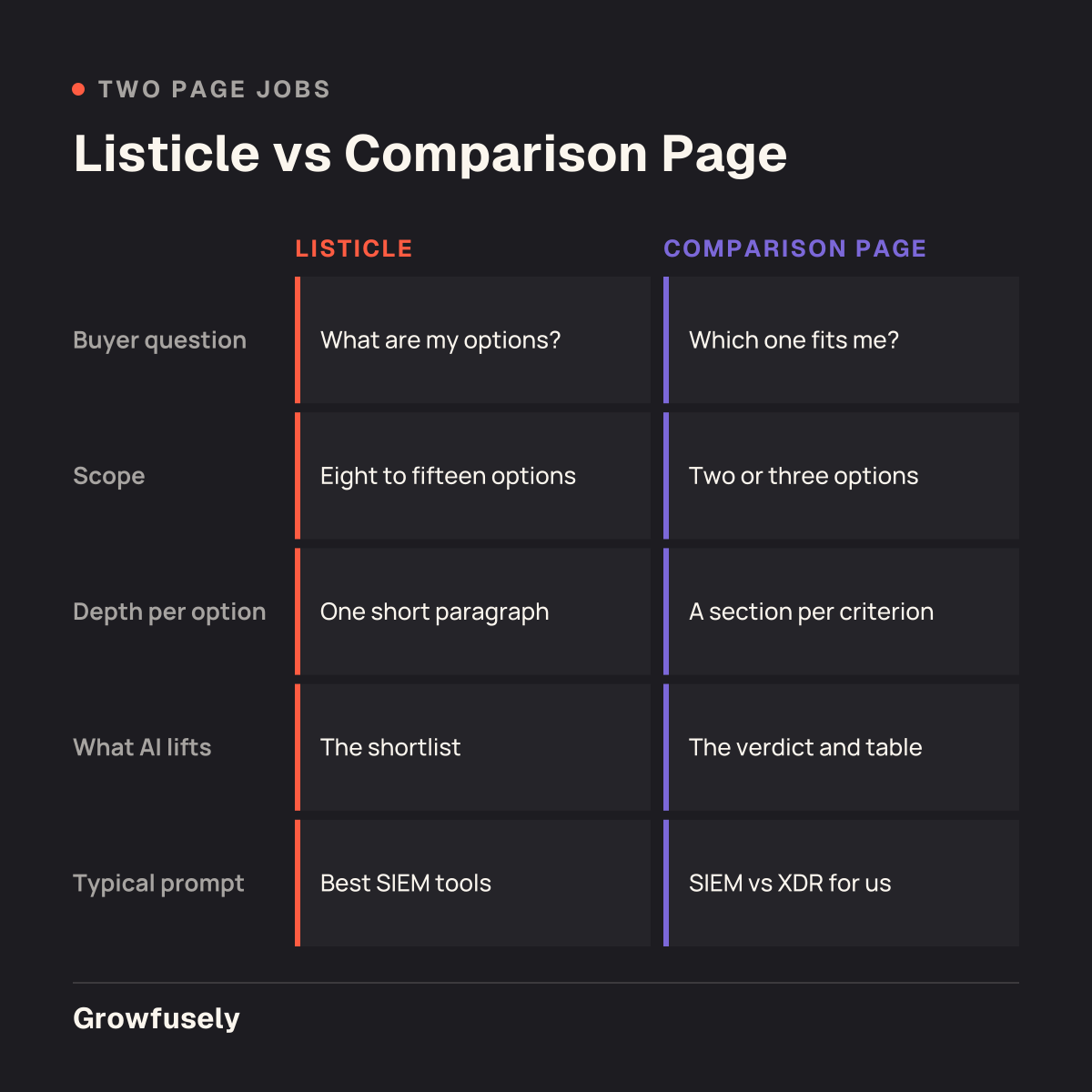
A listicle helps a buyer build a shortlist, and a comparison page helps them pick from it. The two serve different prompts, so an engine reaches for different pages to answer each one.
| Listicle (“best [category]”) | Comparison page (X vs Y, alternatives, approach) | |
|---|---|---|
| Buyer question | What are my options? | Which of these fits my situation? |
| Typical prompt | “Best SIEM tools for mid market” | “Is SIEM or XDR better for a 50 person IT team?” |
| Number of options | 8 to 15 | 2 or 3 |
| Depth per option | One paragraph and a few bullets | A section per criterion |
| What an engine lifts | The shortlist and the summary table | The verdict, the criteria table, the “choose X if” lines |
| Main risk | Thin, interchangeable entries | Reading as a sales page |
Our study pointed to four templates worth building: “best [category] software”, “[You] vs [Competitor]”, “[Competitor] alternatives” and “best [category] for [segment]”. Only the first is a listicle. The other three are comparison content, and they’re the ones most B2B sites skip.
Listicles also have a crowding problem. Every vendor and affiliate in a category publishes one, so an engine has dozens to choose from. There are fewer pages for a specific pairing, so a well built head to head page has less competition.
Which Comparison Formats Work Outside Software?
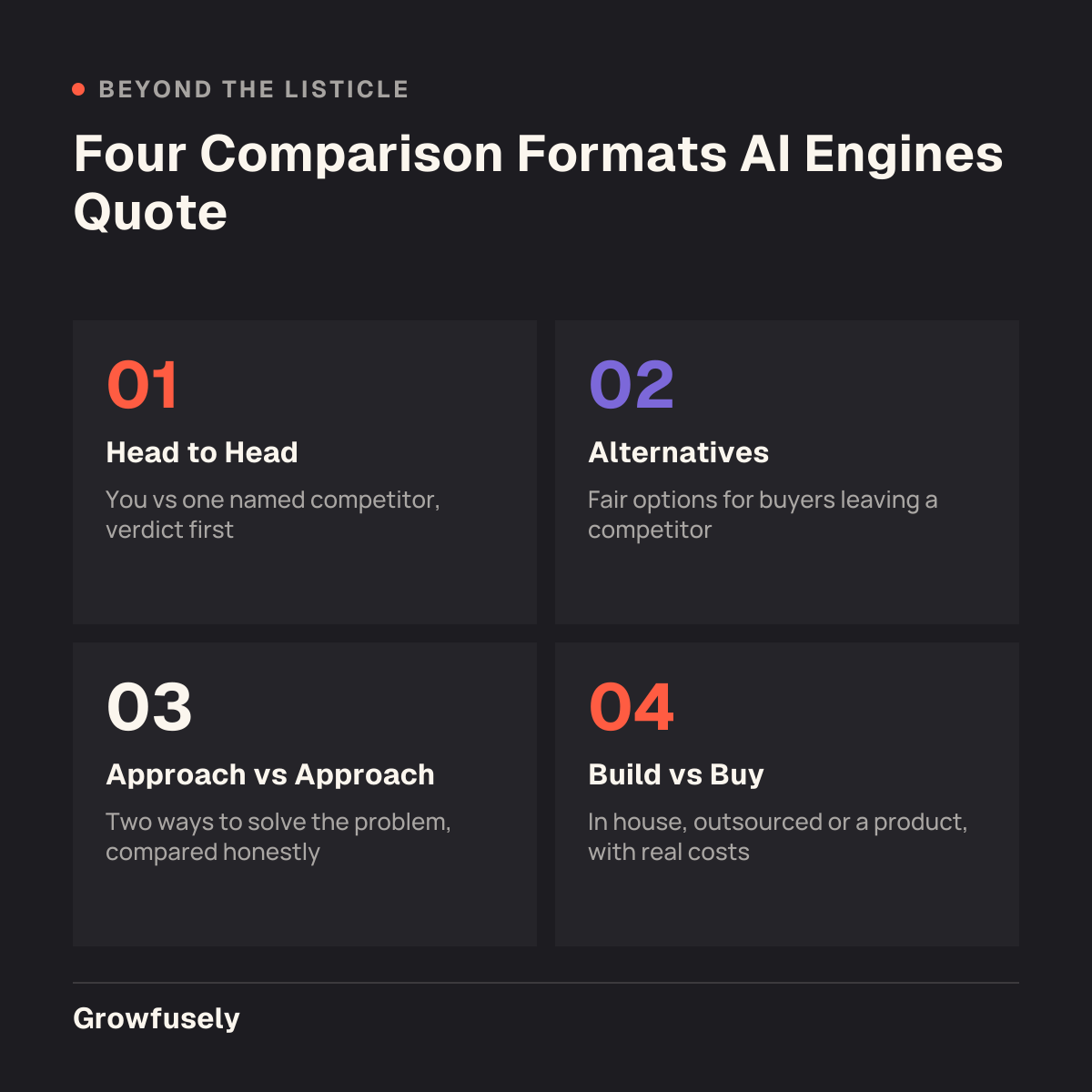
Four formats cover almost every B2B business: head to head, alternatives, approach vs approach, and build vs buy. Software companies use all four. While services and industrial companies lean on the last two.
Head to head pages compare you with one named competitor. They suit any business where buyers shortlist two or three vendors by name: payroll software, ERP for manufacturers, managed IT providers in a region.
Alternatives pages serve buyers who are leaving a competitor. “[Competitor] alternatives” is a high intent prompt, and the honest version lists several options, including yours, with who each one suits.
Approach comparisons compare two ways of solving the problem. A cybersecurity firm can write “managed SOC vs in house SOC.” A contract manufacturer can write “CNC machining vs injection molding for runs under 1,000 parts.” These pages need no named competitor.
Build vs buy pages compare doing the work in house, outsourcing it or buying a product. Fintech, IT services and professional services firms field this question on most sales calls, and buyers are asking AI engines the same thing.
What Makes a Comparison Honest Enough to Cite?
An honest comparison says where the other option wins and shows its sources. Our study put the steady run of vendor citations down to exactly that: fair comparisons that include the vendor get cited.
Here’s why I think that happens. An engine building a balanced answer needs passages covering both options. A page that praises one side gives it half a passage. A page that says “Vendor B is the better pick if you already run its suite” gives it a complete, quotable line.
| Honest comparison signal | Sales page signal | Why it matters for citation |
|---|---|---|
| Verdict names who should choose the competitor | Verdict always picks the author | Engines need both sides for a balanced answer |
| Pricing shown with a date and a link to the source | “Contact sales” or no competitor pricing | Dated figures are specific enough to quote |
| Criteria match the buyer’s job | Criteria chosen where the author wins | Buyer criteria match the words in the prompt |
| Claims about the competitor link to its own docs | Unsourced claims about weaknesses | Traceable claims are safer to repeat |
| Visible “last updated” date | No date, or a 2023 date | Freshness was a shared trait of cited pages in our study |
In my experience, the hardest line to get approved internally is the one that says who should pick the competitor. It’s also the line I’d least want cut, because it’s the one that makes the rest of the page believable.
Honesty also means being accurate about yourself. If a feature is on the roadmap, say so and date it. Engines repeat what you publish, and a buyer who finds the gap on a demo call remembers where they read the claim.
How Should a Cited Comparison Page Be Structured?
Put the verdict first, a criteria table second, then one section per criterion with a question as its heading. The study’s playbook makes the same call: engines lift structured, table driven content far more readily than prose.
A structure that works for most B2B comparisons:
- Verdict block. Two or three sentences naming both options and who each suits.
- At a glance table. Five to eight criteria, both options, plain values.
- One section per criterion. Headings as buyer questions, such as “Which Handles SOC 2 Evidence Collection Better?”
- “Choose X if, choose Y if.” Three bullets each.
- Pricing, dated. With links to both pricing pages.
- Switching notes. What moving between them involves.
- How we compared. Who tested, when, and what you couldn’t check.
The verdict block does most of the work, so here’s a before and after. Both vendors are made up.
Before (illustrative): “Vendor A is the leading platform for teams that want the best results. Unlike legacy tools, we deliver unmatched value and support.”
After (illustrative): “Vendor A suits mid market teams that need built in audit workflows. Vendor B suits enterprises already on its wider suite, and costs less as part of that bundle. Both support SSO and SOC 2 reports as of October 2026.”
The second version names both options, states who each fits and dates a fact. An engine can lift it whole.
Should I Write About Competitors I Rarely Lose To?
Write comparison pages for the pairings buyers actually make, and skip the rest. A page comparing you with a company nobody shortlists alongside you has no prompt to answer.
Start with sales data. List the competitor names that come up in discovery calls and lost deal notes over the last two quarters. The top three or four are your head to head pages. The one buyers most often leave for you is your first alternatives page.
Then add approach comparisons for the questions buyers ask before they’ve picked a category. They answer the earlier prompts, before the buyer has named a vendor. The checklist post covers the comparisons to avoid, so I won’t repeat it here.
Where Should Comparison Content Live: Your Site or Someone Else’s?
Both, and the engine split tells you how to weight them. Your own pages count for more on ChatGPT. Independent comparisons count for more on Perplexity.
| Engine | Vendors’ own pages | Independent content | Tech media |
|---|---|---|---|
| ChatGPT | 24% | 55% | 15% |
| Perplexity | 12% | 67% | 5% |
On your own site, publish the head to head and alternatives pages. Off site, make it easy for independent reviewers to compare you fairly: send current pricing, specs and a trial account, and correct errors politely.
Tech media made up 15% of ChatGPT’s citations, so a fair placement in a tech publication’s comparison is worth going after. Our list of digital PR agencies covers who can help. The ChatGPT vs Perplexity breakdown explains the split in more detail.
How Do I Know If My Comparison Pages Are Being Cited?
Run your comparison prompts in ChatGPT and Perplexity every month and log which URLs each engine cites. Rankings won’t show this.
Write prompts the way buyers phrase them: “[You] vs [Competitor] for [use case]”, “[Competitor] alternatives for [segment]” and “is [approach A] or [approach B] better for [company size]”. Ten to fifteen prompts is enough to start.
For each one, log whether you’re mentioned, which page was cited and whether the engine repeated your verdict. If an engine quotes your verdict wording, the page is doing its job. Our guide to measuring AI search visibility covers the tracker setup, and the same log works as the scoreboard for the rest of your GEO work.
Why Partner with Growfusely for Comparison Content?
We write comparison content from citation data. Our own study of 1,739 AI citations is where the formats and structure in this post come from.
| What you need | What we do |
|---|---|
| Know which comparisons buyers make | Map competitor pairings from your sales data and AI prompts |
| Pages engines can quote | Verdict first pages with criteria tables and dated pricing |
| Fair coverage off your site | Outreach to independent reviewers and tech media in your category |
| Proof it’s working | Monthly prompt tracking on ChatGPT and Perplexity |
Clients include FreshBooks, Murf AI, Shopify, Whatfix and Multidots. Schedule a call and we’ll show you which comparison prompts in your category cite a competitor’s page today.
Conclusion
Comparison content is the page type AI engines need for “which one fits me” prompts. Listicles get a buyer to a shortlist. Getting them off it takes a page that compares real options and says plainly who should pick the other one.
That’s the comparison content engines reach for. In our study of B2B buying queries, independent content and vendors’ own pages made up about 79% of citations, and ChatGPT took 24% of its citations from vendor pages alone.
So start with one pairing: the competitor your sales team hears about most. Put the verdict first, say where they win, date the pricing, and run the prompt again next month. If you’d like to see which comparisons in your category cite a competitor today, schedule a call.
FAQs
Do AI Engines Cite Vendor Comparison Pages?
Yes. In our July 2026 study of 1,739 citations, vendors’ own pages made up 24% of ChatGPT’s citations and 12% of Perplexity’s, and they appeared in all 16 software categories. Comparison, alternatives and product pages made up most of them. Independent content was the larger source on both engines, so your own pages work best alongside fair coverage elsewhere.
Is It Risky to Name Competitors on My Website?
Naming competitors is common practice for comparison pages, and buyers expect it. The risk comes from inaccurate or unsourced claims. Link every claim about a competitor to its own documentation or pricing page, date the comparison and avoid their logos. If you’re unsure about your market, have legal review the first page before you build more.
How Is an Alternatives Page Different from a Listicle?
A competitor alternatives page serves a buyer who already uses a specific competitor and wants to leave. It lists a few options, explains who each suits and addresses switching. A listicle serves a buyer who hasn’t picked anything yet. The alternatives prompt carries more intent, and fewer pages compete for it.
Should a Comparison Page Admit Where the Competitor Is Better?
Yes. A verdict that names who should choose the competitor gives an engine a balanced passage to quote, and it makes your other claims more believable to buyers. Pick the criteria where the competitor wins honestly, such as suite pricing or a specific integration, and state it plainly in the verdict block.
How Often Should Comparison Pages Be Updated?
Review them every quarter, and update any time either product changes pricing or a major feature. Show a visible “last updated” date. A visible date was one of the shared traits of cited pages in our study, and stale competitor pricing is the fastest way for a buyer to stop trusting the page.
What If My Company Has No Direct Competitors?
Write approach comparisons instead. Compare the ways a buyer could solve the problem: in house vs outsourced, one technology vs another, buy a product vs build a process. Services and industrial companies often get more value from these than from vendor comparisons, because buyers ask approach questions before they shortlist anyone.

Pratik Dholakiya is the Founder of Growfusely, a SaaS SEO and AI Search Visibility agency.
