
If you rank well but AI engines never cite you, it’s usually an authority problem. If you have no pages that answer buying questions, or yours add nothing new, it’s a content problem. If the key pages aren’t indexed or readable, it’s technical. Fix technical first.
Something is wrong with your search and AI visibility, and next quarter’s budget has to go somewhere. You have three options on the table: more content, digital PR, or a technical fix.
The hard part is that the symptoms overlap. A competitor getting cited instead of you could mean your pages are thin, nobody outside your company mentions you, or the engine can’t read your site at all. Each one needs a different spend. Picking the wrong one costs a quarter.
Key Takeaways
- A content problem means your pages don’t answer buying questions, or say nothing the engine can’t find elsewhere.
- An authority problem means your pages are fine, and independent sites still don’t mention you. Independent content made up 61% of AI citations in our study.
- A technical problem means engines can’t find or read the pages. Check it first, because it’s the cheapest to rule out.
- Ranking on Google without AI citations points to authority more often than content.
- You can run every check in this post in one afternoon with Search Console, ChatGPT and Perplexity.
- A technical fix is usually a short project. Paying a monthly retainer for it wastes money.
Definition: A content problem is a gap in what your own pages say. An authority problem is a gap in what other sites say about you. A technical problem is a gap in whether engines can reach and read your pages at all.
How Do I Know If It’s a Content Problem or an Authority Problem?
Look at what happens to pages you already have. If good pages exist and still aren’t cited, the gap is authority. If the pages don’t exist, or simply repeat what others are saying, the problem is with the content.
The quickest test is your best page on a buying topic. Put it beside the page ChatGPT actually cites for that question. If yours is weaker, you have a content problem. If yours is as good or better and still loses, the engine trusts the other source more. That’s authority.
Rule out technical issues before either test. A page the engine can’t read will lose regardless of what it says.
What Do the Symptoms Point To?
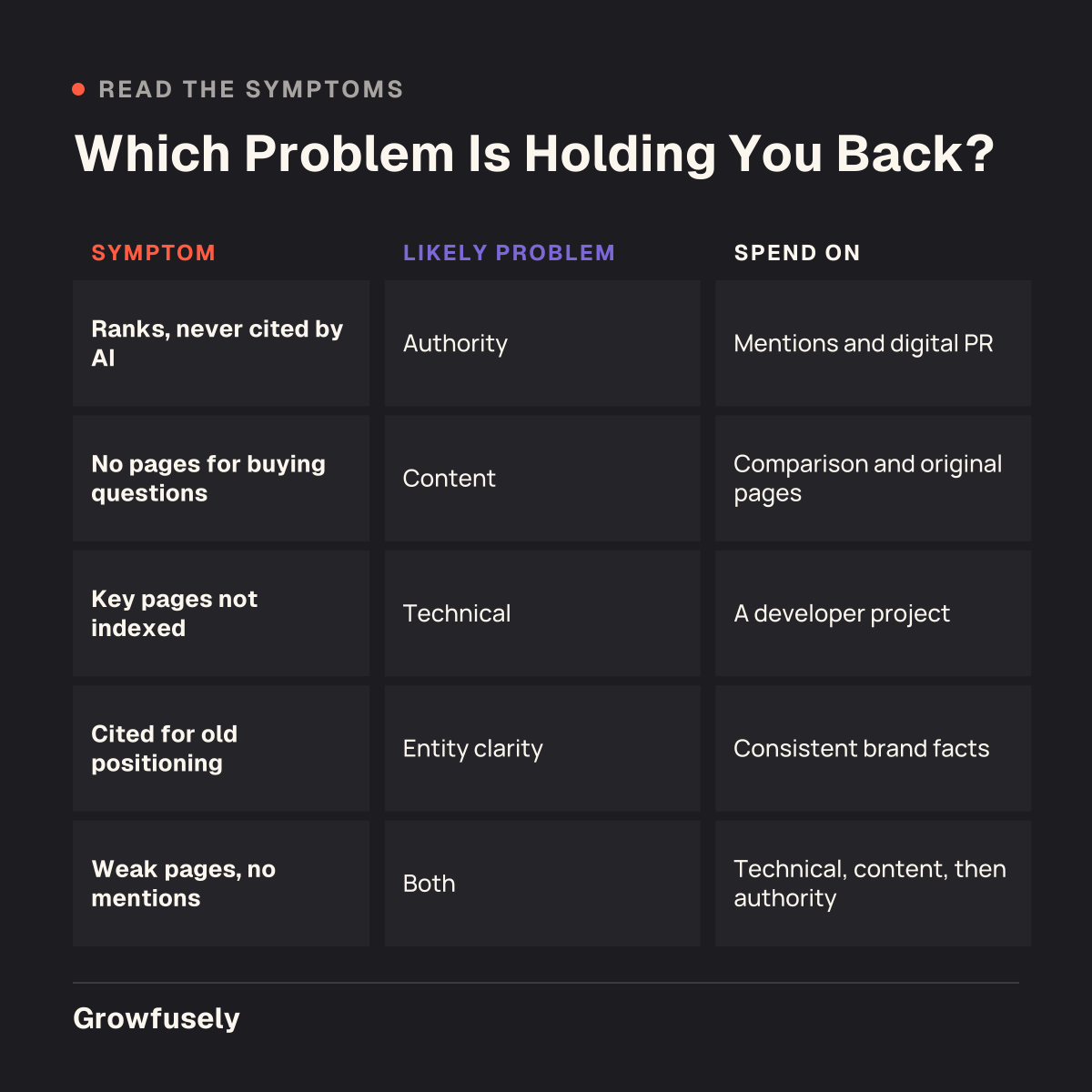
Most symptoms map to one problem, and a few point to two. Find the row that matches your situation, then run the check in the third column.
| Symptom | Likely problem | First check |
|---|---|---|
| You rank on page one, and AI engines never cite or mention you | Authority | Do the sources ChatGPT cites for your queries mention you? |
| Competitors with weaker pages get named instead of you | Authority | Count how many “best [category]” roundups include each of you |
| AI mentions you, for an old product or the wrong category | Entity clarity | Compare your homepage, LinkedIn and directory descriptions |
| You have no pages comparing you with competitors | Content | Search your site for “vs” and “alternatives” pages |
| Your pages cover buying topics, and say what every other page says | Content | Put your page beside the cited one and list what’s missing |
| Key pages show “Crawled, currently not indexed” in Search Console | Technical | Inspect the URLs and check internal links to them |
| Your main text only appears after scripts run | Technical | View the raw page source and search for a key sentence |
| AI cites you only when someone types your brand name | Authority | Run unbranded buying queries and log who appears |
| Few pages, few mentions, falling traffic | Both | Start with the technical check, then content |
We Rank on Page One, but ChatGPT Never Mentions Us. Which Problem Is That?
Almost always authority. Ranking shows Google finds your page relevant. AI engines then lean heavily on what independent sites say. In our study of 1,739 AI citations, independent content made up 55% of ChatGPT’s citations and 67% of Perplexity’s.
So the engine reads the roundups, trade articles and comparison sites that cover your category. If those don’t mention you, your ranking page is one voice against several.
In my experience, this is the most common situation for B2B companies with a mature SEO program. The content investment worked for Google. But nobody invested in being discussed elsewhere.
One caveat: ranking with no leads is a separate problem, often about keyword choice. That’s covered in ranking but no leads.
AI Mentions Us, but for the Wrong Things. What Does That Mean?
It means engines are reading inconsistent or outdated facts about you. That’s an entity clarity problem, and it sits between content and authority.
Take a cybersecurity firm that moved from managed services to a platform two years ago. AI engines will still describe it as a services provider. Old press releases, directory listings and partner pages keep the old story alive.
The fix starts with your own profiles, which is cheap. Then it moves to the third party pages repeating the old description. Here’s how to trace a wrong claim to its source.
Half Our Pages Aren’t Indexed. Do We Even Have a Content Problem Yet?
You don’t know yet, and that’s the point. Unindexed pages can’t rank or be cited, so the technical problem hides everything else. Fix it, wait for recrawl, then diagnose again.
Start with Search Console’s page indexing report. Filter for the pages closest to your buying queries: product, comparison, pricing and solution pages. “Crawled, currently not indexed” often means Google sees the page as thin or duplicated, which may become a content task later.
Then check the AI crawler access. Few sites block the bots that matter: only 21 of 442 B2B SaaS sites in our crawler study blocked any AI crawler. A quick look at robots.txt against the AI crawler directory settles it.
What Can I Check in One Afternoon?
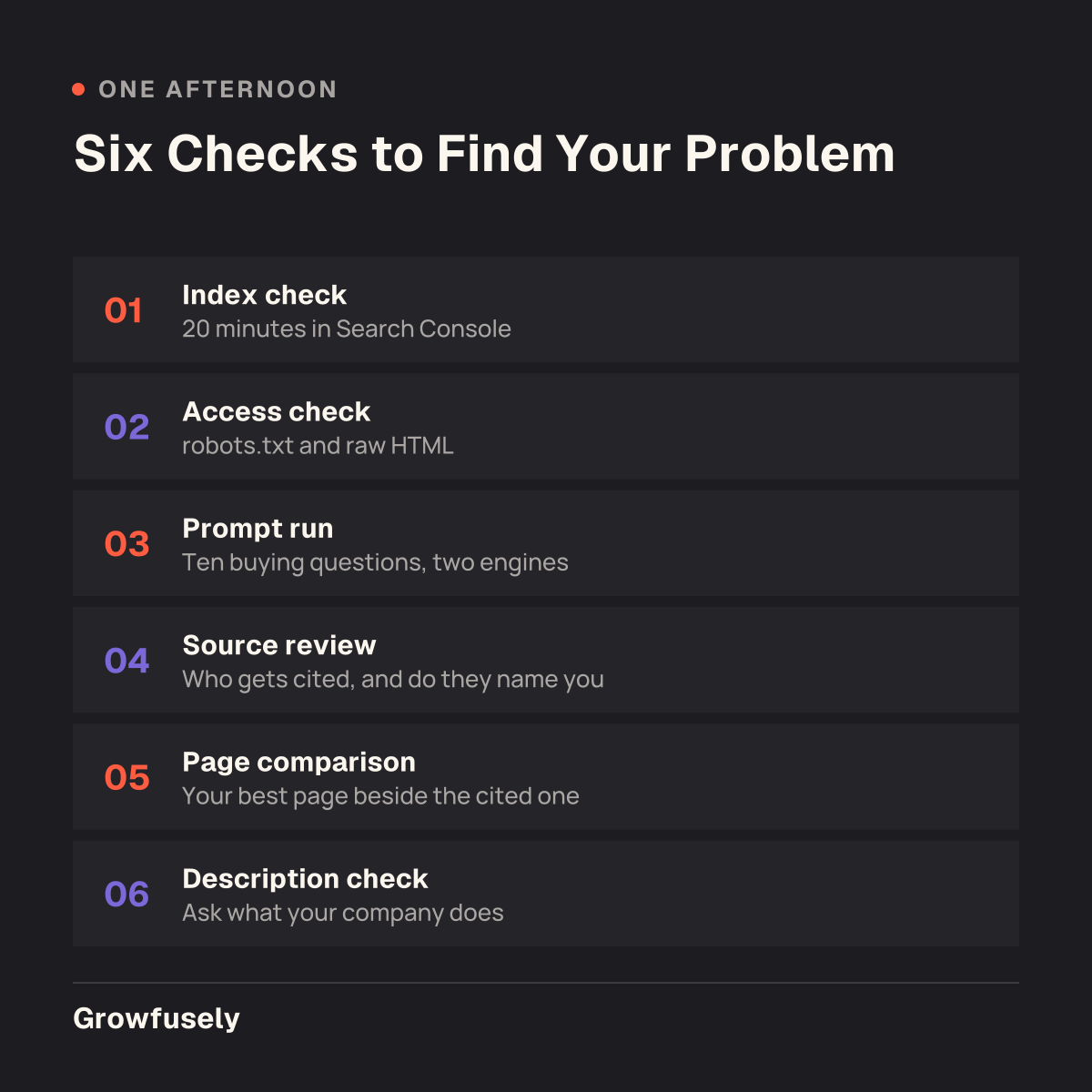
This is a basic AI visibility audit: six checks, about three hours in total. You need Search Console access, ChatGPT with search on, Perplexity, and a spreadsheet.
- Index check (20 minutes). List the 20 pages closest to your buying queries. Confirm each is indexed in the Search Console.
- Access check (15 minutes). Open robots.txt and confirm OAI-SearchBot and PerplexityBot aren’t blocked. View the raw source of two key pages and search for their main text.
- Prompt run (60 minutes). Type ten buying questions into both engines, without your brand name. Log whether you appear and which sources get cited.
- Source review (45 minutes). Open the cited sources. Note which are independent, which mention you, and which mention competitors.
- Page comparison (30 minutes). Put your best page beside the most cited page for the same question. List what it has that yours lacks.
- Description check (15 minutes). Ask both engines “What does [brand] do, and who is it for?” Compare the answer with your positioning.
Read the results in order. Failures in checks 1 or 2 mean technical. Weak results in check 5 mean content. Good pages in check 5 with few mentions in check 4 mean authority. A wrong answer in check 6 means entity clarity.
What If It’s Both?
Sequence them: technical, then content for your buying pages, then authority. Running all three at once spreads the budget thin and makes it hard to see what worked.
Content comes before authority for one reason. Digital PR needs something worth mentioning: original data, a fair comparison page, a clear expert view. Pitching a site with nothing new to point at rarely earns coverage.
In my experience, “both” teams can still start authority work early if one strong asset already exists. One original study or benchmark can carry a quarter of outreach.
Where Should the Budget Go for Each Diagnosis?
Put money where the gap is, and cut spends that feed a problem you don’t have. Here’s how each diagnosis changes the plan.
| Diagnosis | Spend on | Spend less on | First 90 days should produce |
|---|---|---|---|
| Technical | A developer project: indexing, rendering, internal links, crawler rules | New content until key pages are indexed | Buying pages indexed and readable as raw HTML |
| Content | Comparison and alternatives pages, original data, rewrites of buying pages | Volume blogging on topics already well covered | Three to five pages with something no competitor page has |
| Authority | Digital PR, expert placements, roundup inclusion, founder visibility | Publishing more posts on your own blog | Mentions on sites engines already cite for your queries |
| Entity clarity | Internal hours to align profiles, directories and press materials | Paid tools to monitor the problem | One description used on every profile you control |
| Both | Technical first, then content, then authority | Doing all three at half strength | A fixed foundation and one citable asset |
The honest answer for the technical row: this is usually two to four weeks of developer time, and it ends. You don’t need a monthly retainer for it. An agency should scope it as a project and step back.
For the authority row, look at digital PR agencies or a partner that does PR and content together. It’s a different skill set from content production, and not every content agency has it.
How Do I Know the Fix Is Working?
Rerun the same prompts every month and compare. Use the ten buying questions from your afternoon check. Track whether you appear, how you’re described, and which sources get cited.
In Search Console, the technical fixes show up first. Content and authority changes take longer to reach AI answers, so judge that side of your GEO work over a quarter, not a month. Our guide to measuring AI search visibility covers the tracker in detail.
What I’d Do in Your Situation
I’d run the six checks before approving any budget. Three hours of diagnosis costs far less than spending your money in the wrong place for a whole quarter .
If the checks point to technical issues, I’d hand them to a developer as a fixed project and hold off new content until the key pages are indexed. If they point to content, I’d build comparison pages and one original data asset before writing any more blog posts.
When they point to authority, I’d cut the publishing volume by half and move that budget into digital PR and expert placements. That’s the hardest call for most content teams to make.
What I wouldn’t do is buy more of what you already have. More posts won’t fix an authority problem, and more links won’t fix a page that says nothing new.
Why Partner with Growfusely for Diagnosing AI Visibility Gaps?
We run the diagnosis before we propose a plan, and if the fix is a developer project, we’ll say so instead of selling you a retainer.
| What you need | What we do |
|---|---|
| A clear diagnosis | Run your buying queries on ChatGPT and Perplexity and map every cited source |
| Technical fixes | A scoped indexing, rendering and crawler review your developers can act on |
| Content that gets cited | Comparison pages, original research and rewrites of buying pages |
| Authority | Digital PR and expert placements on the sites engines cite for your category |
For Whatfix, we combined content and authority work over two years: page one for more than 3,000 relevant keywords and mentions on 250+ high authority websites. Engagements start from $2,000 per month.
Schedule a call and we’ll tell you which problem you have.
Conclusion
Whether it’s a content problem or authority problem, the answer is already in your own data, and it takes one afternoon to find it. Good pages that never get cited point to authority while missing or generic pages point to content. Wrong descriptions point to entity clarity, and anything engines can’t read is technical, so that gets fixed first.
So block out the three hours before you sign off on the budget. Run the six checks, write down what each one shows, and spend on the gap you actually have. If you’d like a second opinion on your diagnosis, schedule a call with us.
FAQs
What Is the Difference Between a Content Problem and an Authority Problem?
A content problem is about what your own pages say: missing pages or pages that repeat what’s already published. An authority problem is about what other sites say about you: few independent mentions, roundups or press coverage. Good pages with no outside mentions point to authority. Missing or generic pages point to content.
Can Good Content Fix an Authority Problem?
Only indirectly. Original data or a strong comparison page gives other sites a reason to mention you, and those mentions build authority. Publishing more posts on your own blog doesn’t, because engines lean on independent sources. In our study, independent content made up 61% of AI citations for B2B software queries.
How Do I Know If Competitors Have More Authority Than Us?
Search “best [your category]” on Google and open the top ten results. Count how many include each competitor and how many include you. Then check which sources ChatGPT and Perplexity cite for the same query. A competitor that appears in most of them has the authority edge.
Should I Fix Technical SEO Before Working on Content or Authority?
Yes, when key pages aren’t indexed or their text is hidden behind scripts. Engines can’t cite a page they can’t read. If indexing and crawler access are fine, which they are for most sites, move straight to the content and authority checks. Don’t let a technical audit delay work that matters more.
Is Digital PR Worth It for AI Visibility?
When your diagnosis is authority, it’s usually the most direct fix. Digital PR earns mentions on the independent and media sites engines cite most often. It works best with something worth covering, such as original data or a clear expert view. Without that, pitches tend to fall flat.
How Often Should I Rerun the Diagnosis?
Every quarter, with the same buying questions, so results are comparable. Run it sooner after a site migration, a rebrand, or a major product change, since each can create new technical or entity problems. Track changes in a simple spreadsheet so trends are visible over time.

Pratik Dholakiya is the Founder of Growfusely, a SaaS SEO and AI Search Visibility agency.
