
Does founder visibility affect AI search? It can, mostly indirectly. Engines cite pages, so a founder helps when their expertise lands on pages engines retrieve: podcast pages, guest articles, quotes in independent articles, LinkedIn and YouTube. Nobody has yet shown a direct causal effect for B2B companies.
Does founder visibility affect AI search? Founders keep asking me some version of it: if I post more, speak more and get quoted more, will ChatGPT start recommending my company?
Some of the answers are backed by data. Some of it is plausible but unproven. And some popular claims have no evidence at all. This post sorts the claims into those three groups, then shows the paths founder content actually takes into AI answers and how to test it for your own company.
Key Takeaways
- AI engines cite pages, so founder visibility only matters when it creates pages engines can retrieve and trust.
- LinkedIn content is cited by AI engines for professional queries, but those studies don’t show that it drives recommendations for B2B buying queries.
- Independent content makes up most AI citations for B2B software, so founder quotes and guest articles on independent sites sit in the largest pool.
- A founder only helps the company if engines can connect the two, which takes consistent names, titles and links everywhere.
- Founder visibility adds to the company’s own comparison pages and mentions. It can’t replace them.
Definition: Entity association is how clearly search and AI systems connect two things, such as a founder and their company. When every bio, byline and profile names the same person with the same title at the same company, engines can carry credit from one to the other.
Does Founder Visibility Affect AI Search?
It can, through the pages it creates. AI engines answering buying questions retrieve web pages and cite them. A founder’s name on its own doesn’t move an answer. A founder quoted in the article that an engine retrieved can certainly do so.
So the useful question is narrower: does your founder’s activity produce pages on the sites engines cite for your category? A podcast on a show nobody indexes adds little. A quote in the roundup that ranks for “best [category]” adds a lot.
I should be clear about what we know. We haven’t run a study on founder visibility. Our study of 1,739 AI citations recorded the type of source cited. It didn’t record whether the author was a founder.
What Can We Prove, and What Can’t We?
Some founder channels are proven sources of AI citations. The link from founder fame to company recommendations is still unproven. Here’s where each common claim stands.
| Claim | Evidence | Status |
|---|---|---|
| AI engines cite LinkedIn content | Semrush found LinkedIn in about 11% of AI responses across 325,000 prompts (Semrush, 2026) | Supported, for professional queries |
| Individuals get cited on LinkedIn, beyond company pages | Individual members were 59% of LinkedIn citations on ChatGPT Search and Google AI Mode (Semrush, 2026) | Supported |
| Perplexity cites YouTube | All 47 YouTube citations in our study came from Perplexity (Growfusely, 2026) | Supported, for B2B software queries |
| Independent articles are the biggest citation pool | Independent content was 67% of Perplexity’s and 55% of ChatGPT’s citations (Growfusely, 2026) | Supported |
| Founder quotes in independent articles help the company get cited | Follows from the two rows above, untested directly | Plausible |
| A bigger founder following makes engines recommend the company more | No published study we know of | Unproven |
| Founder posting alone puts a company on AI shortlists | No published study we know of | Unproven |
The LinkedIn studies come with a caveat. Semrush published its findings with LinkedIn (Semrush, 2026), and both it and Profound measured broad professional queries. Neither isolated B2B buying questions such as “best [category] for [industry]”.
How Does Founder Content Reach AI Answers?
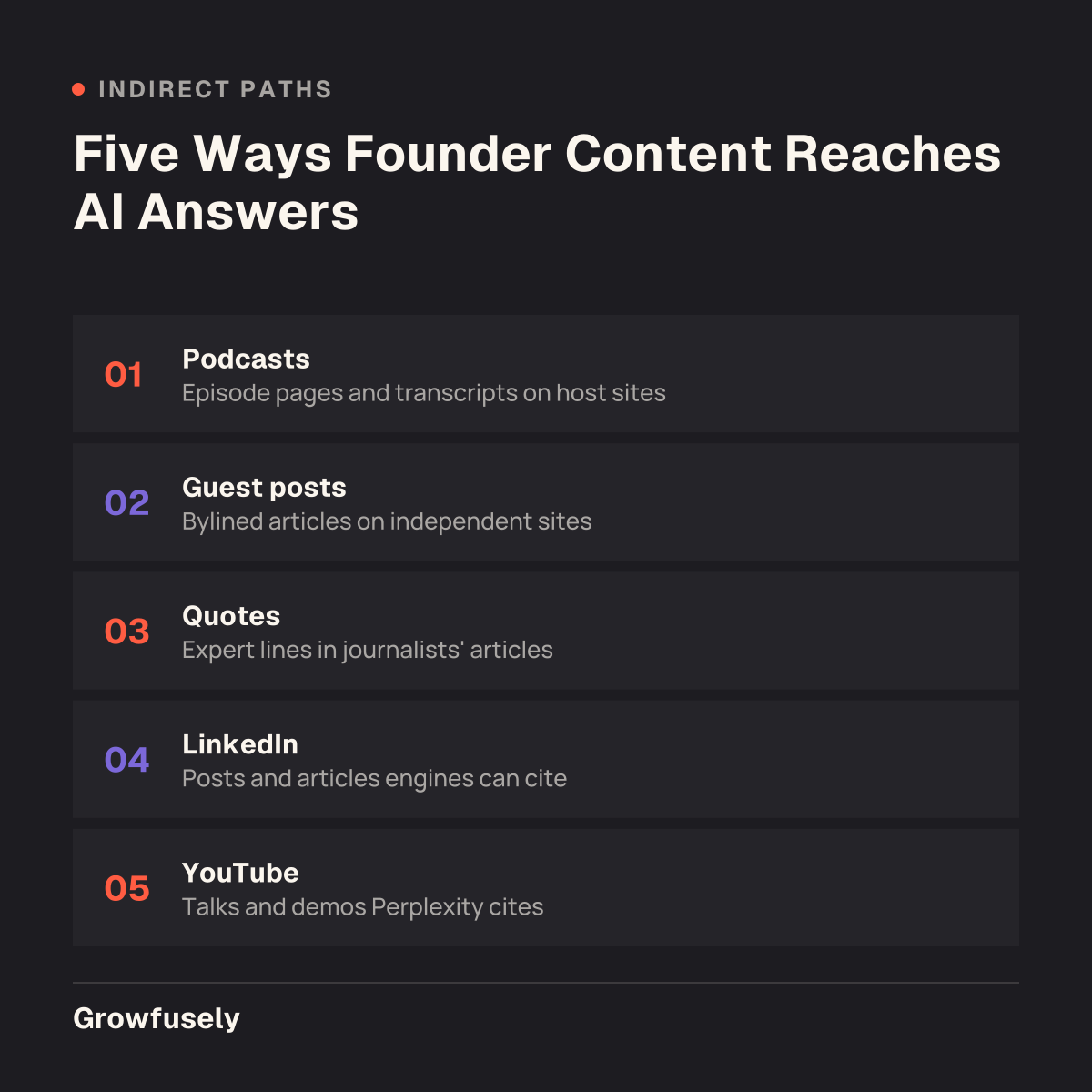
Through five main paths, all indirect: podcasts, guest posts, quotes in independent articles, LinkedIn and YouTube. Each one creates a page that an engine can retrieve. Which path matters most depends on the engine.
Podcasts
A podcast reaches AI through its episode page. Show notes, a summary and a transcript on the host’s site make it the kind of text an engine can read. An audio file on its own gives engines very little to quote.
Before saying yes to a show, check its episode pages. If they carry a transcript or detailed notes and rank for topics in your field, the appearance can keep working long after the recording.
Guest Posts
A bylined article on an independent site lands in the source type engines cite most. In our study, independent content was the largest source for B2B software, ahead of vendors’ own pages and review sites.
The byline bio matters as much as the article. One sentence naming the founder, their title and the company, with a link to the company site, is what lets engines connect the expertise to the business.
Quotes in Independent Articles
Journalists and editors building roundups often quote practitioners. When that roundup is the page an engine retrieves for a buying question, the quote travels with it, along with the company name next to it.
This is the path I’d bet on most for B2B founders, because it puts the founder inside the exact articles engines already cite. Our list of digital PR agencies covers who can help you earn these placements.
LinkedIn as a Public Profile
LinkedIn is now a cited source in its own right. Profound found LinkedIn was the most cited domain for professional queries across six AI models (Profound, 2026).
What gets cited is changing. In Profound’s data, profiles fell from 33.9% to 14.5% of ChatGPT’s LinkedIn citations between November 2025 and February 2026, while posts and articles rose. Semrush found articles made up 50% to 66% of cited LinkedIn content.
Engines also differ. In Semrush’s data, Company Pages made up 59% of Perplexity’s LinkedIn citations, while individual members made up 59% on ChatGPT Search and Google AI Mode. A founder’s posts may matter more on ChatGPT, and the company page more on Perplexity.
So treat the profile as an identity anchor, with the right title, company and a one line description. Treat posts and articles as the part that gets cited. Our B2B LinkedIn content strategy covers what to post.
YouTube for Perplexity
YouTube matters on one engine in our data. All 47 YouTube citations in our study came from Perplexity, and ChatGPT cited none (Growfusely, 2026).
A founder explaining a problem on camera, a conference talk or a product walkthrough can all count. Titles and descriptions that name the topic, the founder and the company help. For more on how the engines split, see ChatGPT vs Perplexity citations.
Why Does the Link Between Founder and Company Matter?
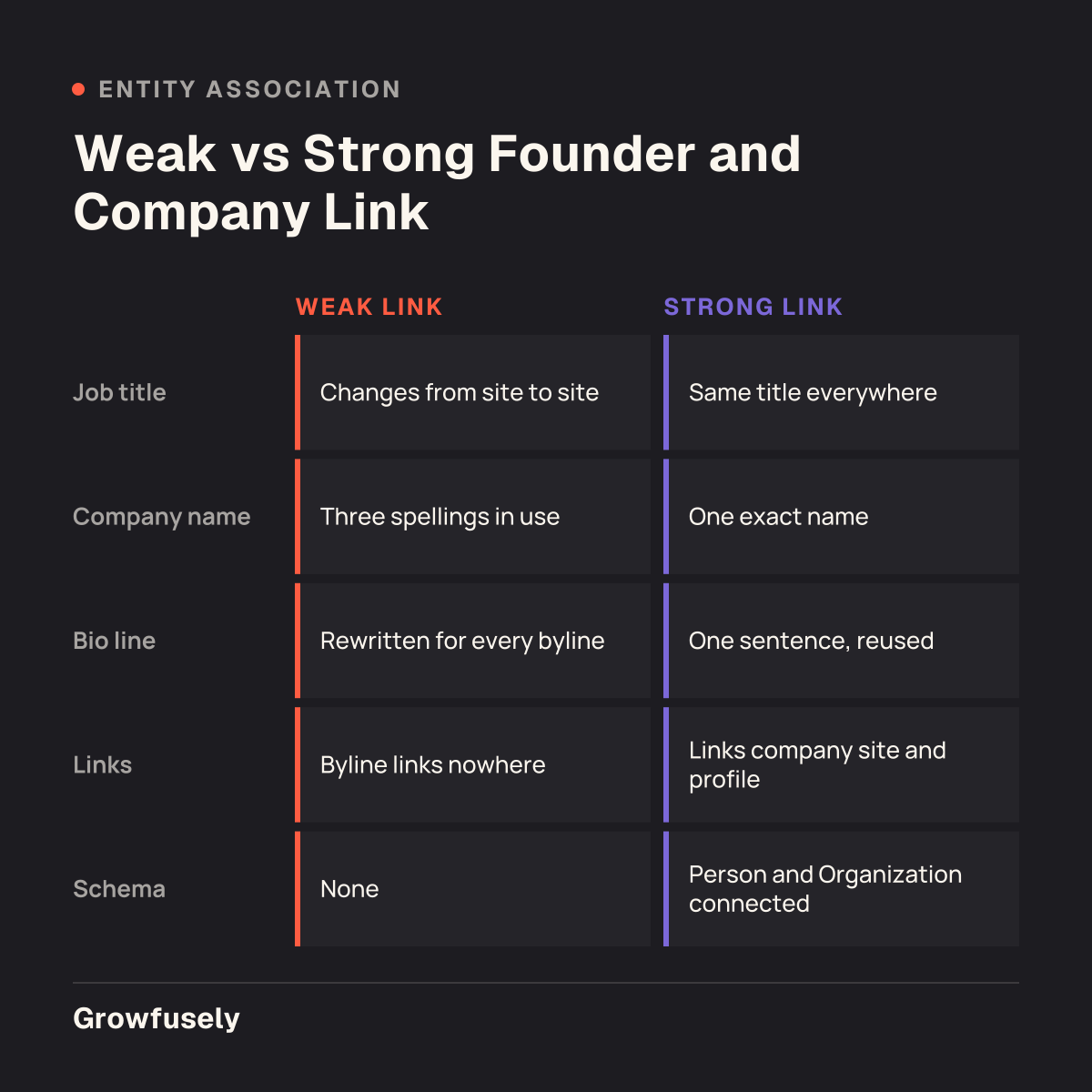
Because a founder’s visibility only helps the company if engines know the two belong together. If one article calls her “CEO of Acme”, another “founder of Acme Labs” and a third gives no company, the credit gets split or lost.
Engines resolve people and companies as entities in their knowledge graph. Consistent signals make that easy:
- The same name and title on the company site, LinkedIn, podcast pages and every byline
- One bio sentence, reused, that names the company exactly as it appears on your site
- Bylines that link to the company site and the founder’s LinkedIn profile
- Structured data on your site: a Person with worksFor and sameAs, and an Organization with founder
When engines describe your company vaguely or mix it up with another, that’s often entity drift. The same fixes cover the founder.
When Does Founder Visibility Not Help?
When the company has nothing for engines to cite, when the founder talks off topic, or when engines can’t connect founder and company.
Founder content can’t fill the gap left by missing comparison pages. If a buyer asks “[competitor] alternatives” and your site has no answer, a founder’s podcast won’t put you in that list.
Topic drift is the second trap. A founder whose thought leadership is about fundraising, hiring and management builds a following, but engines answering a question about payment fraud tools have no reason to retrieve those posts.
In my experience, the founders who see results talk about the buyer’s problem, again and again, on other people’s sites. Volume on their own feed matters far less.
How Can You Test This for Your Own Company?
Pick a handful of prompts and run them before and after a founder push. Note which sources the engines cite each time. It won’t prove anything for every company, but it will show you the evidence for yours.
Add two prompt groups to your AI visibility scorecard:
- Founder prompts: “Who is [founder name]?” and “What company does [founder name] run?” These test entity associations.
- Expertise prompts: questions in the founder’s topic area, such as “How should a regional bank evaluate fraud detection vendors?” These test whether founder content gets retrieved.
Run them monthly for three months before a push and three months after. Log every cited URL that carries the founder’s name. If the citations of founder pages rise and the category mention rate follows, you have a useful signal.
Be honest about the limits. Other work happens at the same time, and engines change. Treat the result as evidence for your own decisions, and avoid publishing it as proof.
Where Should a Founder Start?
Start with entity consistency, then quotes and guest posts on independent sites, then LinkedIn articles and video. That order puts effort where the evidence is strongest first.
| Priority | Action | Why it can reach AI answers | Effort |
|---|---|---|---|
| 1 | Align name, title, bio and links everywhere; add Person and Organization schema | Lets engines connect founder and company | Low, one time |
| 2 | Pitch expert quotes to roundups that rank for your category | Places the founder inside pages engines already cite | Medium, ongoing |
| 3 | Write two to four guest articles a year on independent sites | Adds to the largest citation pool | Medium |
| 4 | Publish LinkedIn articles on buyer problems | LinkedIn content is cited for professional queries | Medium, ongoing |
| 5 | Choose podcasts with transcripts or detailed episode pages | Turns audio into retrievable text | Low per episode |
| 6 | Put talks and walkthroughs on YouTube with clear titles | Perplexity cites YouTube; ChatGPT didn’t in our data | Medium |
Skip any channels that your buyers never use. A manufacturing founder may get more from trade publication quotes than from LinkedIn posts.
Why Partner with Growfusely for Founder Led AI Visibility?
We treat founder visibility as one input to the company’s AI visibility, measured on the same prompts. This is what keeps it honest: if founder work doesn’t move citations, you’ll see it. Our approach draws on our analysis of 1,739 AI citations, where independent content was the largest source type.
| What you need | What we do |
|---|---|
| Engines that connect founder and company | Entity audit across site, profiles, bylines and schema |
| Placements engines actually cite | Expert quotes and guest articles on independent sites that rank for your category |
| Content worth citing | Founder led articles built from your expertise, with your review |
| Proof for your own case | Founder and expertise prompts added to a monthly scorecard |
Conclusion
A founder’s name on its own doesn’t move an AI answer. A founder quoted on the page that an engine retrieves can. That’s the real case for founder visibility, and it’s narrower than a lot of LinkedIn advice suggests.
So fix the basics first: one name, one title and one bio line everywhere. Then get the founder quoted on the sites your category’s answers already cite, and run the founder prompts for three months to see whether it’s working. If you’d like a second opinion, schedule a call.
FAQs
Does LinkedIn Content Get Cited by ChatGPT?
Yes, for many professional queries. Semrush found LinkedIn in about 14.3% of ChatGPT Search responses in early 2026, and individual members made up most of those LinkedIn citations. Neither Semrush nor Profound isolated B2B buying queries, so treat it as a strong signal for expertise topics rather than for vendor shortlists.
Should the Founder or the Company Page Post on LinkedIn?
Both, for different engines. In Semrush’s data, individual members made up 59% of LinkedIn citations on ChatGPT Search and Google AI Mode, while Company Pages made up 59% on Perplexity. Keep the company page factual and current, and let the founder publish the expert articles and posts.
Do Podcasts Help with AI Search Visibility?
They can, when the episode lives on a page engines can read. Show notes, summaries and transcripts on the host’s site turn a conversation into text an engine can retrieve and quote. Choose shows whose episode pages are indexed and rank for topics in your field.
Can a Founder’s Personal Brand Replace Company SEO in AI Search?
No. Engines answering buying questions cite comparison pages, independent reviews and roundups about the company’s category. Founder content adds mentions and expertise. The comparison pages and category content still have to come from your own site, so build that foundation first and add the founder layer on top.
How Do I Connect a Founder to Their Company for AI Engines?
Use one name, title and bio sentence everywhere, and make every byline link to the company site. On your own site, add structured data: a Person with worksFor pointing to the company and sameAs pointing to the founder’s profiles, and an Organization with a founder property.
Is There Research Proving Founder Visibility Increases AI Citations?
Not directly, as far as we know. Studies show AI engines cite LinkedIn content and individual creators, and our own data shows Perplexity cites YouTube and independent content heavily. No published study we know of links founder visibility to more company recommendations in B2B buying answers.

Pratik Dholakiya is the Founder of Growfusely, a SaaS SEO and AI Search Visibility agency.
