
A year ago, checking AI visibility mostly meant opening ChatGPT, typing five prompts, taking screenshots, and dropping them into a Slack thread.
That’s fine, until the CMO asks a fairly reasonable follow-up: “Is this getting better?”
With that manual approach, you didn’t have any history, competitor data, prompt coverage, citations, or sentiment tracking. You just had some idea whether the source ChatGPT keeps quoting is a page you can improve, a publisher you should pitch, or Reddit doing Reddit things again.
Hence the explosion of AI visibility tools.
Profound, Otterly.AI, Peec AI, ZipTie, Similarweb, Semrush, Ahrefs, Clearscope, Writesonic, Scrunch. A lot of dashboards, a lot of new metrics, and enough terminology to make an experienced SEO feel like they have accidentally joined a different profession.
The tools are useful. And from our experience, some are indeed very good.
But AI visibility measurement is still young enough that buying the fanciest dashboard can give you an extremely precise view of the wrong thing.
A visibility score built from 500 prompts means very little if 430 of them have no relationship to how your buyers evaluate software. Tracking six AI engines sounds comprehensive until you learn that nearly all the commercial discovery in your category happens on two. And a sudden 20% drop in “share of voice” can look terrifying until you remember that AI answers are probabilistic, models change, citations rotate, and prompt wording can alter the result.
In fact, we saw the platform differences firsthand when we analyzed 1,739 AI citations across 128 B2B software queries. ChatGPT-family search and Perplexity regularly cited different source types for the same questions. Vendor pages carried more weight on one. YouTube and Reddit showed up meaningfully on the other.
So the job is not to find one perfect AI visibility number.
You need a tool that gives your team enough signal to answer better questions:
- Where are we showing up?
- Where are we absent?
- Which competitors keep getting recommended?
- What sources are shaping those answers?
- Which pages or third-party mentions can we realistically influence?
- And after we change something, did visibility move in a useful direction?
That is the lens we used for this guide.
Quick Comparison of the Best AI Visibility Tools
| Tool | Best suited for | Core strength | Ideal user |
| Profound | Larger brands running serious AI visibility programs | Deep answer-engine intelligence, real-user prompt data, citations, competitive analysis, and AI workflows | Enterprise SEO, brand, content, and AEO teams |
| Otterly.AI | Affordable AI visibility monitoring | Straightforward daily prompt, citation, competitor, and brand tracking | Small teams, consultants, and companies getting started |
| Peec AI | Agencies and multi-brand marketing teams | Clean reporting, multi-project tracking, competitor visibility, and agency workflows | Agencies, consultants, and in-house teams managing several markets |
| ZipTie | Teams wanting granular control over what they monitor | Flexible prompt-by-engine pricing, citation analysis, UGC intelligence, and technical depth | SEO teams and agencies with precise tracking needs |
| Similarweb | Combining AI visibility with traffic and market intelligence | AI brand visibility plus real AI referral traffic and competitive intelligence | Mid-market and enterprise digital teams |
| Semrush AI Visibility Toolkit | Connecting AI monitoring with existing SEO workflows | AI visibility, prompt research, competitor gaps, site audits, and SEO data in one ecosystem | Existing Semrush users and integrated SEO teams |
| Ahrefs Brand Radar | Large-scale AI brand benchmarking | Huge prompt index, custom prompt tracking, citations, SEO, Reddit, YouTube, and TikTok visibility | SEO teams already working heavily in Ahrefs |
| Clearscope | Content teams connecting AI visibility to optimization | Prompt tracking tied closely to content research and optimization | Content, editorial, and SEO teams |
| Writesonic | Teams wanting AI visibility tied directly to execution | AI visibility, citations, AI traffic, content optimization, and built-in action workflows | SEO, content, and growth teams that want monitoring and optimization in one platform |
| Scrunch | Teams wanting monitoring plus site-level AI diagnostics | AI visibility, citations, agent traffic, site diagnostics, and optimization recommendations | Brands and agencies moving from monitoring into execution |
The market is changing way too quickly to treat this table as a permanent league table, so keep that in mind. This analysis is accurate as of September 2026.
Several of these products barely resembled their current versions a year ago. Ahrefs and Semrush have pulled AI visibility much closer to their established SEO suites. Similarweb now combines AI answer visibility with referral-traffic intelligence. Tools such as Profound, Scrunch, and Writesonic are pushing beyond monitoring into workflows that help teams act on what the data finds. Pricing models keep moving as vendors learn whether customers prefer prompts, checks, credits, projects, or some delightful combination of all four.
So “best” needs context.
A founder who wants to know whether ChatGPT mentions their company across 20 commercial questions does not need the same stack as a global SaaS brand tracking five product lines, eight markets, dozens of competitors, and thousands of answer-engine responses.
Buy what fits the measurement problem you actually have.
What AI Visibility Tools Actually Do
AI visibility tools typically do more than what meets the eye.
They track how your brand appears in AI answers
The basic job is fairly simple.
You give the platform a brand, competitors, topics, and usually a set of prompts. The tool runs those prompts through selected AI engines, records the answers, and turns the resulting mess into something you can analyze.
Instead of manually asking:
“What are the best contract lifecycle management platforms for enterprise companies?”
…every Tuesday afternoon, the software keeps checking for you.
A decent platform should tell you whether your brand appeared, which competitors appeared, where you were positioned, whether the answer cited you directly, and how that pattern changes over time.
Some go further into sentiment and factual accuracy.
Profound, for example, can surface claims AI engines make about the brand and flag inaccuracies. Similarweb lets teams compare sentiment across topics and competitors. Other tools focus more heavily on mention frequency and share of voice.
One distinction is worth keeping straight from day one:
A mention is not the same as a citation.
ChatGPT can recommend your software without linking to your site. It can cite your article while recommending a competitor. A publisher can be the cited source that caused your brand to appear in the answer.
Those are three very different signals.
If your dashboard collapses all of them into a single visibility score, dig underneath the score before making strategy decisions.
They help identify prompts and topics that matter
Prompt tracking looks straightforward until someone has to decide what to track.
Then the spreadsheet gets weird.
Do you monitor:
- “best CRM”
- “best CRM for B2B”
- “best CRM for SaaS”
- “best CRM for SaaS startups”
- “best CRM for a 20-person SaaS sales team”
- “HubSpot alternatives”
- “Salesforce vs HubSpot”
- “what CRM should a Series A SaaS startup use”
All of them could be relevant. Tracking all possible phrasings becomes expensive and analytically useless very quickly.
The better tools are getting smarter about prompt discovery rather than leaving you to invent a giant list.
Profound uses real-user prompt data alongside custom prompts. Similarweb exposes normalized user prompts around tracked topics. Ahrefs has gone in a different direction with a very large search-backed AI Visibility Index plus custom prompts. Peec AI includes prompt, topic, and competitor suggestions.
That is useful, but software cannot decide your commercial priorities for you.
A Head of SEO may be tempted to track every informational query where the brand could theoretically appear. A VP Marketing usually cares far more about the 30 prompts where somebody is actively building a shortlist.
We would start there.
Category recommendations. Alternatives. Comparisons. Use cases. Pricing questions. “Best for” prompts. Problems where your product should logically enter the answer.
You can broaden the set later once you have enough data to know what deserves more coverage.
They show citation and source patterns
For us, this is where AI visibility tools become much more interesting than glorified rank trackers.
Knowing that your brand appears 18% of the time is useful.
Knowing why competitors appear when you do not is actionable.
Suppose Perplexity recommends three competitors for “best API security tools” and keeps citing the same two editorial roundups. Your website may not be the immediate problem. You may need to be included in those roundups.
Or ChatGPT keeps citing competitor-owned comparison pages. Now you have a content gap you can control directly.
Or AI Overview repeatedly pulls from Reddit and a technical publication where your brand barely exists. That starts to look like an authority and distribution problem.
Citation analysis turns AI visibility from a scoreboard into research.
Our own citation analysis across B2B software found that independent content and vendors’ own pages accounted for nearly 79% of the citations we collected, while traditional review platforms represented a much smaller share than many marketers would expect. More interestingly, ChatGPT-family search and Perplexity showed materially different citation patterns.
A tool that lets you inspect citations by engine, topic, prompt, domain, and URL gives you much more to work with than a single “AI score.”
You can feed that data into content strategy, digital PR, comparison-page development, link building, partnership outreach, and brand positioning.
That is where the reporting starts earning its subscription.
They turn AI visibility into a measurable workflow
Without tooling, AI visibility work tends to become anecdotal.
Someone finds a nice ChatGPT answer.
*Screenshot*
Someone notices a competitor disappearing from Gemini.
*Screenshot*
A prospect says they discovered you through Perplexity.
Another screenshot, this one circulated with more enthusiasm.
But none of that creates a reliable baseline.
Visibility tools give teams repeatable measures such as:
- Brand presence
- Share of voice
- Citation share
- Average position
- Competitor visibility
- Sentiment
- Source influence
- Prompt-level performance
- AI referral traffic
- Changes over time
Useful, yes. Absolute truth, no.
AI answers are unstable by design. The same prompt can return different wording, brands, and citations across runs. Results may change by location, model, browsing behavior, account context, or simply because the platform updated something yesterday afternoon.
Profound responds to that volatility by running tracked prompts daily and aggregating results. Clearscope uses rolling averages in its Prompt Tracking product. Peec and Otterly also emphasize daily monitoring.
That is a healthier way to read AI visibility data.
You are looking for a pattern, not obsessing over whether ChatGPT mentioned you at 9:04 a.m. and forgot you at 9:11.
Think more like Search Console trends, less like a fixed SERP rank.
How to Evaluate an AI Visibility Tool
These are the questions you should ask before signing up for the free trial.
Does it cover the AI platforms your buyers actually use?
Feature tables love platform counts.
Nine models sounds better than four. Thirteen sounds better than nine. Eventually somebody will advertise 27 and nobody will admit they have never opened 19 of them.
Coverage only helps when those platforms matter to your category.
If your enterprise software buyers are using ChatGPT, Google AI Mode, and Perplexity during research, paying extra to monitor every available model can create cost without much decision value.
The reverse problem is worse.
A cheap plan may look perfect until you discover Gemini or Claude is an add-on, Google AI Mode is absent, or the engine that matters most to your audience sits behind the enterprise tier.
Check three things:
- Which engines are supported?
- Which ones are included in the plan you can actually afford?
- Are responses captured from consumer interfaces, APIs, or another methodology?
The third point gets overlooked.
Profound explicitly captures responses from consumer answer-engine experiences for its visibility product. Ahrefs says its monitored prompts are run through the public web versions of supported AI platforms without stored user context. Other vendors may use APIs for some models.
That does not automatically make one method right and another wrong. It does mean you should understand what the number represents before comparing it to what your sales team sees manually.
Does it track prompts, citations, and competitors clearly?
You should be able to answer three questions without exporting six CSVs:
- Where do we appear?
- Who appears instead of us?
- What sources influenced the answer?
If the platform is good at those three, you already have a useful operating system.
Prompt-level tracking gives you the buying questions.
Competitive benchmarking gives you context.
Citation analysis gives you possible causes.
What we would avoid is a dashboard where everything rolls into one proprietary score and the only recommendation is “improve visibility.”
Improve it where? Against whom? For which buying question? By changing what?
If the tool cannot get you closer to those answers, you are paying for prettier uncertainty.
Does it provide useful recommendations, not just dashboards?
AI visibility software is entering the same phase SEO tools went through years ago.
First came data.
Then came so much data that customers needed another feature to tell them what to do with the first set of features.
Several vendors are now moving into action layers.
Profound has Agents that can use visibility data in content and optimization workflows. Scrunch surfaces Signals and recommendations, then ties monitoring into site diagnostics. Otterly provides recommendations and GEO audits. Semrush combines visibility gaps with prompt research, site auditing, and broader SEO tools. Clearscope connects tracked prompts directly to content planning and optimization.
Recommendations are useful when they preserve context.
“Create more content about expense management” is not particularly useful.
“You lose five high-intent CFO comparison prompts to Ramp and Brex, and three of the most-cited pages are current-year comparison guides you do not have an equivalent for” is much closer to a strategy input.
Still, do not outsource judgment to the recommendations tab.
Tools are very good at finding patterns inside the data they collect. They know much less about your margins, sales motion, product roadmap, regulatory constraints, internal politics, or which enterprise segment your CEO decided to abandon last quarter.
Use recommendations to shorten analysis. Keep prioritization human.
Does it connect AI visibility with SEO performance?
We would be wary of any AI visibility workflow that lives entirely apart from SEO.
Google has made its position increasingly explicit: many of the fundamentals behind traditional search visibility still carry into AI search experiences. And in practice, the connection shows up everywhere.
- A page gets cited because it is retrievable.
- A brand appears because its entity is clear.
- A third-party article shapes recommendations because it has authority.
- A comparison page earns visibility because it covers the buyer’s intent properly.
- A crawler cannot retrieve your brilliant content because the site serves it in a way the system cannot reliably access.
These are familiar problems wearing newer clothes.
We have written separately about how AEO, GEO, and AI SEO fit together, but the practical buying advice here is straightforward: if you already have a mature SEO stack, look at how much AI visibility data can plug into it.
Semrush and Ahrefs have an obvious advantage for existing customers because the AI layer sits beside years of SEO data and workflows. Similarweb can connect AI visibility with broader traffic and competitive intelligence. Clearscope puts AI prompt tracking directly next to content optimization.
A standalone AI visibility tool can still be the right choice, especially if its monitoring is deeper.
Just make sure somebody is connecting the findings back to SEO rather than running two independent dashboards that never speak to each other.
Does the pricing fit your tracking needs?
The sticker price tells you very little in this category.
Prompt economics do.
A plan can start at $29 and become significantly more expensive once you add another model, another market, and 100 extra prompts. Another platform may look costly until you realize projects and teammates are unlimited.
Before buying, sketch the monitoring setup you actually want:
- Number of commercially meaningful prompts
- Number of AI engines
- Number of competitors
- Number of countries or languages
- Daily vs. weekly tracking
- Number of brands or projects
- Number of users
- API or Looker Studio access
- Client-facing reporting, if relevant
Then price that configuration.
Otterly.AI, for example, starts at $29 per month for 15 prompts across four included engines, while Gemini, Claude, and Google AI Mode are add-ons. Its Standard plan jumps to 100 prompts and adds API and MCP access.
Peec AI prices around prompt and model volume, with dedicated agency packages and unlimited users. ZipTie takes an unusually granular usage-based approach where you choose prompts, engines, and tracking cadence rather than paying for seats or projects.
Profound now has a $99 Starter plan, but broader engine coverage and more sophisticated workflows move you toward Growth or Enterprise.
The cheap tool is the one that fits your tracking design without forcing you to rebuild it three months later.
The Best AI Visibility Tools to Consider in 2026
With the evaluation parameters clear in mind, here are the top AI visibility tools available today.
1. Profound: Best for Enterprise AI Visibility Programs
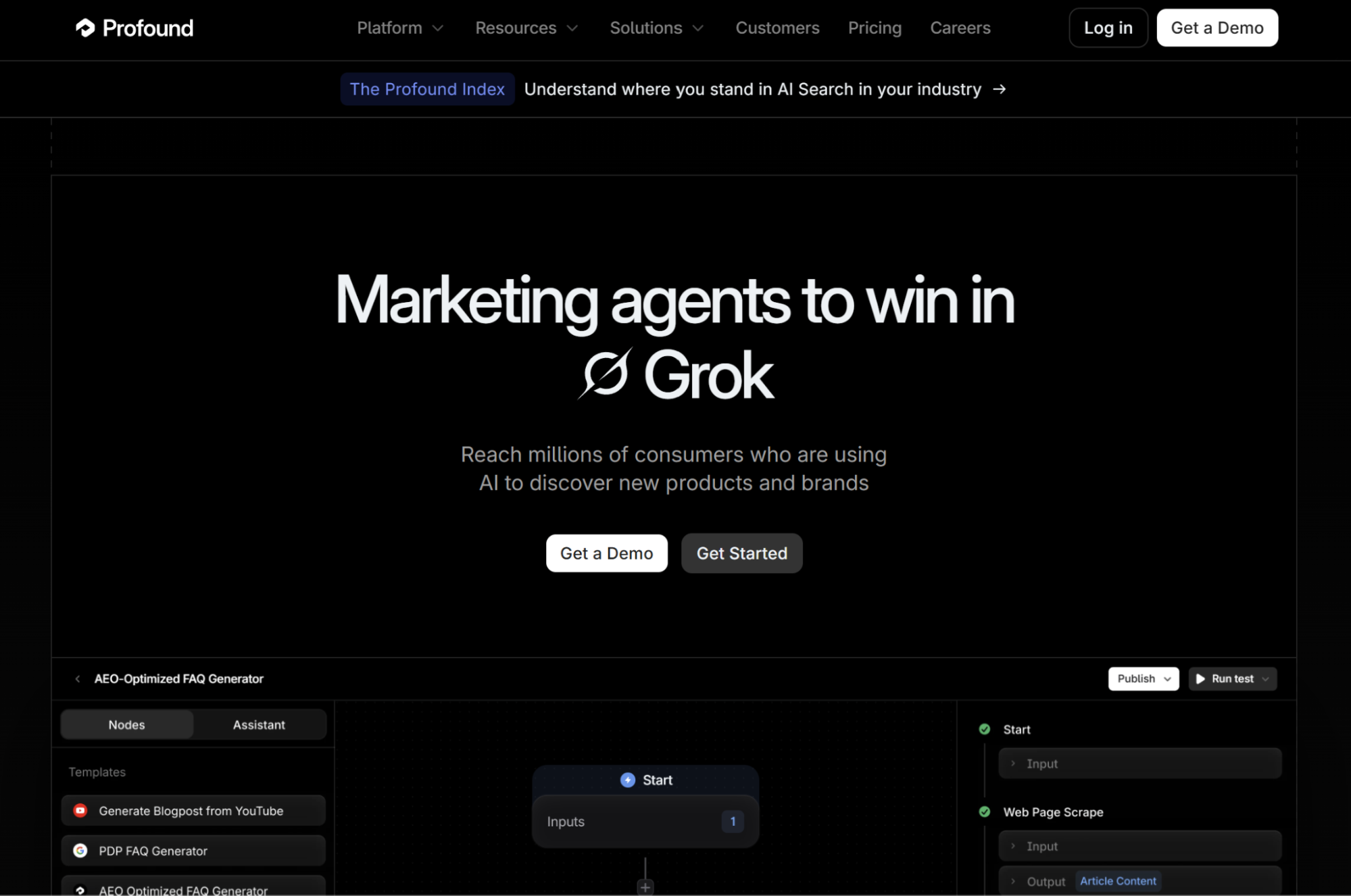
Profound is the platform we would look at first if AI visibility has graduated from “SEO experiment” to an actual company program.
Its Answer Engine Insights product covers the expected monitoring layer: brand visibility, share of voice, sentiment, competitors, citations, platform comparisons, and prompt-level analysis.
Then it goes further.
Profound has built a large real-user prompt dataset rather than relying solely on prompts marketers invent themselves. Its Summer 2026 Profound Index is based on more than 1.9 billion real-user conversations across 50+ industries, giving teams a way to investigate what people are actually asking AI systems rather than treating synthetic prompt ideation as demand research.
That difference is useful for larger brands.
If you sell an enterprise HR platform, your marketing team can invent 500 sensible prompts. It still does not mean buyers use them.
Profound can combine real-world prompt intelligence with custom tracked prompts, then analyze how the brand and competitors appear across answer engines. Citation Authority shows which domains influence answers. FactCheck is designed to surface inaccurate claims and trace the sources behind them. Enterprise plans can cover up to nine answer engines, including ChatGPT, Perplexity, Google AI Mode, Gemini, Copilot, Grok, DeepSeek, Claude, and AI Overviews.
The platform is also moving beyond monitoring through Profound Agents, which can use visibility data for research, content creation, optimization, and other AEO workflows.
Pricing has become more accessible than Profound’s enterprise reputation might suggest. Starter is currently $99 per month billed annually, but it tracks ChatGPT only and 50 prompts. Growth is $399 per month billed annually, with three answer engines and 100 tracked prompts. Enterprise is custom.
Our take: Profound becomes compelling when the questions get complicated.
Which prompts carry real demand? How does visibility differ by region? Which citations are influencing brand perception? Where are competitors gaining ground? What false claims are AI engines repeating? Can visibility data feed directly into an optimization workflow?
A five-person SaaS startup probably does not need that much machinery.
A global software company with multiple product lines very well might.
2. Otterly.AI: Best for Affordable AI Visibility Tracking
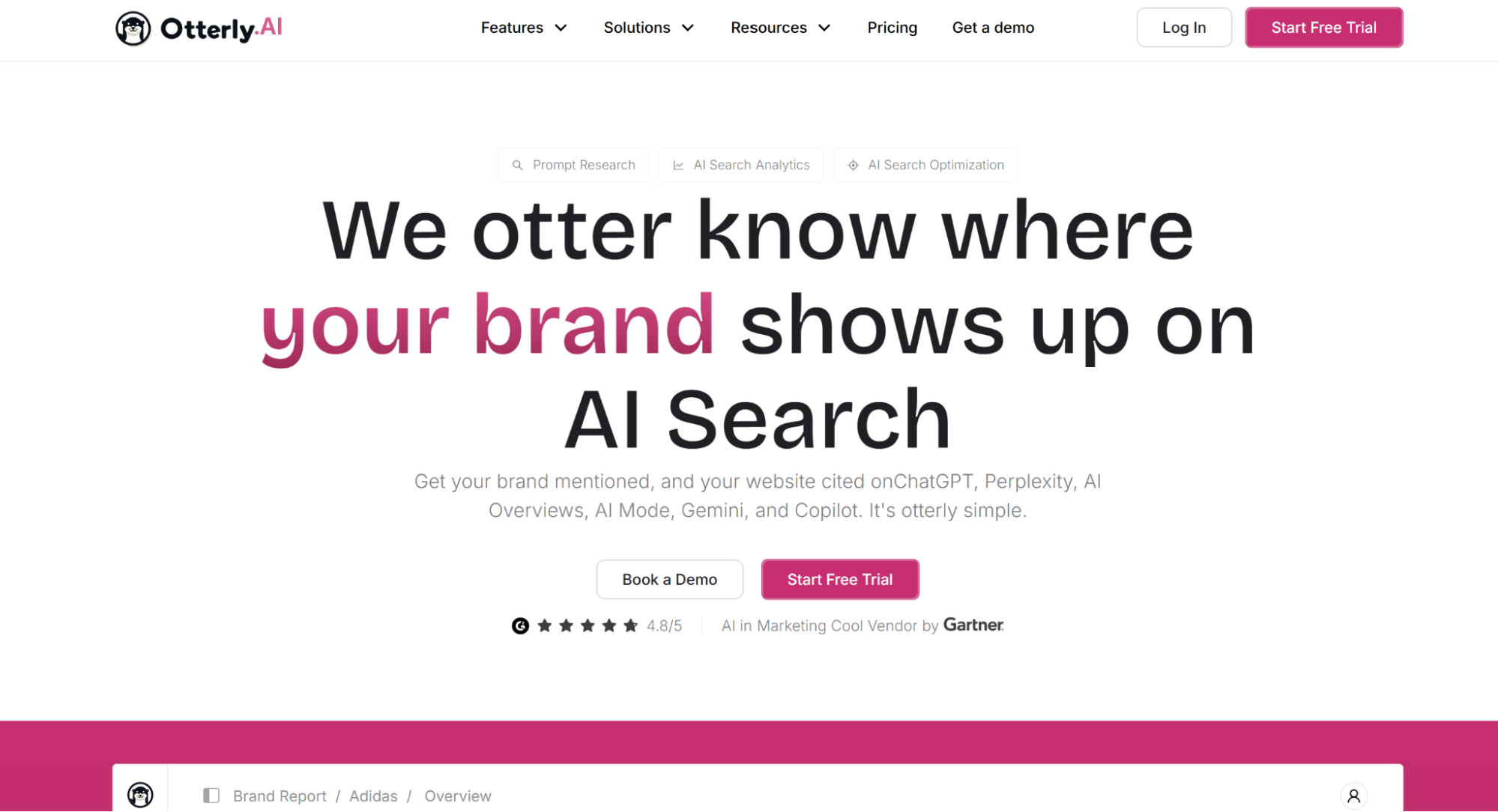
Otterly.AI is almost the opposite buying decision.
You can get started without convincing finance that AI visibility requires a new enterprise software category.
Its Lite plan costs $29 per month and includes 15 prompts with daily tracking across ChatGPT, Google AI Overviews, Perplexity, and Microsoft Copilot. Gemini, Google AI Mode, and Claude can be added separately. Unlimited team members are included, which is unusually friendly at the low end of this market.
The product covers most of what a smaller SaaS team needs for an initial measurement workflow:
- Brand visibility
- Competitor monitoring
- Citation analysis
- Prompt research
- Domain rankings
- GEO audits
- Recommendations
- Multi-country support
- Reporting and exports
Move up to Standard and you get 100 prompts, unlimited workspaces and recommendations, plus API, MCP, Agent Analytics, and Looker Studio support.
There is quite a gap between the $29 Lite plan and the $189 monthly Standard plan, so check whether 15 prompts is genuinely enough before deciding based on the entry price.
For some teams, it is.
If you sell a focused SaaS product in one market and can identify 10 to 15 buying prompts that really matter, tracking those properly is better than collecting 300 vague prompts because your plan allows it.
Otterly is also a sensible option for an SEO consultant who needs to add AI visibility monitoring without buying an enterprise platform before the service has paying clients behind it.
Where it gets less attractive is when your program becomes complicated across many models, brands, products, or markets. Add-ons and prompt expansion can change the economics quickly.
Start small. Otterly makes that unusually easy.
3. Peec AI: Best for Agencies and Teams That Need Shareable Reports
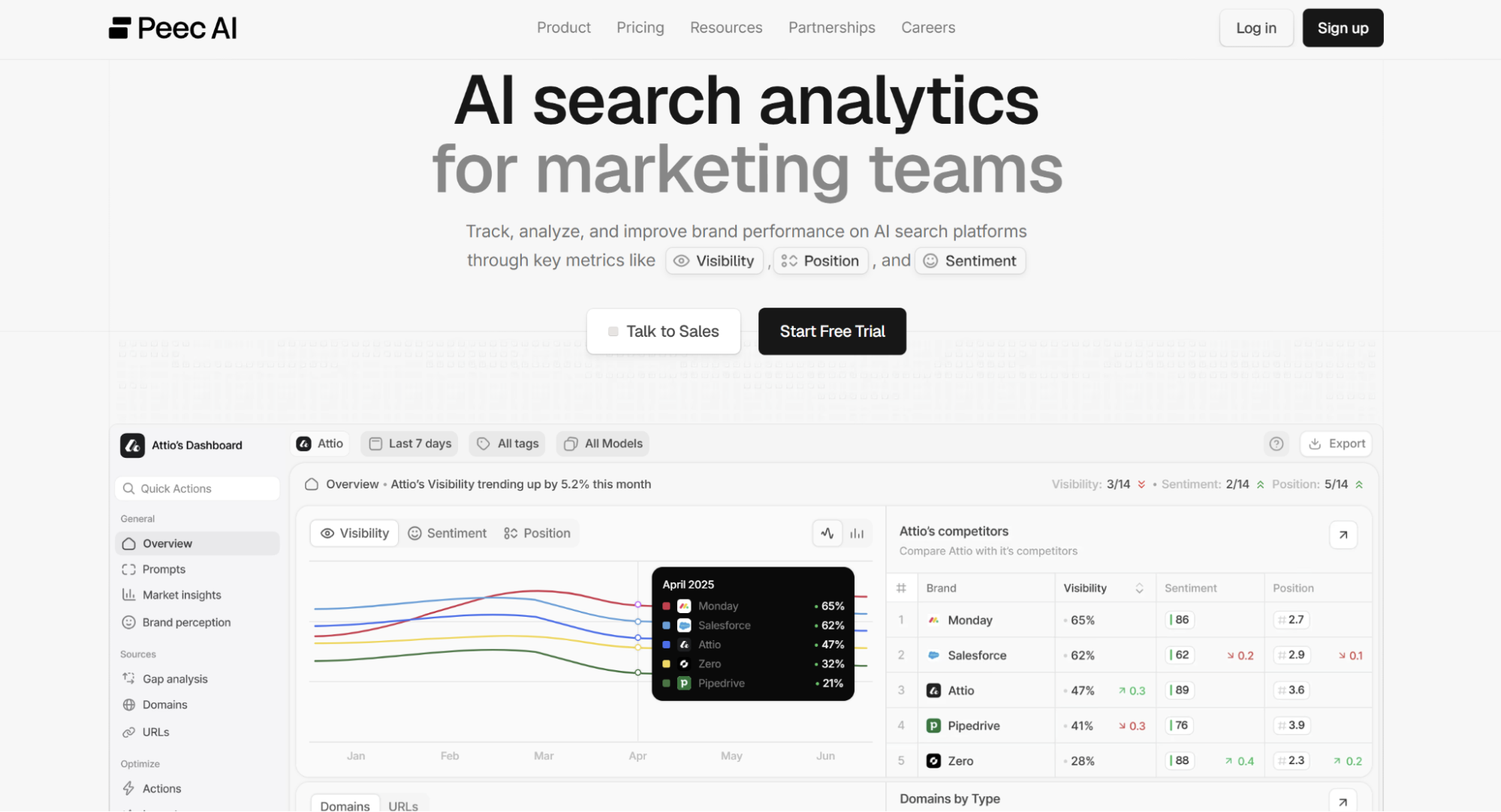
Peec AI feels built by people who know somebody eventually has to show the data to another person.
That sounds trivial until you have used analytics software that is wonderful for analysts and miserable for everybody attending the quarterly review.
The platform tracks visibility, position, sentiment, competitors, prompts, and citation sources across major AI search experiences. Current supported models include ChatGPT, Google AI Overviews, Google AI Mode, Microsoft Copilot, Perplexity, and Gemini on standard plans, with additional models available higher up the product.
Brand plans start with 50 prompts, three selected models, daily tracking, unlimited users, and one project. Pro increases that to 150 prompts and two projects. Advanced moves to 350 prompts, five projects, multi-country support, and Looker Studio integration.
The agency offering is where Peec becomes particularly interesting.
It has dedicated multi-client pricing, unlimited client seats, shared prompt capacity, reporting integrations, and pitch projects that agencies can use when prospecting. That is a much cleaner operating model than buying a separate brand subscription every time another client asks, “So, can you tell us how we rank in ChatGPT?”
Peec also makes prompt demand part of the workflow, with prompt-volume scores, topic suggestions, competitor suggestions, and prompt suggestions. That can help teams avoid building a tracking set entirely from internal brainstorming.
If you run an agency or consultancy, we would pay particular attention to:
- How easily projects can be separated by client
- Whether the reporting is usable without explanation
- How prompt capacity gets allocated
- Whether multi-country tracking fits your client base
- Whether the API, MCP, or Looker Studio connection can feed your existing reports
Peec is less compelling if you want a giant AI-search research corpus before you set anything up. Ahrefs and Profound are stronger in different ways there.
For teams that already know roughly what they need to monitor and want a clean way to operationalize it across clients, Peec makes a lot of sense.
4. ZipTie: Best for Detailed AI Visibility Analysis
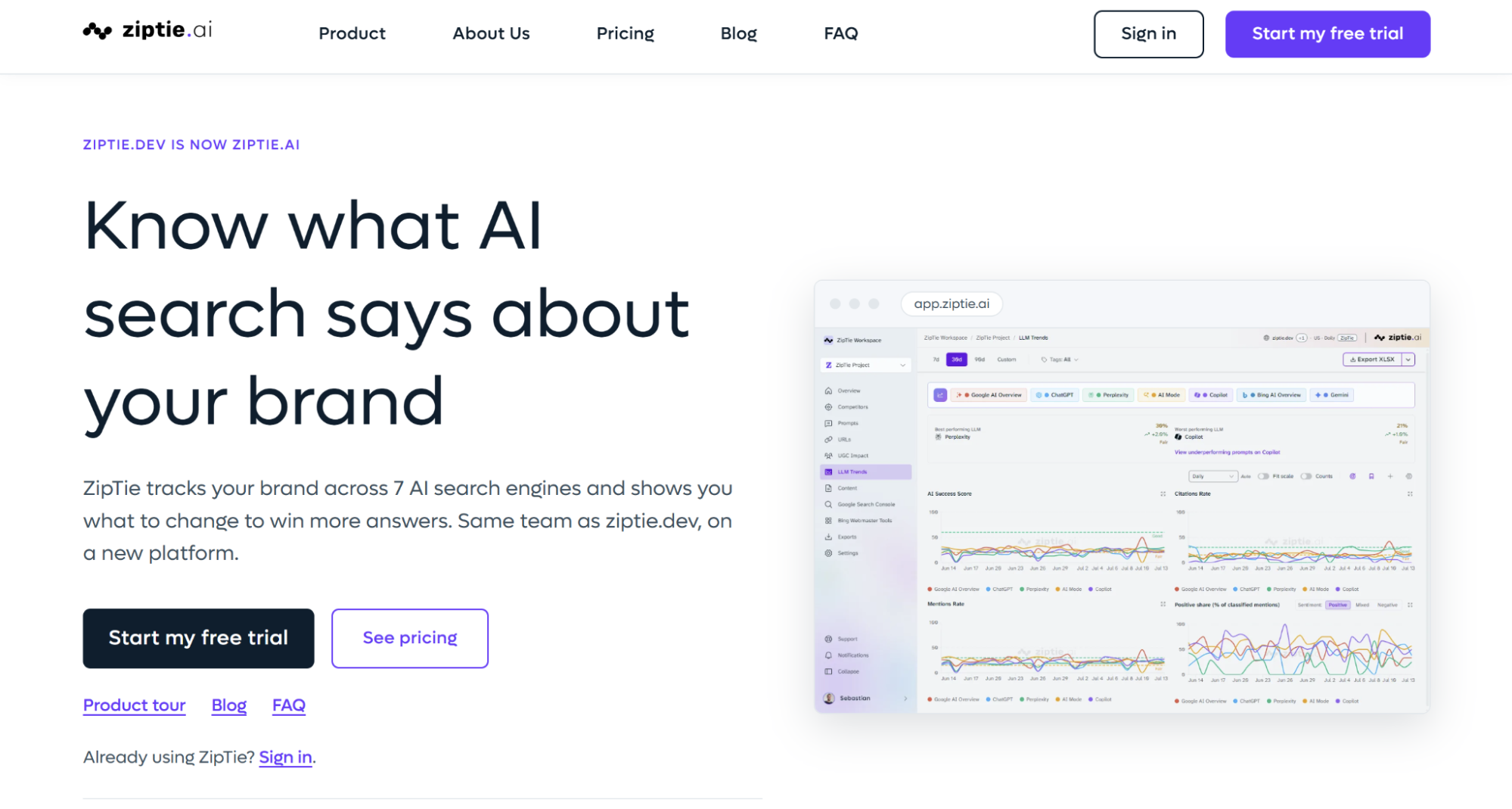
ZipTie has one of the more interesting pricing models in the category because it treats AI tracking like configurable infrastructure rather than a SaaS tier you have to squeeze yourself into.
You choose the engines. You choose how many prompts run daily, weekly, or monthly. You can have unlimited teammates and projects. Then you pay based largely on the monitoring configuration.
That flexibility is valuable when you know what you are doing.
Maybe you want 40 commercial prompts checked daily on ChatGPT and Google AI Mode, another 100 informational prompts checked weekly, and no interest whatsoever in paying for six additional platforms because they do not show up in customer research.
ZipTie lets you build closer to that shape.
Engine coverage currently includes ChatGPT, Google AI Overviews, Perplexity, Google AI Mode, Microsoft Copilot, Bing AI Overview, and Gemini. Its Google and Bing AI Overview checks also capture the top 10 organic results, which is useful if you want to compare AI visibility against traditional search behavior.
Monitoring goes into competitor rankings, responses, citations, and dashboard metrics. There is also an optional UGC Impact Analysis layer designed to show which third-party platforms influence AI descriptions of the brand, with deeper Reddit analysis and topic clustering.
For technical or data-heavy teams, API and MCP access can be added cheaply rather than requiring an enterprise contract.
The trade-off is that configurable tools put more responsibility on the buyer.
If nobody on your team knows which prompts deserve daily tracking versus monthly tracking, flexible pricing will not rescue the strategy. You may simply build a very efficient monitoring system for a poor prompt set.
ZipTie works best when your SEO or growth team already has a strong hypothesis about what it wants to measure and appreciates being able to configure the tool around that hypothesis.
5. Similarweb: Best for Combining AI Traffic and SEO Visibility
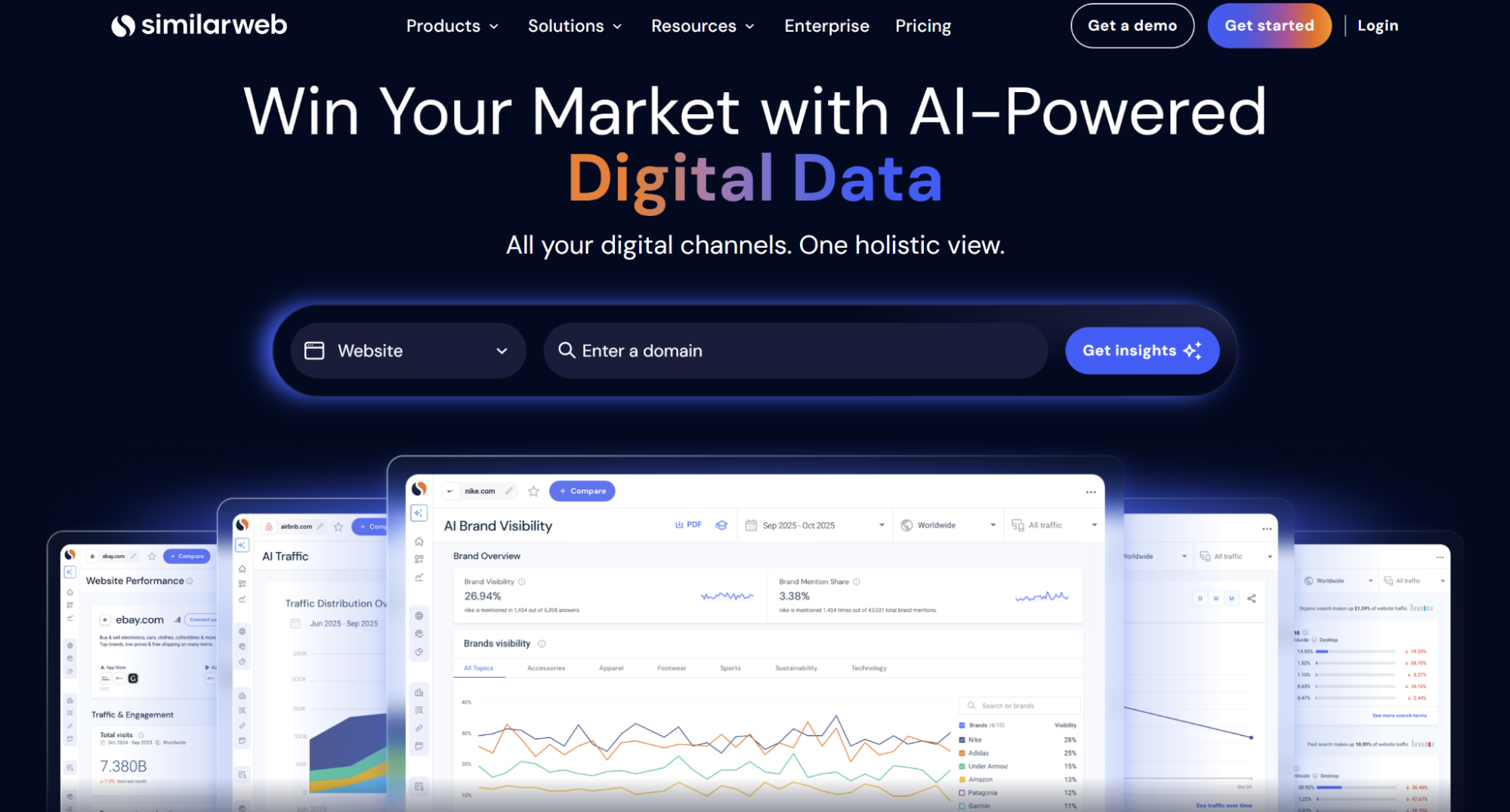
Similarweb brings something different to the category: it already has a large competitive-intelligence business built around how people move around the web.
So its AI Search Intelligence product is not limited to asking, “Did ChatGPT mention us?”
It can also ask what happened when AI actually sent somebody somewhere.
The product combines AI Brand Visibility with AI Traffic. Brand Visibility covers topics, tracked prompts, competitors, citations, sentiment, and sources. AI Traffic looks at referral volume, which AI platforms send traffic, and which landing pages receive those visits.
That combination can be useful for a SaaS marketing leader trying to connect two conversations that often happen separately.
The SEO team says AI visibility increased.
Analytics says ChatGPT referrals are up.
Product marketing says the brand is appearing more often in comparison answers.
Similarweb gives you a better chance of putting those signals in one competitive picture rather than treating them as separate screenshots.
There is another useful distinction in the underlying data. Similarweb says its Gen AI Intelligence combines aggregated, anonymized real-user data with large-scale prompt and response analysis. That allows the platform to surface normalized user prompts rather than depending entirely on a marketer-created tracking set.
Pricing is now relatively transparent.
AEO Intelligence starts at $99 per month billed annually and includes AI Brand Visibility, 150 tracked prompts, sentiment, citation analysis, and AI Traffic. The $333-per-month tier adds SEO Intelligence and wider competitive web data, which is where Similarweb becomes more compelling for teams that want AI and traditional search analysis together.
If you already use Similarweb for market or competitive intelligence, the AI layer is an obvious extension.
If your only requirement is monitoring 25 purchase-intent prompts in ChatGPT and Perplexity, it may be more platform than you need.
The advantage is breadth.
You can move from “Are we mentioned?” to “Who is mentioned?”, “What gets cited?”, “Which prompts are involved?”, “Who receives AI referral traffic?”, and “How does that compare with the wider organic market?” without stitching together quite as many tools.
6. Semrush AI Visibility Toolkit: Best for Existing Semrush Users
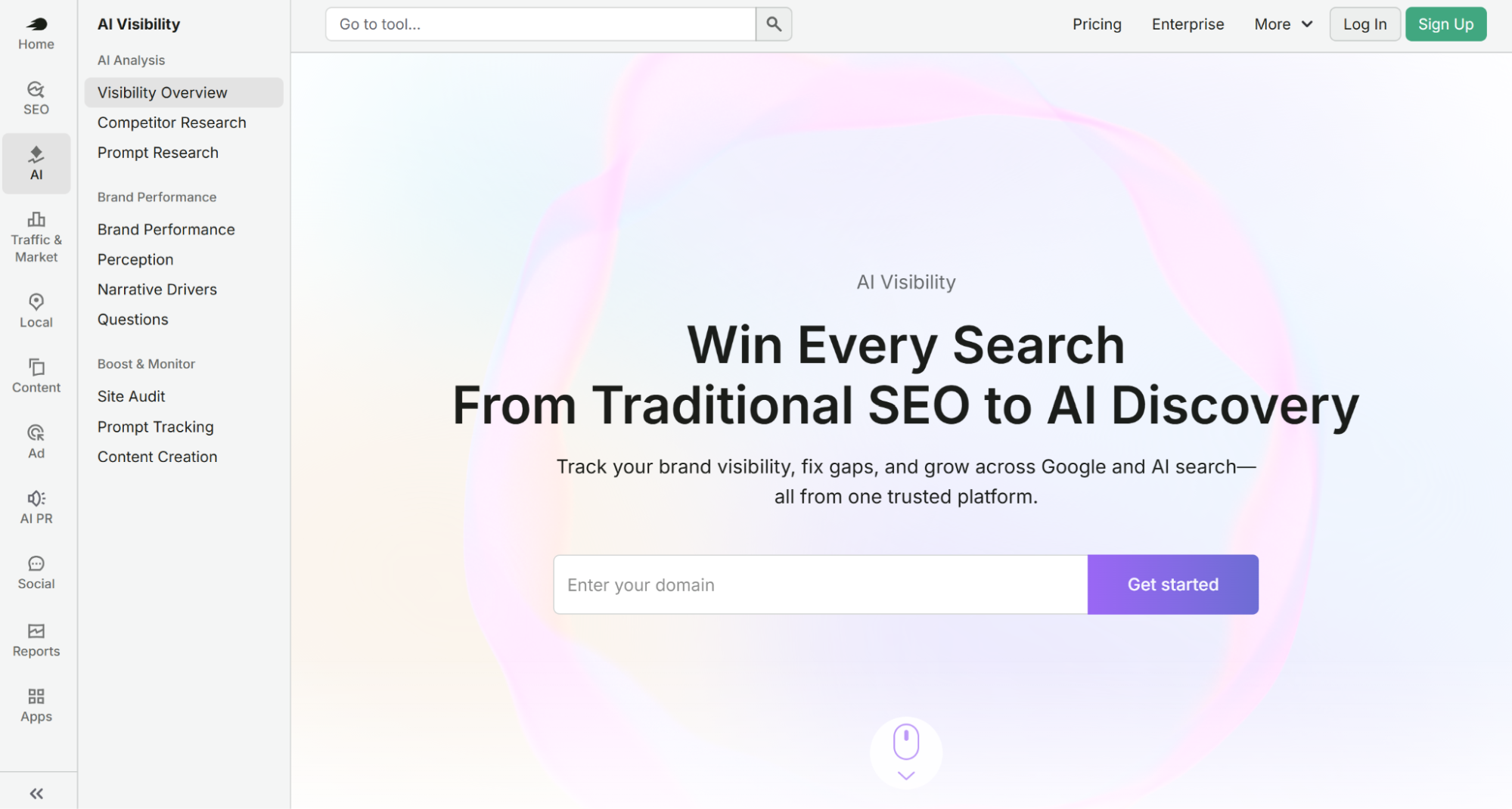
Semrush has one advantage that a brand-new AI visibility startup cannot manufacture quickly: a lot of SEO teams already live inside it.
That makes the AI Visibility Toolkit interesting for a fairly mundane reason. You do not need another isolated dashboard sitting three tabs away from the keyword, competitor, technical, and content data your team already uses.
The standalone AI Visibility plan currently starts at $99 per month per domain when billed annually. It includes 25 custom prompts with daily tracking, brand-performance analysis for one domain, competitor and prompt research, citation data, and AI-readiness checks for up to 100 pages. Coverage includes ChatGPT, Google AI experiences, Gemini, and Perplexity.
For a SaaS team already paying for Semrush, the appeal is the connective tissue.
Say ChatGPT visibility drops around a product category. You can investigate the prompts, compare competitors, look at citations, then move into the traditional SEO side of Semrush to inspect rankings, keyword gaps, links, or technical issues. That is a much healthier workflow than treating “AI search” as a separate project managed by a different person with different data.
Semrush One goes further by bundling the traditional SEO and AI visibility stacks, with higher prompt limits depending on the plan.
Where Semrush feels less specialized is in the depth of AI-native research available from platforms built entirely around answer engines. Profound, for instance, has gone much further into real-user prompt intelligence. Scrunch adds AI agent traffic and site diagnostics. Ahrefs has its enormous precomputed prompt index.
But if your SEO team already knows Semrush and mainly needs AI visibility to become another part of the weekly workflow, rather than another software implementation, there is a strong case for keeping it under one roof.
7. Ahrefs Brand Radar: Best for Large-Scale Brand Benchmarking
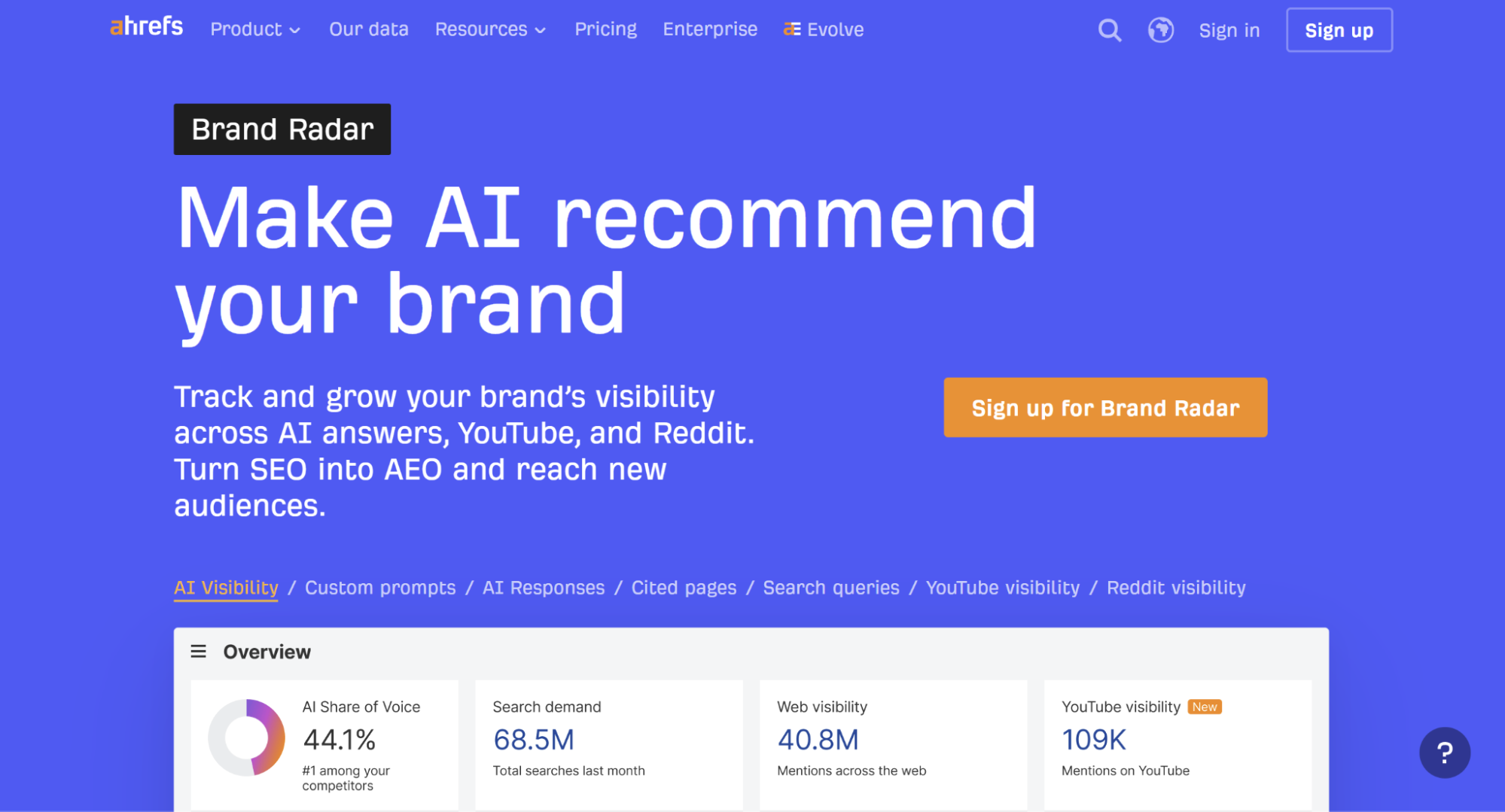
Ahrefs took a different route into AI visibility.
Instead of making you define every prompt before you can see anything useful, Brand Radar gives you access to a prebuilt AI Visibility Index spanning hundreds of millions of search-backed prompts.
As of September 2026, Ahrefs says the index covers more than 450 million prompts across Google AI Overviews, AI Mode, ChatGPT, Perplexity, Gemini, and Copilot. You can search for a brand, product, person, or competitor and immediately see mentions, citations, impressions, share of voice, and the pages or domains appearing around them.
No six-week prompt workshop required.
That makes Brand Radar unusually good for market reconnaissance.
If your CMO asks, “How visible are we compared with Gong, Clari, and Outreach across AI search?”, you can get a broad answer before building a custom monitoring program.
Then there is a second layer: custom prompts.
Paid Ahrefs plans include a small number of daily tracked prompts, and additional custom tracking starts at $50 per month. The full AI Visibility Index starts at $199 per month for individual platform access, while all-platform access is currently $699 per month.
Ahrefs also pulls Reddit, YouTube, TikTok, and traditional web visibility into Brand Radar. For SaaS categories where third-party conversations influence recommendations, that wider view can be useful.
The distinction between its two datasets is important.
The large index is excellent for discovery and benchmarking. Custom prompts are better when your company has a specific set of evaluation-stage questions that leadership wants monitored every day.
If your team already uses Ahrefs for links, technical SEO, rankings, and competitor research, Brand Radar creates a compelling bridge between SaaS SEO and AI visibility rather than forcing the two into separate operating systems.
8. Clearscope: Best for Content Teams Optimizing for AI Citations
Clearscope has spent years sitting close to the content workflow, so its AI visibility product feels more like an extension of content optimization than a standalone market-intelligence suite.
That distinction makes it useful for a particular buyer. If your question is:
“Which AI prompts are we losing, and which content should we improve because of it?”
Clearscope fits naturally.
But, if your question is:
“Map our global share of voice across nine models, twelve countries, and an entire competitor set for the board.”
You will probably want something heavier.
Clearscope’s Essentials plan currently costs $129 per month and includes 50 tracked prompts, 50 monitored pages, topic exploration, and content drafting tools. Business starts at $399 per month with 300 prompts and 300 pages. Users and projects are unlimited on both.
Prompt Tracking currently focuses on ChatGPT and Gemini. It monitors brand mentions over time, while query fan-out data shows the related searches AI systems may trigger when constructing an answer. Those findings can move directly into the content-research and optimization workflow Clearscope is already known for.
That tight loop is the selling point.
A content lead can see that the brand is absent from a cluster of prompts, inspect how the topic is being interpreted, identify content gaps, update the relevant page, then keep tracking the same prompt set.
Fewer handoffs. Less exporting.
The platform coverage is narrower than dedicated AI monitoring products, so we would not choose Clearscope solely because we needed comprehensive answer-engine intelligence. For a content team already using optimization software and wanting AI visibility to influence briefs, refreshes, and topic decisions, it is much easier to justify.
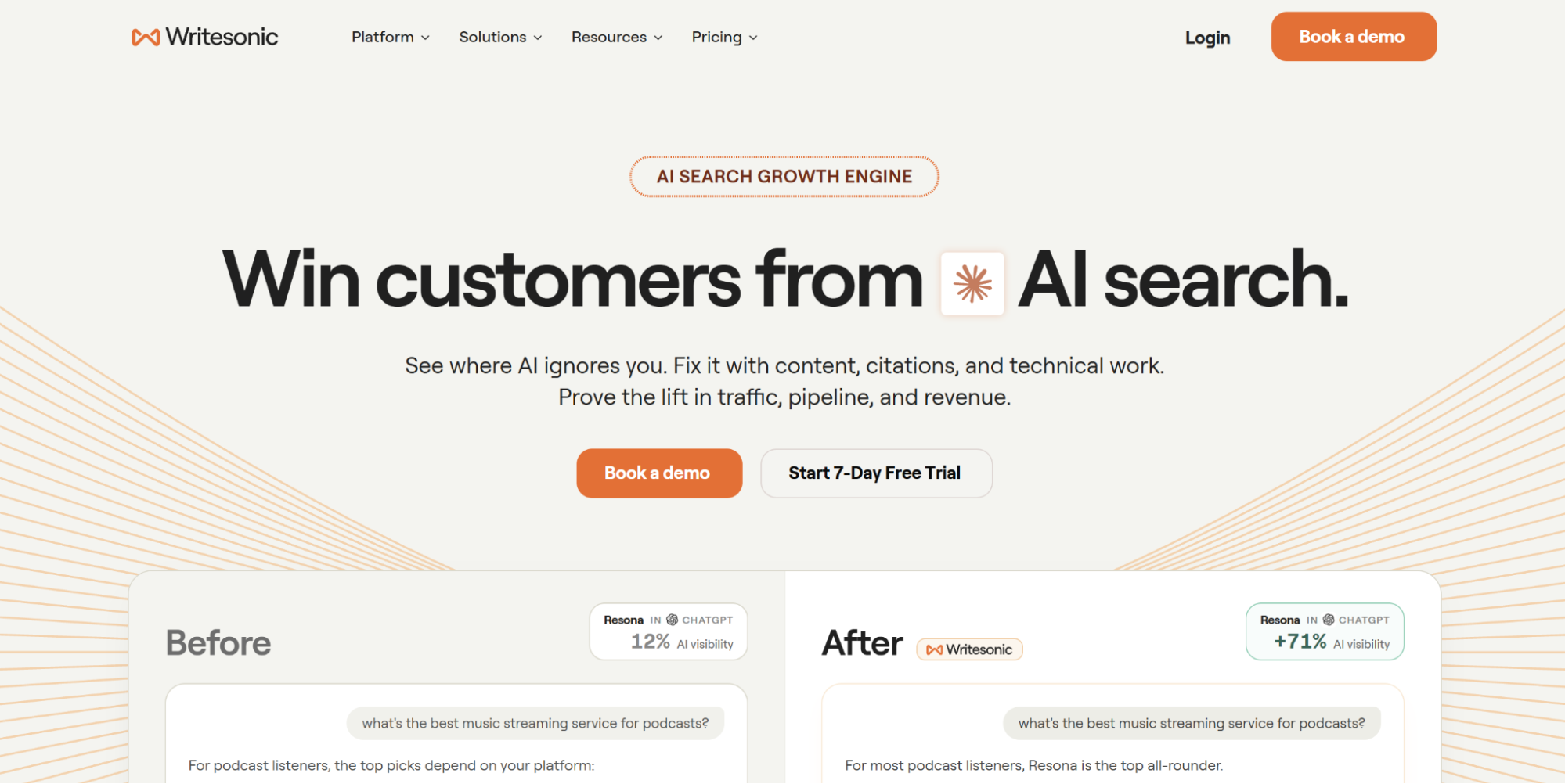
9. Writesonic: Best for Turning AI Visibility Data Into Content and SEO Action
Writesonic is an interesting inclusion here because it started from the other end of the market.
A lot of AI visibility platforms began with monitoring and are gradually adding ways to act on the data. Writesonic already had content creation and SEO workflows, then built AI-search monitoring around them.
That gives the product a fairly obvious use case: your team finds an AI visibility gap and wants to do something about it without moving the problem through three different platforms.
The monitoring side covers brand visibility, share of voice, citations, sentiment, competitors, prompts, and the sources influencing AI answers. Writesonic says it crawls the consumer experiences rather than relying on model APIs, and its Enterprise tier currently covers 10 platforms, including ChatGPT, Perplexity, Claude, Gemini, Google AI Mode, Google AI Overviews, Copilot, Grok, DeepSeek, and Meta AI.
It also has a second data layer we do not see in every visibility tracker: AI Bot Analytics. Server-side tracking shows which AI crawlers are reaching the site, which pages they access, and how AI exposure translates into human referral traffic.
Then comes the execution side.
Writesonic can take visibility gaps into content optimization, site audits, content production, citation-oriented work, and its Action Center and agentic workflows. So if the dashboard shows that competitors dominate a topic, the product is designed to help move from “we have a problem” toward the page, technical fix, or content work required to address it.
Pricing currently starts at $79 per month billed annually for 50 prompts tracked daily across ChatGPT, Gemini, and Google AI Overviews. Basic is $199, Growth is $399, and Enterprise opens up the broader platform coverage, custom markets, prompts, integrations, and workflows.
That breadth is also the trade-off.
If all you want is a lightweight tracker for 20 commercial prompts, Otterly.AI is easier to justify. If you already have mature content and SEO systems elsewhere, some of Writesonic’s bundled functionality may overlap with tools you already pay for.
But for a SaaS team that wants AI visibility, SEO, content, and the response to those insights sitting closer together, Writesonic is one of the more complete options on this list.
10. Scrunch: Best for Moving From AI Monitoring Into Site-Level Optimization
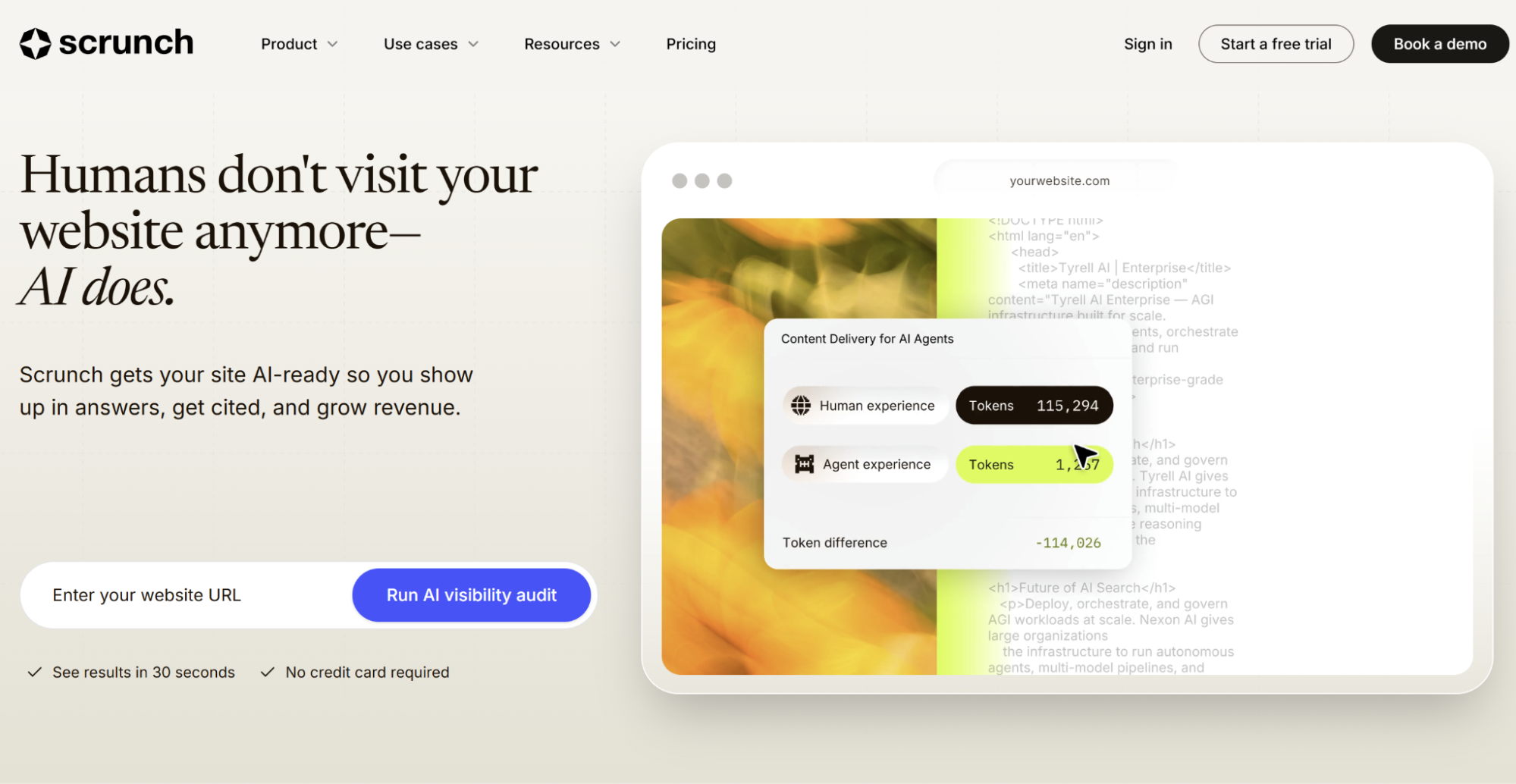
Scrunch stands out because it does not stop at what AI platforms say about your brand.
It also spends a lot of time looking at what AI agents do when they reach your website.
The Core plan currently costs $250 per month and includes 125 prompts, five site audits per month, five user licenses, and monitoring across ChatGPT, Perplexity, Google AI Overviews, and Copilot. Enterprise expands coverage to nine AI platforms, including Claude, Gemini, Google AI Mode, Grok, and Meta AI, with custom limits and API access.
The monitoring layer covers the usual ground: presence, competitors, citations, sentiment, prompt performance, and share of voice.
Then Scrunch adds site diagnostics and AI agent traffic.
You can see which bots are visiting, distinguish retrieval traffic from training or indexing activity, identify pages AI agents access frequently, and find technical or content issues that may make information harder to retrieve.
Its Signals feature pushes further into recommendations, surfacing content opportunities and visibility problems rather than leaving teams to sift through every chart manually.
Scrunch also offers an Agent Experience Platform on its Enterprise tier that can serve structured, AI-optimized content to AI agents while preserving the human-facing website experience.
That is a much more opinionated product direction than simple prompt tracking, and one a technical team should evaluate carefully against its own site architecture and governance requirements. But it also illustrates where this category is heading.
Monitoring is becoming table stakes.
The next fight is over who can connect the answer-engine data to changes on the site quickly enough to improve the result.
If that is the problem you are trying to solve, Scrunch is one of the more interesting products in the market.
When You May Not Need a Dedicated AI Visibility Tool Yet
There is an awkward truth in a guide about AI visibility software:
Some SaaS companies should not buy any of these tools yet.
Suppose you are a 15-person startup in one market with one product, weak organic authority, and a website containing twelve meaningful pages. You can probably identify your ten most commercial AI prompts yourself.
Run them manually through ChatGPT, Perplexity, Gemini, and Google. Record whether you appear. Save the citations. Note the competitors.
Repeat next month.
Pair that with Search Console, GA4 referral data, and whatever SEO stack you already pay for.
You have a baseline.
Once the spreadsheet becomes annoying, good. Now there is a real operational problem for software to solve.
Buying a $400-per-month visibility platform before you have clear positioning, useful comparison content, technical SEO, or third-party authority can create a strange situation where the team receives excellent weekly evidence that the brand is invisible and has no system for changing it.
The tool diagnoses.
It does not manufacture authority.
We would put the money into the underlying work first if your obvious problems are:
- Google still barely understands the site
- Core commercial pages are thin or missing
- Competitors have dramatically stronger authority
- Your category positioning changes from page to page
- There is little original or reference-worthy content
- Nobody outside your own domain talks about the company
Once you have enough surface area to optimize, dedicated tracking becomes much more useful.
How to Use AI Visibility Tools Without Mistaking Tracking for Strategy
You have the right weapon in your AI arsenal. Now what?
Start With Commercially Relevant Prompts
There is no prize for having the largest prompt library.
A SaaS company selling AP automation software can track 1,000 prompts around finance. Or it can start with the 40 questions a controller, CFO, and finance operations lead might ask when they are actively comparing solutions.
We would take the 40.
Prioritize prompts around:
- Category recommendations
- “Best for” use cases
- Competitor comparisons
- Alternatives
- Implementation questions
- Pricing and evaluation criteria
- Problems your product directly solves
Informational coverage has value, but buying-stage prompts tell you much faster whether AI systems understand where your company belongs.
Compare Against Competitors Buyers Actually Consider
Benchmarking becomes silly when the competitor list comes from whoever has the largest brand in the category.
Your sales team already knows which names appear in deals.
Start there.
If a $20 million SaaS company loses deals to three similarly positioned vendors, knowing that Salesforce has 14 times more AI visibility is technically interesting and commercially useless.
Track the brands that appear in win-loss notes, demo calls, G2 comparisons, and actual procurement conversations.
Then investigate where they win.
Study Citations, Not Only Mentions
A mention tells you the outcome. A citation may tell you how the outcome happened.
When a competitor keeps appearing, open the sources. Maybe the answer is being shaped by its own comparison page. You can build a better one.
Maybe three industry publications consistently include the competitor but omit you. Now digital PR and outreach enter the plan.
Maybe Reddit threads dominate the citations. That requires a completely different response from “publish another blog post.”
Our SaaS digital PR guide goes deeper into the authority side, but the principle applies directly to AI search: third-party visibility increasingly influences how brands are framed before a buyer reaches the website.
A source report is often more useful than a visibility score because it points toward an action you can actually take.
Turn the Data Into Content and Authority Work
The weekly report should end with a decision. Otherwise you have bought an unusually expensive weather app.
Suppose your tool finds:
- You rarely appear in “best for enterprise” prompts
- Your competitor appears in 70% of them
- AI engines frequently cite two industry roundups
- Your enterprise use-case page is thin
- Neither roundup mentions you
You now have two jobs.
Strengthen the owned page. Then work on the external citation gap.
Or perhaps the data shows that AI systems already cite your content but describe the product inaccurately. That is a messaging and entity-clarity problem.
Maybe you are mentioned constantly but never linked. That is different again.
The dashboard should change the work queue. If it never does, reconsider either the prompt set or the subscription.
How Growfusely Thinks About AI Visibility Measurement
We like AI visibility tools. But we do not think they are an AI visibility strategy.
There is a difference.
A tool can tell us that a SaaS client appears in 22% of a commercial prompt set while two competitors sit above 50%. It can show the pages ChatGPT cites, reveal that Perplexity leans more heavily on community sources, or flag a category where the brand has disappeared over the last month.
Useful signal. Then someone still has to work out why.
In our experience, the answer usually cuts across several parts of the organic system. Sometimes:
- The client lacks the page AI engines need.
- The page exists but Google barely trusts the domain.
- Competitors have far stronger third-party mentions.
- The company explains its category inconsistently enough that retrieval becomes messy.
- An influential roundup simply does not include the brand.
- The visibility dip is noise.
That is why we treat AI monitoring as a diagnostic layer sitting on top of SEO, content, entity clarity, authority, and citations.
Traditional SaaS SEO still does a lot of the foundational work. Strong architecture makes content retrievable. Useful pages give engines something to quote. Authority helps sources get trusted. Distribution and PR build corroboration around the company.
Then AI visibility data tells us where that system is working and where it is leaking. We also resist the temptation to make one proprietary score the new Domain Rating.
AI search is too variable for that.
We care more about patterns across commercially relevant prompts:
- Are we appearing more often?
- Are citations becoming more relevant?
- Are high-intent categories improving?
- Is the brand represented accurately?
- Which competitors are gaining?
- Which sources keep influencing the answers?
- Is AI referral traffic or assisted pipeline starting to show up downstream?
The right tool helps answer those questions faster. The strategy begins when you decide what to do with the answers.
Choose the Tool That Matches Your Maturity Stage
If you are doing your first AI visibility audit, start small.
- Otterly.AI may be enough. Manual tracking may be enough.
- If your SEO team already lives inside Semrush or Ahrefs, test the AI capabilities you can add there before buying another standalone platform.
- If content optimization is the center of the workflow, Clearscope is easier to operationalize.
- If you manage several clients, Peec AI deserves a look.
- If your team wants fine-grained control over prompts and tracking cadence, ZipTie is attractive.
- If you want monitoring tied directly to content and SEO execution, Writesonic is worth a closer look.
- If AI visibility is becoming a serious enterprise program, Profound, Similarweb, and Scrunch offer deeper layers of intelligence, competitive data, and workflow.
The point is: there is no trophy for buying the most advanced platform first.
Buy enough instrumentation to expose the next problem. Then solve the problem.
And if your dashboard keeps showing that competitors are getting cited while your SaaS brand is absent, the next purchase probably should not be another dashboard.
At Growfusely, we help B2B SaaS brands work on the layer underneath the monitoring: SEO foundations, reference-grade content, entity clarity, digital PR, authority, and the third-party citations that influence both Google and AI search.
The visibility tool tells you where you stand. We help you change what it finds. Get in touch to learn more.

Pratik Dholakiya is the Founder of Growfusely, a SaaS SEO and AI Search Visibility agency.
