
A majority of B2B companies continue to utilize long-established SEO methods to enhance their visibility and capture leads. This includes creating keyword clusters, acquiring links from authoritative publications, updating existing content, and monitoring progress on how Google ranks them in the SERPs.
No doubt they have professionals who are disciplined in their approach, yet they aren’t achieving the results they aim for.
Reason?
The discoverability rules have changed. SEO remains relevant, but it has become a smaller part of the search ecosystem. Buyers find answers across platforms.
So, the question isn’t whether your content ranks in the SERP; it’s whether your brand gets retrieved, cited, and recommended across the ecosystem where modern buyers are researching.
The brands that are aware of this change are creating an integrated “discoverability” stack. On the other hand, those who are unaware pr ignoring it are becoming structurally invisible.
At Growfusely, we understand that this scenario deserves a different approach, thinking, and stack.
In this post, I will delve deeper into what the new discoverability model looks like.
The Shift: From Rankings to Retrieval
Over the past decade, SEO professionals have had pretty straightforward objectives: rank well, get seen, and get clicked. Then, visibility meant position in the SERP, and the goal was getting high-intent traffic.
Today, this model is outdated and is under real pressure.
Here is some data to set the context:
- AI Overviews now appear in 43.5% of B2B informational searches. This means that for nearly half of the research queries, the answer lands before organic listings come into view.
- Gartner forecasts a 25% decline in traditional search traffic by 2026 as AI tools carry most of the research workload.
- According to EMARKETER, in just the first five months of 2025, AI-referred searches surged 527%.
For B2B brands, what matters most is the distinction as to how they think about visibility:
- Search was a ranking event, versus
- AI is a retrieval event
When a buyer asks ChatGPT or Perplexity, “What’s the best solution for building credible links?” they don’t receive a ranked list of URLs.
They receive a synthesized response that’s drawn from sources the model considers authoritative. Their vendor shortlist is already taking shape inside that response.
There is no page two. There is no second impression.
If your brand isn’t in the retrieval pool when that question gets asked, you are structurally absent from a buying conversation that has already begun.
Not difficult to find. Not ranked lower than you’d like.
Absent.
This is what makes the shift from rankings to retrieval so consequential for B2B specifically.
Buying decisions in the B2B domain involve committees, extended evaluation periods, and significant research investment. AI has compressed and obscured these phases. Procurement leads and heads of growth are now querying AI systems before they engage with any vendor.
They form preferences, build mental shortlists, and sometimes arrive at a decision before a single demo is booked.
A brand that only shows up in traditional search results is present at one point in a journey that now starts somewhere else entirely.
The New Discoverability Stack – A 7-Layer Stack
In my experience, the visibility issues I’ve encountered in B2B aren’t caused by weak content or SEO fundamentals. An incomplete stack causes real issues.
Most B2B teams have built one or two layers well, but left others unaddressed. Then they wonder why their content marketing and SEO investments aren’t yielding the expected results.
At Growfusely, we spend a lot of time building a solid discoverability stack. We think about discoverability in terms of seven interdependent layers, each equally important.
This infographic summarizes the stack for us. The order matters because each layer enables/undermines the one above.
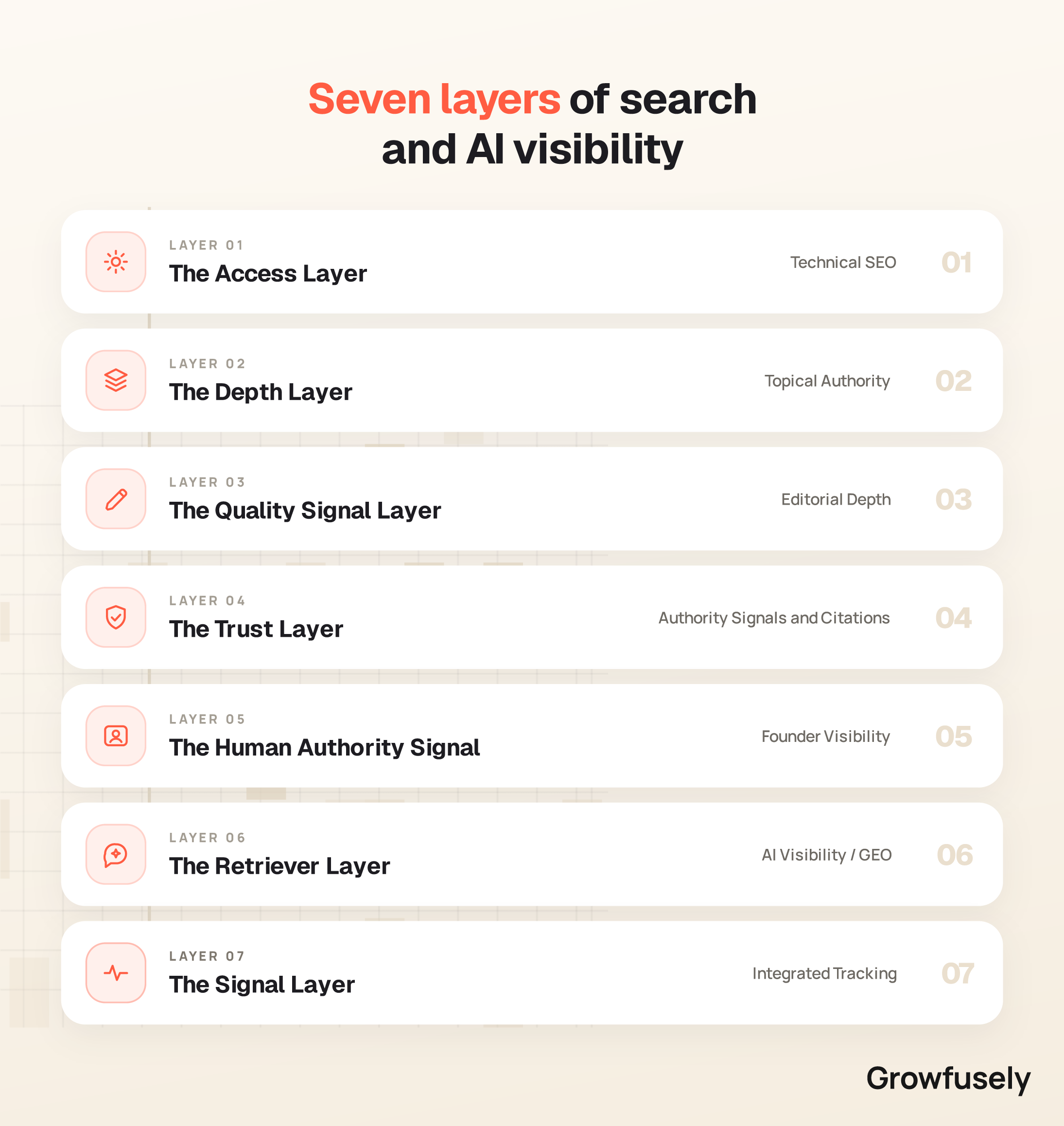
Let’s look at each layer in detail.
Layer 1: The Access Layer – Technical SEO
It all begins here because none of the layers above can function without a solid technical SEO foundation.
The question this layer answers: Can AI systems and search engines read what you’ve built?
For a vast majority of B2B websites, the response is no.
Here’s why.
The JavaScript Problem
AI crawlers like GPTBot from OpenAI, ClaudeBot from Anthropic, and PerplexityBot don’t execute JavaScript. They don’t wait for content to load.
For B2B brands running heavily JavaScript-dependent frameworks, this means entire sections of their site, like product features, case studies, and thought leadership content, are invisible to the systems doing the retrieving. The content exists. The crawler just can’t see it.
The Schema Problem
The second access barrier is structured data.
Structured data is the language AI speaks. Content with proper schema markup has a 2.5x higher chance of appearing in AI-generated answers. Sites with a complete Tier 1 schema see up to 40% more AI Overview appearances.
Schema is, in the most practical sense, the translation layer between your content and the machine systems evaluating it. Without it, AI systems treat your site like a random collection of pages instead of a real business.
In a 2025 Search Engine Land controlled experiment, three nearly identical pages were compared. All had the same content and keyword difficulty, but one with strong schema, one with poor schema, and one with none.
Only the page with a well-implemented JSON-LD schema appeared in AI Overview and got the best organic ranking. The page with no schema wasn’t indexed.
For implementation: JSON-LD is the only format worth using in 2026. Microdata and RDFa embed schema inside HTML, creating parsing conflicts when AI crawlers process the page.
JSON-LD lives in a separate script block: a clean, unambiguous signal AI systems can extract without interference.
For B2B brands specifically, the schema types that carry the most weight are –
- OrganizationSchema, which establishes your brand as a recognized entity
- Article
- FAQPage
- BreadcrumbList on relevant pages.
The Entity Consistency Problem
This is the third dimension of this layer, which is often overlooked by teams.
AI systems cross-check whether your brand information matches across your website, your LinkedIn page, and your Google Business Profile. If details don’t match, AI gets confused and becomes less likely to recommend you.
Inconsistent positioning language, mismatched product descriptions, or different brand narratives across platforms create what I refer to as entity confusion.
Entity-confused brands get low-confidence recommendations from AI, or worse, no recommendation at all.
Layer 2: The Depth Layer – Topical Authority
This layer is about being recognized. AI systems and search engines don’t just evaluate individual pages in isolation; they look at your entire topical footprint.
Simply put, the breadth and depth of what you’ve built around a subject. They use this picture to decide whether your brand belongs in an answer.
Topical authority isn’t about publishing content in bulk or covering every keyword, but owning a subject convincingly enough for systems to retrieve you.
Depth Beats Breadth, Consistently
A brand with three deeply developed topic clusters will typically outperform a brand with ten shallow ones for both SEO and GEO.
A recent Yext research analyzed 6.8 million citations across ChatGPT, Gemini, and Perplexity. The study found that 86% of AI citations come from sources that brands control, like websites and listings.
Hence, brands must invest their energy in creating topic clusters and having more interconnected pages on the topic.
For consistent AI citation visibility on any topic, you need at least 5-7 substantive, interlinked pages covering it from different angles.
Internal Linking Is a Retrieval Signal
LLMs parse internal linking structure as evidence of topical authority. Research shows that AI citations link to nested pages within established topical hierarchies, not isolated articles. \
The architecture of how your content connects matters as much as the content itself.
The Trap: Volume without Ownership
Most B2B content programs that have plateaued share the same pattern.
Posts spread thin across too many topics, offering shallow content and owning none convincingly. Content volume without topical ownership doesn’t build discoverability. It dilutes it.
The goal of this layer is to own the territory: presenting a set of subjects where your brand is the most complete, most coherent source available. That’s when AI systems recognize you as an expert.
Layer 3: The Quality Signal Layer – Editorial Depth
Topical authority tells AI systems what you cover. Editorial depth tells them whether your content is worth citing.
What Is Editorial Depth?
Editorial depth is the structural signal that tells AI models this content was written by someone who’s an expert in the subject.
That means:
- A clear argument opened in the first paragraph
- Original data or research
- Specific examples
- Citations with dates
- FAQ sections that answer the follow-up questions a buyer would actually ask
A recent study revealed that adding statistics to content increases AI visibility by 22%, and adding direct quotations from credible sources increases it by 37%.
Answer First. Support the Argument Later.
Most B2B content still buries the key insight in the latter half of the page. AI systems extract passages, not conclusions. If the most citable sentence is in paragraph eight, it may never surface.
Lead with the answer. Follow with the reasoning. Every section should stand alone as a quotable response to a real buyer question.
Ask yourself:
Does this content contain something a buyer couldn’t easily find elsewhere?
Does it offer a specific position, an original data point, or a direct answer?
If not, it’s unlikely to be retrieved ahead of content that does.
This is where firms must look at B2B content marketing programs that work on the depth of the content.
Layer 4: Authority Signals and Citations: The Trust layer
This layer has the strongest and direct impact on AI visibility, and ironically, this is where most B2B content teams underinvest.
Layers 1 through 3 make your content accessible, deep, and well-structured.
Layer 4 determines whether AI systems trust it enough to cite it.
That trust is built externally, through how the broader digital ecosystem, like press, industry publications, review platforms, and analyst coverage.
The Signal That Matters Most
The Digital Bloom’s 2025 AI Citation Report analyzed more than 680 million citations and found that brand search volume (not backlinks) is the strongest predictor of LLM citations (a correlation of 0.334). This means that the brand-building activities that felt disconnected from SEO now directly impact AI visibility.
Platform Presence Compounds
Reports also show that sites present on four or more platforms are more likely to appear in ChatGPT responses. Your website, LinkedIn page, G2 or Capterra profile, and third-party press mentions are not separate concerns; they are collectively the trust signal AI systems triangulate from.
Presence on each of these credible platforms is a data point, pointing to a pattern that AI systems recognize as authority.
Backlinks: Quality over Quantity
A recent Semrush study revealed that what actually moves the needle is high-quality backlinks more than sheer volume.
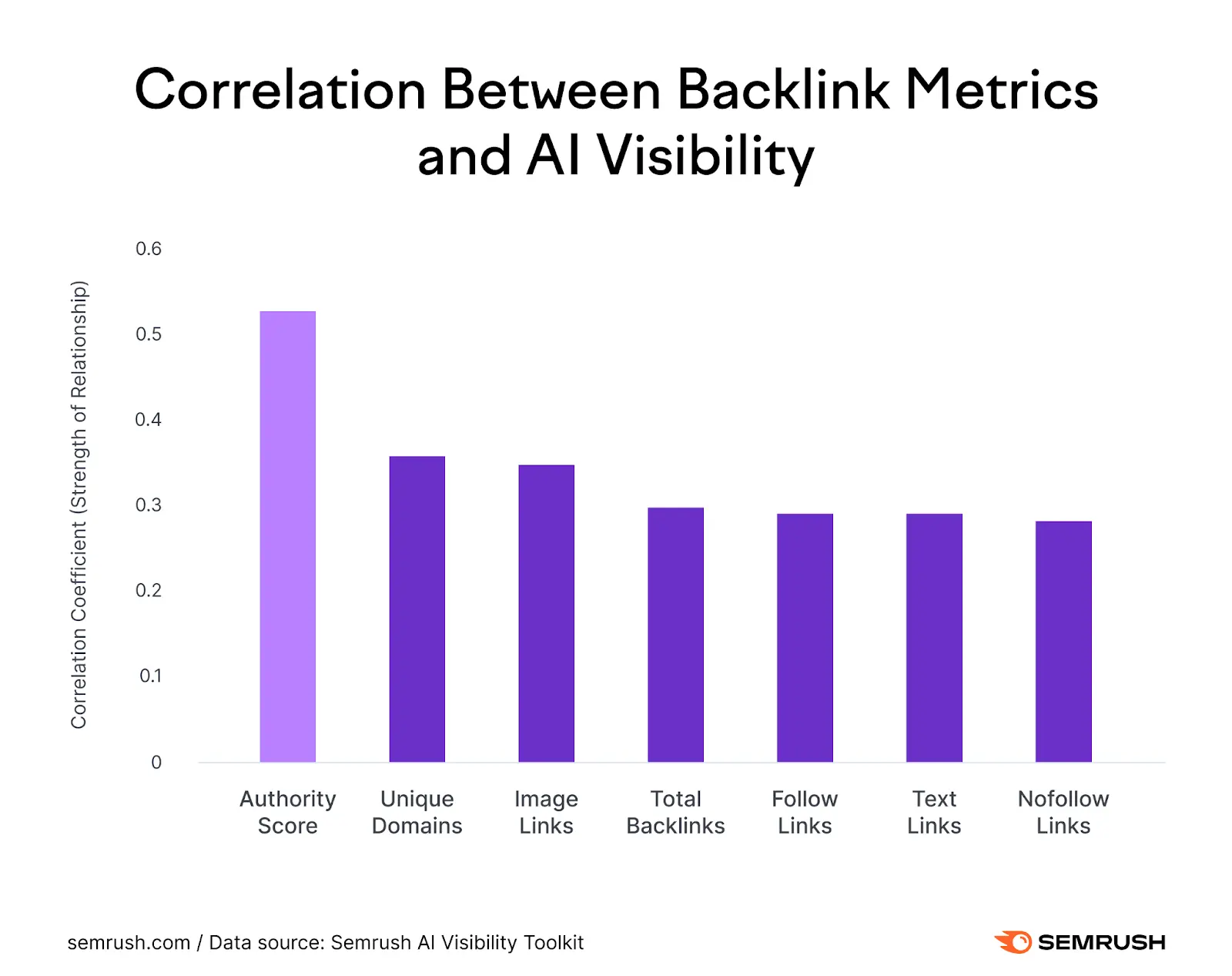
AI visibility gains only appear once a site reaches the higher authority tiers. The correlation between Authority Score and AI mentions highlights a clear threshold: visibility increases meaningfully only once a site crosses into strong authority territory.
Here’s what Growth Advisor, Kevin Indig, has to say about it.
“The big takeaway here is that your backlink needs to hit a minimum threshold. In simple terms: Don’t expect returns when you just get started or from linear growth. You need a minimum investment to see the expected impact.”
A handful of placements in genuinely authoritative industry publications outperforms dozens of low-authority links, for both Google and AI retrieval.
The Gap Most B2B Brands Haven’t Closed
Digital PR today is the primary mechanism for building the external validation AI systems use to decide whether a brand belongs in a given answer.
Analyst citations, editorial coverage, review platform presence, and consistent mentions in industry conversations all compound into this layer over time.
Layer 5: The Human Authority Signal – Founder Visibility
Most B2B content strategies treat the founder or executive voice as optional; it isn’t a strategic priority.
That thinking needs to change.
AI systems evaluate brands and the people behind them. A named expert with a consistent, visible track record on a topic becomes a citable entity, thereby raising the authority of the entire firm.
LinkedIn Is an AI Citation Source (Not Just a Social Platform)
Profound confirms that LinkedIn is the most authoritative source shaping AI-driven discovery. It is the most‑cited source on ChatGPT and is now the #1 most‑cited domain for professional queries.
Semrush analyzed 89K LinkedIn URLs cited in AI search and found that LinkedIn was the second most cited domain across ChatGPT Search, Google AI Mode, and Perplexity.
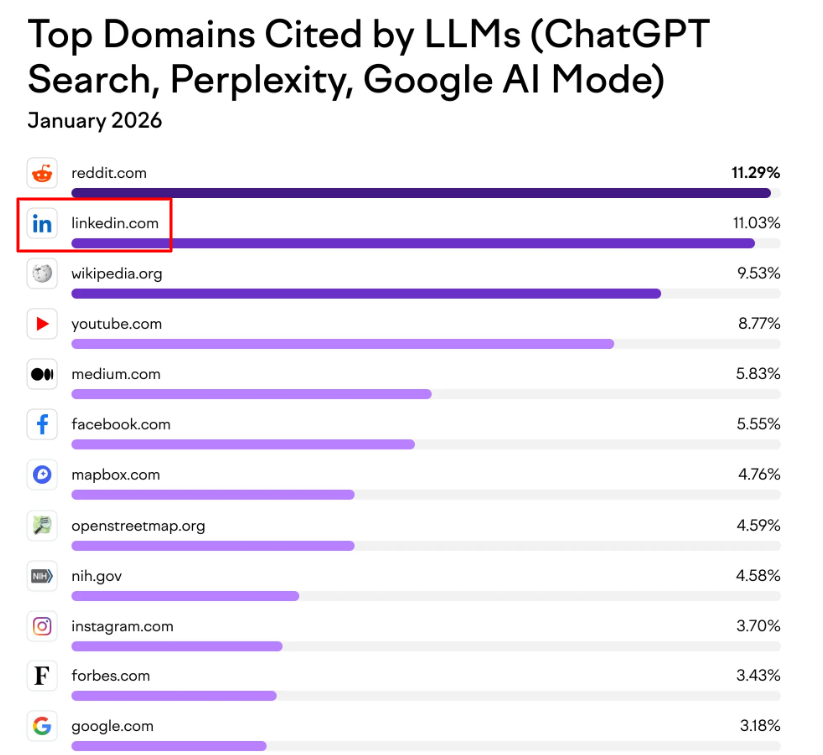
For professional queries specifically, LinkedIn is the most-cited domain across all six major AI platforms.
What Gets Cited on LinkedIn
Not all LinkedIn content is treated equally by AI systems. Over 70% of LinkedIn AI citations land on articles between 500 and 1,500 words. These are structured, substantive content pieces that open with a clear argument and sustain it.
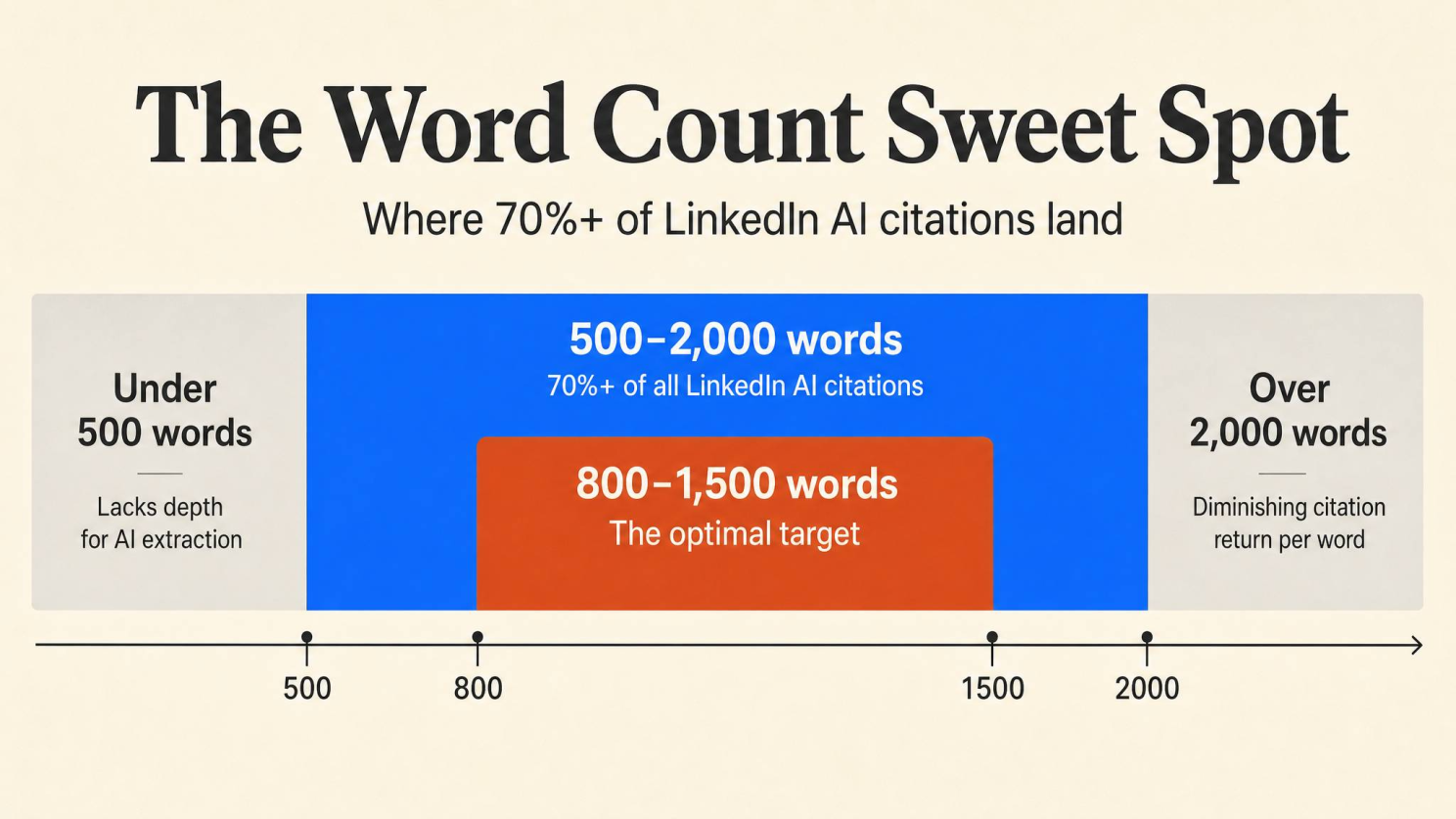
Besides, AI retrieval favors content with clear organization, defined sections, and content that flows from question to answer. Vague positioning, corporate jargon, and generic statements produce vague AI representations.
In practical terms, a founder-led bylined essay on a category-level topic and published consistently, with a clear point of view, builds the kind of entity association that compounds. The person becomes recognizable as a credible voice on the subject.
We Treat LinkedIn as a Separate Channel
At Growfusely, we’ve started building founder visibility as a distinct content channel. We work on it with its own publishing cadence, distribution strategy, and measurement framework, separate from the brand content calendar.
The reason is simple: a company blog post and a founder’s LinkedIn essay on the same topic carry different authority signals to both AI systems and human buyers. They serve different functions in the discoverability stack. Conflating them means underinvesting in both.
A majority of B2B buyers prefer thought leadership content over product-focused material when evaluating a vendor. The founder voice is where that preference gets satisfied, and trust gets built.
Layer 6: The Retriever Layer – AI Visibility/ GEO
The first five layers build the foundation of discoverability. Layer 6 is where we structure content so AI platforms can accurately extract, cite, and surface it when a relevant question gets asked.
This is what Generative Engine Optimization (GEO) actually means in practice. Not a single tactic, but a set of content decisions that make your material easier for AI systems to parse, chunk, and use.
Structural Decisions That Move the Needle
As mentioned earlier, AI systems don’t read pages the way humans do. They extract passages that can stand independently as a response to a specific query.
The mechanics that matter most:
- Answer-first structure. Open each section with the direct answer. AI systems extract the first substantive response to a query, context that comes before the answer is frequently skipped.
- FAQ blocks. Explicitly formatted question-and-answer sections give AI systems pre-packaged, citable units. These are among the most reliably retrieved content formats across ChatGPT, Perplexity, and Google AI Overviews.
- Schema markup on content types. FAQPage, HowTo, and Article schema help AI systems classify what kind of content they’re reading and increase the likelihood of structured extraction.
- Cross-platform content distribution. YouTube video transcripts, long-form LinkedIn articles, and content on authoritative third-party platforms all extend the retrieval surface area beyond your own domain, feeding AI systems through multiple access points simultaneously.
Entity Consistency across Platforms
The language your brand uses to describe itself, like the category, product, and positioning, needs to be consistent across your website, LinkedIn page, G2 profile, press coverage, and anywhere else your brand appears.
AI retrieval works by identifying named entities like companies, people, products, concepts, and understanding their relationships. Content that consistently uses accurate terminology and provides precise, verifiable information is more likely to be incorporated into AI responses accurately.
Brands that use a different language in different places create entity ambiguity, and ambiguous entities get low-confidence, inconsistent recommendations.
A Quick Word on llms.txt
The llms.txt file is a plain-text, Markdown-formatted file placed at a website’s root directory that provides AI crawlers with a curated map of a site’s most important pages, helping large language models navigate content with greater precision.
What it doesn’t do?
LLMs.txt cannot restrict any crawler or prevent AI systems from reading your site.
It does not improve Google rankings. Google’s John Mueller confirmed in 2025 that no Google Search system reads or acts on llms.txt.
What does it do?
AI coding assistants like Cursor, GitHub Copilot, and Claude retrieve documentation in real time, and llms.txt helps them fetch the right pages with less token waste.
For B2B SaaS brands with developer audiences, that’s a meaningful application.
For everyone else, it’s useful infrastructure, a crawl hint worth implementing, but not a substitute for the content and authority work that actually drives AI citation.
GEO is the execution layer of the discoverability stack. It doesn’t create authority. It makes authority accessible.
Layer 7: The Signal Layer – Integrated Tracking
At present, most B2B marketing teams are measuring the wrong things for AI visibility.
Rankings and organic traffic still matter, but they tell you nothing about whether your brand is appearing in the AI answers your buyers are actually receiving.
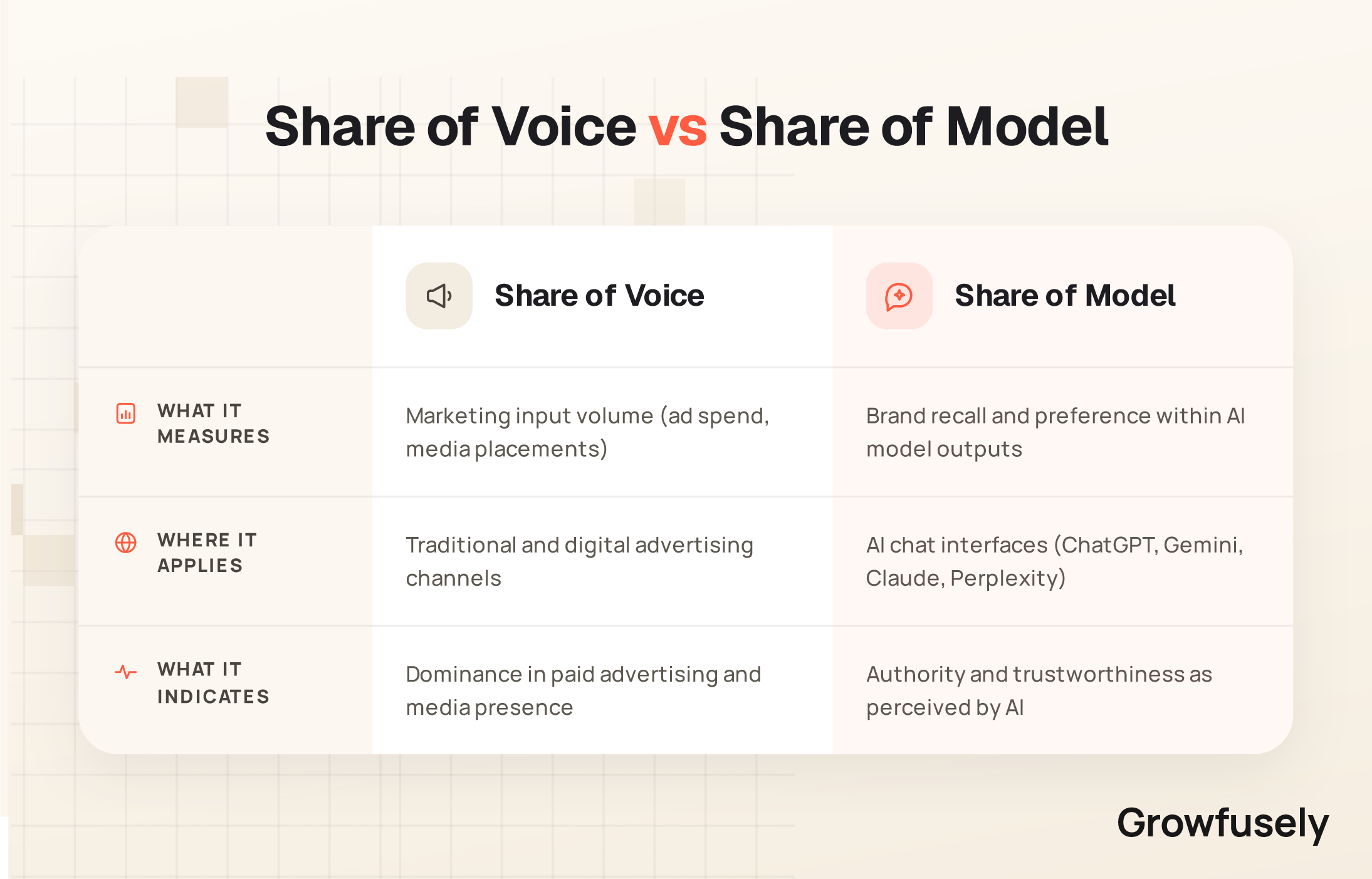
The Metric That Matters the Most: SOM (Share of Model)
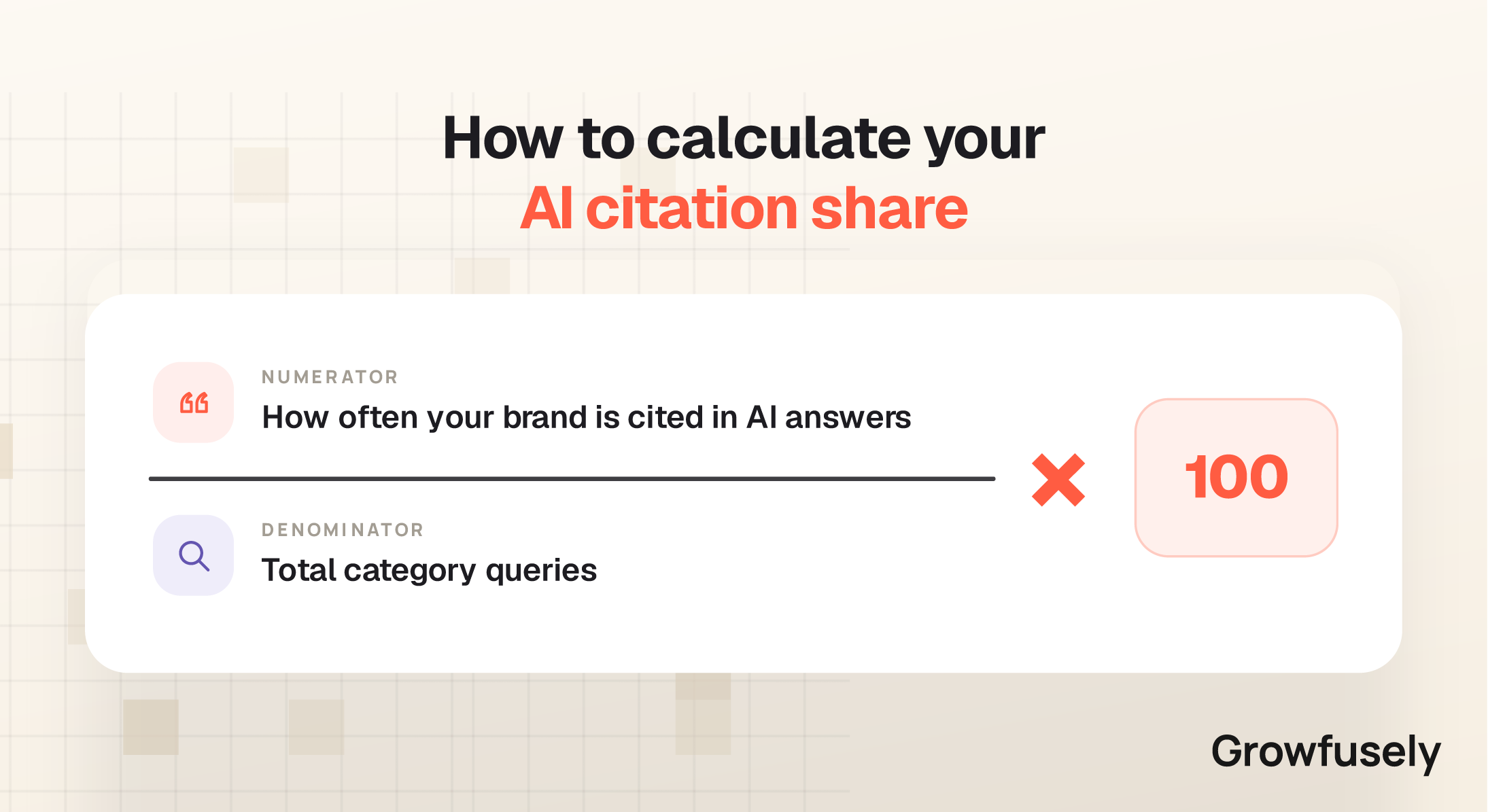
SOM measures how often your brand is cited in AI-generated answers for category-level queries, across ChatGPT, Perplexity, Gemini, and other platforms.
It’s calculated simply:
how often your brand is cited in AI answers ÷ total category queries × 100
According to Cited’s 2026 analysis, most B2B brands start below 6% SOM
As per this analysis, a realistic target that B2B brands must aim for:
“Most B2B brands starting a full GEO program should expect to reach 15–25% SOM on Perplexity within 90 days, and 10–20% on ChatGPT within 120 days. Gemini and Claude vary by industry.”
What Else to Track?
- Linked citation rate: Citations that include a hyperlink to your domain generate trackable referral traffic. Mentions without links build brand association but are invisible to GA4.
- Branded search lift: When ChatGPT SOM doubles, branded search in GSC typically lifts 15-20% within four to six weeks.
- AI referral conversion rate: According to the Cited analysis shared above, AI referral traffic converts at 15.9% on ChatGPT versus 1.76% for Google organic. When SOM grows, lead quality follows.
Why B2B brands need an integrated discoverability system
The B2B buying process was already complex before AI entered the picture: long cycles, committee decisions, multiple research phases. AI has compressed and obscured all of it.
According to 6sense’s 2025 Buyer Experience Report, buyers now make their vendor shortlist before any seller contact 95% of the time. That shortlist is increasingly formed inside AI conversations that no one at the vendor ever sees.
A brand absent from early AI answers isn’t ranked lower. It’s not in the conversation at all.
Isolated tactics like these cannot change this:
- A blog sprint builds content
- PR push builds citations
- A schema audit improves crawlability
Each moves one layer. None of them moves the stack.
What works today is an integrated system, where every layer reinforces the others continuously.
At Growfusely, this is the shift we’ve been making with clients: from content production to discoverability infrastructure.
What This Means for B2B Marketing Teams
The shift from SEO to discoverability is about expanding the operating model, and three things need to change in how teams think.
Move from ranking to retrieval.
The goal is to be in the answer when a buyer asks an AI what the best solution in your category is. Those are different problems, and they don’t respond to the same work.
Move from traffic to presence.
A brand can be invisible in analytics and highly visible in the places that actually shape buyer decisions, like AI answers, Reddit threads, and LinkedIn feeds. Presence precedes traffic. Building it requires showing up before the click, not just after it.
Move from domain authority to distributed authority.
Authority built only on your own domain stays there. The brands winning AI visibility have authority that radiates outward, through press coverage, expert voices, review platforms, and community presence.
That’s what AI systems draw from when they decide who belongs in an answer.
Technical SEO remains the floor throughout all of this. Without it, none of the layers above it are accessible to the systems doing the retrieving.
Let’s Build for Where Discovery Actually Happens
The discoverability stack we spoke about above is already operational for brands paying attention. The gap between those building it now and those who start later will compound the same way early SEO advantages did.
At Growfusely, we build SEO and AI search visibility for B2B SaaS brands, helping them show up across Google, ChatGPT, Perplexity, Claude, and Gemini.
We don’t work through isolated tactics; we believe in an integrated infrastructure that holds up wherever buyers are looking.
If this piece helped you see the landscape differently, we’d love to hear from you and explore what building your discoverability stack could look like. Get in touch with us now.

Pratik Dholakiya is the Founder of Growfusely, a SaaS SEO and AI Search Visibility agency.
