
A SaaS company can publish eight articles a month, rank for a few hundred more keywords, and still have a content problem.
We’ve seen the symptoms often enough. The SEO dashboard is green, but sales cannot name three articles that genuinely help move a deal. Product marketing keeps correcting technical nuance in drafts. The blog attracts people researching the category, yet the pages buyers need when they start comparing vendors are thin or missing altogether. And when someone asks ChatGPT or Perplexity for recommendations, competitors appear far more often than the company that has spent two years “investing in content.”
At that point, adding four more posts to next month’s calendar is unlikely to fix much.
The issue is usually how the program has been assembled. SEO finds keywords. Writers fill briefs. PR chases coverage. Someone else builds links. Product experts get dragged into reviews near the end, usually when they’re already busy. Each function can be doing competent work while the overall system produces less than the sum of its parts.
The top SaaS content marketing agencies connect those pieces around the buyer.
What are the buyers trying to solve? What do they search when the problem becomes urgent? Which alternatives are they weighing? What proof do they need before bringing another stakeholder into the deal? Where does your company need authority beyond its own website? And now, which sources are AI answer engines using when those same buyers ask for recommendations?
That is the standard we’d use when hiring a SaaS content marketing agency in 2026.
You are not really buying articles anymore. You are hiring a partner to turn product expertise, search demand, brand authority, and distribution into an organic growth system that gets stronger with time.
Quick Comparison of the Best SaaS Content Marketing Agencies
| Agency | Best suited for | Core strength | Service focus |
| Growfusely | B2B SaaS brands wanting one partner across content, SEO, AI-search visibility, and authority | Integrated organic visibility for Google and AI search | Content strategy and production, SEO, AI visibility, authority, digital PR, links |
| Animalz | Established B2B SaaS and technology companies | Premium editorial programs and thought leadership | Content strategy, SEO/AEO, research, thought leadership |
| Grow and Convert | SaaS companies prioritizing trials, demos, and attributable conversions | Bottom-of-funnel content through Pain Point SEO | SEO, GEO, content strategy, expert-led content |
| Omniscient Digital | B2B software companies needing senior organic-growth strategy | Connecting SEO, GEO, content, and pipeline | Organic strategy, content, SEO, AI visibility |
| Siege Media | Brands investing heavily in content-led authority | Design-led content, digital PR, and GEO | Content marketing, SEO, GEO, digital PR, design |
| Optimist | SaaS companies wanting a flexible, embedded organic-growth team | Bespoke SEO, AEO, and content programs | Strategy, advisory, content, SEO, AEO |
| Skale | SaaS companies treating organic search as an acquisition channel | SEO and AI search tied to SQLs and revenue | SEO, AI search, content, technical SEO, outreach |
| Campfire Labs | Complex B2B companies selling to sophisticated buyers | Interview-led editorial and thought leadership | SEO content, reports, case studies, newsletters, social |
| Foundation | B2B SaaS and technology brands building visibility across multiple channels | Research, distribution, and AI visibility | GEO, SEO, distribution, thought leadership, demand generation |
There is no useful way to crown one agency “best” without first understanding what is broken.
If your company already ranks well but disappears when buyers reach the vendor-comparison stage, you have a different problem from a startup whose category barely has search demand yet. A developer platform with deeply technical evaluators needs a different content operation from a PLG tool where the buyer can swipe a credit card after twenty minutes of research.
Start with the constraint. Then judge the agency.
Why SaaS Content Marketing Requires a Specialist Approach
Well, there are many reasons why, including:
1. SaaS Products Are Hard to Explain Well
You can tell when a writer learned a SaaS category by reading the first five Google results.
Everything is technically correct. Almost nothing is useful.
The introduction repeats the accepted definition. The “benefits” could apply to six competitors. The examples feel suspiciously neat. Nobody talks about implementation friction, switching costs, the ugly workaround buyers are currently using, or why a seemingly obvious alternative fails in a particular situation.
Someone close to the product reads the draft and leaves 37 comments.
That gap between technically accurate and commercially useful is where SaaS content gets difficult.
A writer covering payroll compliance software, observability tooling, API security, construction management software, or treasury automation does not become credible because they studied the SERP for an afternoon. They need enough access to understand how the buyer experiences the problem and enough editorial judgment to turn that knowledge into something an outsider can follow.
A capable SaaS agency therefore needs ways to extract information that Google cannot hand it.
That might involve:
- Product walkthroughs and sandbox access
- Interviews with founders or product leaders
- Sales-call recordings
- Customer success and implementation teams
- Support tickets and recurring objections
- Customer interviews
- Internal decks and enablement material
- Win-loss notes
- SME review at the right stage of production
The operative phrase is “at the right stage.”
Pulling a subject-matter expert into a nearly finished article and asking them to “add some insights” is backwards. By then, the structure is already generic. Their expertise becomes garnish.
We prefer getting the useful disagreement, nuance, examples, and product context upstream, before the writer decides what the article should say.
There is another reason this bar has gone up. Generic explanatory content used to be cheap. Now it is practically free. ChatGPT can produce a competent overview of almost any established SaaS topic before your writer has opened Ahrefs.
So your advantage cannot be “we explained the basics thoroughly.”
It has to come from what your company knows, has seen, has measured, or believes that the generic version does not contain.
2. The SaaS Buyer Journey Is Rarely Linear
A content calendar organized neatly into TOFU, MOFU, and BOFU looks great in a spreadsheet. Buyers are less cooperative.
Take an enterprise security product.
A security lead may discover the company through an educational article. Someone in engineering checks the documentation. Their manager searches for alternatives. Procurement wants security and vendor-risk information. Finance wants to understand cost. An executive sponsor wants evidence that another tool will actually remove enough risk or labor to justify the implementation.
Meanwhile, the original buyer has probably visited G2, searched Reddit, read a competitor comparison, asked colleagues, and increasingly, thrown a few questions into an AI assistant.
One “ultimate guide” is not carrying that deal.
A serious SaaS content marketing strategy needs content for the whole research process: educational resources, category pages, use-case pages, product-led guides, comparisons, alternatives, customer stories, implementation content, technical documentation, proof assets, and sometimes material your sales team can send directly after a call.
The mix changes by business model.
A $49 self-serve tool should not copy the content architecture of a six-figure enterprise SaaS platform with a nine-month buying cycle. Yet you still see teams benchmarking their blog output against companies whose economics, sales process, and buyer are nothing like theirs.
Volume is an especially poor proxy here. Forty awareness articles do not compensate for the comparison page every serious prospect searches for and cannot find.
3. Visibility Now Extends Beyond Google Rankings
SEO remains the foundation. We would be wary of any agency suggesting otherwise.
Your pages still need to be crawlable, technically sound, internally connected, aligned with search intent, and authoritative enough to compete. Our broader SaaS SEO guide goes deeper into those mechanics.
What changed is the number of places where buyers can encounter your company before they visit it.
A buyer can ask ChatGPT for the best SOC 2 compliance platforms for startups, use Perplexity to compare two vendors, ask Gemini how a category differs from an adjacent one, then search Google once they already have three names in mind.
By the time the traditional organic click happens, part of the shortlist may already exist.
Content therefore has another job now: being understandable and referenceable enough to survive synthesis.
Our analysis of 1,739 citations across B2B software queries made one thing fairly hard to ignore. AI visibility is not something you manufacture by adding an FAQ section and calling the page “GEO optimized.” ChatGPT-family search and Perplexity did not behave identically, and the sources they leaned on went well beyond vendor-owned pages. Comparative content, third-party authority, communities, editorial publications, and other referenceable sources all entered the picture.
For a SaaS decision-maker choosing an agency, that creates a useful test.
Ask what the agency actually means when it says “AI search optimization.”
If the answer is mostly schema, headings, prompt-shaped FAQs, and an llms.txt file, keep asking.
A credible answer should eventually get into SEO fundamentals, entity clarity, topical coverage, content retrievability, external mentions, citation sources, and the authority your company has across the wider web.
4. Publishing Is Only One Part of the Job
One of the easiest agency services to package is “four articles per month.”
Everyone knows what gets delivered. Finance understands the invoice. Marketing gets a predictable calendar.
And it can be completely wrong for what the company needs.
We’ve seen SaaS sites where another twenty articles would add very little because the existing library is cannibalizing itself. Or the commercial pages are weak. Or the internal linking is a mess. Or strong pages are sitting in positions 5 to 12 and need authority, not replacement content. Or the company has perfectly decent owned content but almost no presence on the third-party sources buyers and AI engines keep referencing.
A useful agency should be willing to tell you when writing another article is the lazy option.
Sometimes the higher-leverage move is a content refresh. Sometimes it is merging three mediocre pages into one strong one. Sometimes technical SEO is blocking the entire program. Sometimes you need a comparison page, a data study, a digital PR campaign, or relevant links into a commercial asset that already deserves to rank.
Our 2026 guide to digital PR for SaaS covers the authority side in more detail, but the operating principle is simple: creation and distribution cannot live in separate universes.
If an agency’s responsibility ends the moment a Google Doc becomes a URL, understand exactly who owns everything that happens next.
How to Evaluate These Top SaaS Content Marketing Agencies
Be sure to ask these key questions.
Does the Strategy Begin With the Business Objective?
“How many articles do you want per month?” is an order-form question.
It is not a strategy question.
Before talking deliverables, an agency should understand what you are actually trying to change.
Maybe organic traffic is healthy and demos are not. Maybe paid acquisition is carrying too much of the pipeline. Maybe sales keeps losing deals because competitors own the category narrative. Maybe you are expanding into enterprise and the website still speaks almost entirely to self-serve users. Maybe the company ranks for informational terms but barely appears for searches with buying intent.
Those situations should produce different plans.
If demo quality is the problem, doubling down on high-volume informational keywords because they have attractive search volume is hard to defend. If your category authority is weak, publishing twelve more unpromoted articles is equally questionable. If buyers understand the category but not why your approach is different, the gap may be positioning and commercial content before it is SEO volume.
A few questions expose how an agency thinks:
- What would you prioritize first for our business, and why?
- Which parts of our buyer journey look underserved?
- Where do you see the biggest mismatch between search opportunity and commercial value?
- What would you deliberately avoid doing during the first six months?
- How will you know whether the work is attracting the right audience, not simply a larger one?
Traffic still counts. Rankings still count. Anyone dismissing them entirely has swung too far in the other direction.
But a SaaS leadership team should be able to trace why those metrics deserve investment.
Can the Agency Capture Real Product and Customer Expertise?
Ask an agency how its writers learn your product.
The answer tells you a lot.
“We review your website and competitors” is a weak start for anything remotely technical. So is a single onboarding questionnaire that gets reused for six months.
A writer producing content for a compliance platform may need to understand why customers choose one framework before another, what evidence auditors actually request, which integrations create implementation friction, and where the product removes manual work. None of that reliably emerges from keyword research.
The research process should fit the difficulty of the topic.
For some articles, product documentation and a good brief will be plenty. A strategic category piece may warrant an SME interview. A customer story obviously requires the customer. A technically opinionated article may need time with someone who has lived the problem.
What you are looking for is judgment, not a mandatory interview ritual attached to every 1,500-word post.
A few warning signs:
- Writers rarely interact with people close to the product.
- The editorial process cannot accommodate product access or internal research.
- Topics are chosen almost entirely from keyword exports.
- “Original insight” means paraphrasing an SME quote into an otherwise generic article.
- The agency cannot explain where AI is used in its workflow and where human judgment remains essential.
If your subject-matter experts keep rewriting drafts, you are paying twice. Once for the agency, then again in senior internal time.
Can It Build Visibility Across Google and AI Answer Engines?
There are agencies now selling GEO as if someone discovered a second internet.
We would be cautious with that framing.
Google itself has been clear that the fundamentals of SEO continue to apply to AI search experiences. And from the work we are seeing across SaaS categories, the overlap is substantial: strong site architecture, clear entities, useful content, internal linking, topical depth, authoritative mentions, and pages worth citing all carry forward.
AI search adds new questions, though.
Which prompts produce vendor recommendations in your category? Which domains are repeatedly cited? Does your competitor appear because its own page is strong, because Gartner or G2 mentions it, because Reddit discussions reinforce the brand, or because it owns a comparison format your site lacks?
The agency should be able to investigate those questions rather than hand you a generic “AEO checklist.”
Ask:
- Which AI surfaces are relevant to our buyers?
- What prompts would you monitor?
- How do you distinguish a citation problem from a content problem?
- How do third-party mentions fit into the strategy?
- What can we measure reliably today, and what would you treat as directional?
If every recommendation ends in “add an FAQ,” you have your answer.
Does It Have a Plan for Authority and Distribution?
Publishing a strong article and waiting six months is technically a distribution strategy.
It is simply not a very ambitious one.
A SaaS company entering a competitive SERP may need links. A founder trying to establish a new category may need contributed commentary, podcasts, industry coverage, and repeated third-party association with that category. A company trying to improve AI citations may discover that the sources answer engines trust are publications, communities, review platforms, or comparison pages it does not control.
Authority work needs a reason behind it.
Five links from loosely relevant websites because they meet a DR threshold is activity. A mention in a publication your buyers actually read, attached to a topic you want the brand associated with, can carry a very different kind of value.
When you evaluate agencies, ask:
- Who owns distribution after publication?
- How are link and PR targets chosen?
- Can authority work support product and commercial pages?
- Do you pursue linked and unlinked brand mentions?
- Can you show where earned coverage changed search visibility, authority, or category perception?
The answers should sound specific to your market. If the same outreach plan could be pasted into a proposal for an ecommerce mattress company, it probably is not much of a SaaS authority strategy.
Can It Build a Full-Funnel Content System?
Here is a useful litmus test.
Give the agency a commercial problem and see whether every solution somehow becomes a blog post.
A prospect comparing your product with an incumbent may need an alternatives page. A buyer trying to get budget approved may need an ROI asset. A developer evaluating implementation may need a technical guide. A category that buyers routinely misunderstand may need a definitive explanatory page. A sales team hearing the same objection every week may need proof content they can send immediately after a call.
Different job, different asset.
A good agency should be comfortable recommending less editorial content when the website needs more commercial depth.
For SaaS, that can include:
- Category and solution pages
- Use-case pages
- Comparison and alternatives pages
- Product-led content
- Case studies
- Technical guides
- Buyer guides
- Original research
- Templates and tools
- Sales enablement assets
The goal is not to produce every format on the list.
It is to remove the gaps that cause buyers to leave your site and find the answer somewhere else.
Can It Prove How the Work Produced Results?
“Organic traffic increased 300%” sounds excellent.
Until you learn the site went from 500 visits to 2,000, nearly all of it came from one broad informational article, and demo volume barely moved.
Case studies need context.
Look for the starting problem, what the agency changed, how long the work ran, what kinds of pages were involved, whether links or technical work contributed, and what happened beyond raw traffic.
Good proof should let you understand the mechanism.
A case study from a company with a similar buyer, ACV, category, authority level, or sales motion is especially useful. A giant traffic graph from a consumer-adjacent freemium product may tell you very little about what the agency can do for enterprise infrastructure software.
And ask about the ugly parts.
What did not work initially? What changed during the engagement? Which assumptions proved wrong? Agencies that have done enough real work usually have an answer. Organic growth rarely follows the neat upward arrow drawn in a proposal deck.
The Top SaaS Content Marketing Agencies to Consider
With the evaluation parameters clear in mind, here are the finest SaaS-specific content marketing agencies available today.
1. Growfusely: Best for Integrated SaaS Content, SEO, and AI-Search Visibility
We built Growfusely around a problem we kept seeing in SaaS marketing: content was being managed as a production function when the actual growth problem crossed SEO, content quality, technical structure, links, PR, and authority.
You can have very good writers inside a weak organic system.
A technically excellent article may sit on a poorly structured site. A page that deserves to rank may lack the authority to move. PR can earn great coverage that has almost no connection to the topics the company wants to own. SEO can drive traffic to informational pages while the commercial layer remains anaemic. Then AI search arrives, and someone adds another vendor to monitor prompts without fixing any of the underlying gaps.
Our approach is to work on those pieces as one system.
Growfusely now works exclusively with B2B SaaS companies, including horizontal and vertical SaaS, cybersecurity, fintech, AI companies, and developer tools. The common denominator is less about the software category and more about the buying behavior: people research carefully before they buy.
That changes how we plan content.
A strategy cannot stop at “these keywords have volume.” We look at what the category needs the brand to be known for, what buyers search across different stages, where product and use-case pages need support, which topics can build authority, how competitors are represented, and what AI answer engines surface when buyers ask adjacent questions.
From there, the work typically spans three connected disciplines.
Content strategy and production
The objective is reference-grade content with enough product and category depth to rank, convert, and earn citations. Depending on the gap, that could mean editorial content, pillar resources, comparison and alternatives pages, thought leadership, refreshes, or content built specifically around a product or use case.
SEO and AI-search visibility
Technical SEO, site architecture, product-led SEO, internal linking, topical mapping, and content optimization still form the base. AI-search work builds on it through entity clarity, retrievability, prompt and citation analysis, and content designed to survive both traditional ranking systems and answer-engine synthesis. We describe modern SEO as the foundation and AI Search Visibility as the surface because, for SaaS, separating the two is becoming increasingly artificial.
Authority and citations
A brand’s website can only say so much about itself.
Relevant links, industry mentions, digital PR, founder visibility, original research, and placement in sources that buyers and AI engines already trust can strengthen the external evidence around the brand. We increasingly think about authority as more than “build links to improve DR.” The useful question is where your company needs to be referenced, by whom, and around which ideas.
Our own client work shows why combining those disciplines tends to work better than optimizing them in isolation.
- With Mind the Graph, the engagement included restructuring SEO, building a coherent content program, and earning relevant links and mentions. Their co-founder credited the work with 217% growth in qualified traffic and more than doubling the number of referring domains.
- JetOctopus is a different example. It is a technically complex crawler and log-analysis platform, exactly the sort of product where generic SaaS writing falls apart quickly. Its co-founder specifically called out how deeply our team learned the platform and translated its value propositions into content, alongside doubling organic traffic within six months of the partnership.
- Whatfix leaned more heavily into authority building, with 249 backlinks built over an 18-month engagement.
- Document360’s work included 20+ organic PR stories that reinforced its position in the knowledge-base software category.
Different bottlenecks, different mix of work.
Growfusely tends to fit well when:
- Organic search is important enough that you want senior strategic involvement, rather than a content queue managed through tickets.
- Your SaaS product requires genuine product or domain understanding.
- Content, SEO, digital PR, link building, and AI visibility currently sit in separate silos.
- Buyers do substantial research before converting.
- You want to build authority around a category rather than chase publishing volume.
- Your internal team has useful expertise but needs a system for turning it into scalable content and visibility.
We are probably the wrong partner if you want 30 cheap articles a month, expect SEO to pay back in a few weeks, or need an agency that will execute a predetermined keyword list without challenging it.
There is some productive friction in good agency relationships.
If we think a topic has no commercial value, a page should be consolidated rather than rewritten, or the missing ingredient is authority rather than another article, we should be able to say so. Otherwise you are hiring extra hands when what you actually needed was judgment.
And for a SaaS company investing seriously in organic growth, judgment compounds rather nicely.
2. Animalz: Best for Premium Editorial Programs and Thought Leadership
Animalz has been one of the better-known names in B2B SaaS content for years, but its 2026 offering is broader than the long-form editorial work it originally became known for.
The agency now combines content strategy and production with SEO, AEO, thought leadership, survey-driven research, LinkedIn programs, and content distribution. Its site is fairly explicit about serving established B2B SaaS brands, with clients ranging from Intercom and Amplitude to Airtable and Google.
Where Animalz makes the most sense, in our view, is when editorial quality itself is part of the competitive strategy.
Say you already have a capable marketing team, but the CEO wants to build a recognizable point of view around the category. Or your existing blog ranks reasonably well but reads like SEO content from 2022. Or you need whitepapers and executive-led pieces that can carry a campaign rather than another batch of keyword articles.
Animalz has built processes around those jobs, including dedicated LinkedIn thought leadership and survey-driven whitepaper services. Its SEO/AEO work now includes technical SEO, content refreshes, audits, and citation outreach too.
If your primary need is cheap production volume, there are easier places to buy it. Animalz is more interesting when the content itself has to carry some intellectual weight.
3. Grow and Convert: Best for Bottom-of-Funnel Content Tied to Product Signups
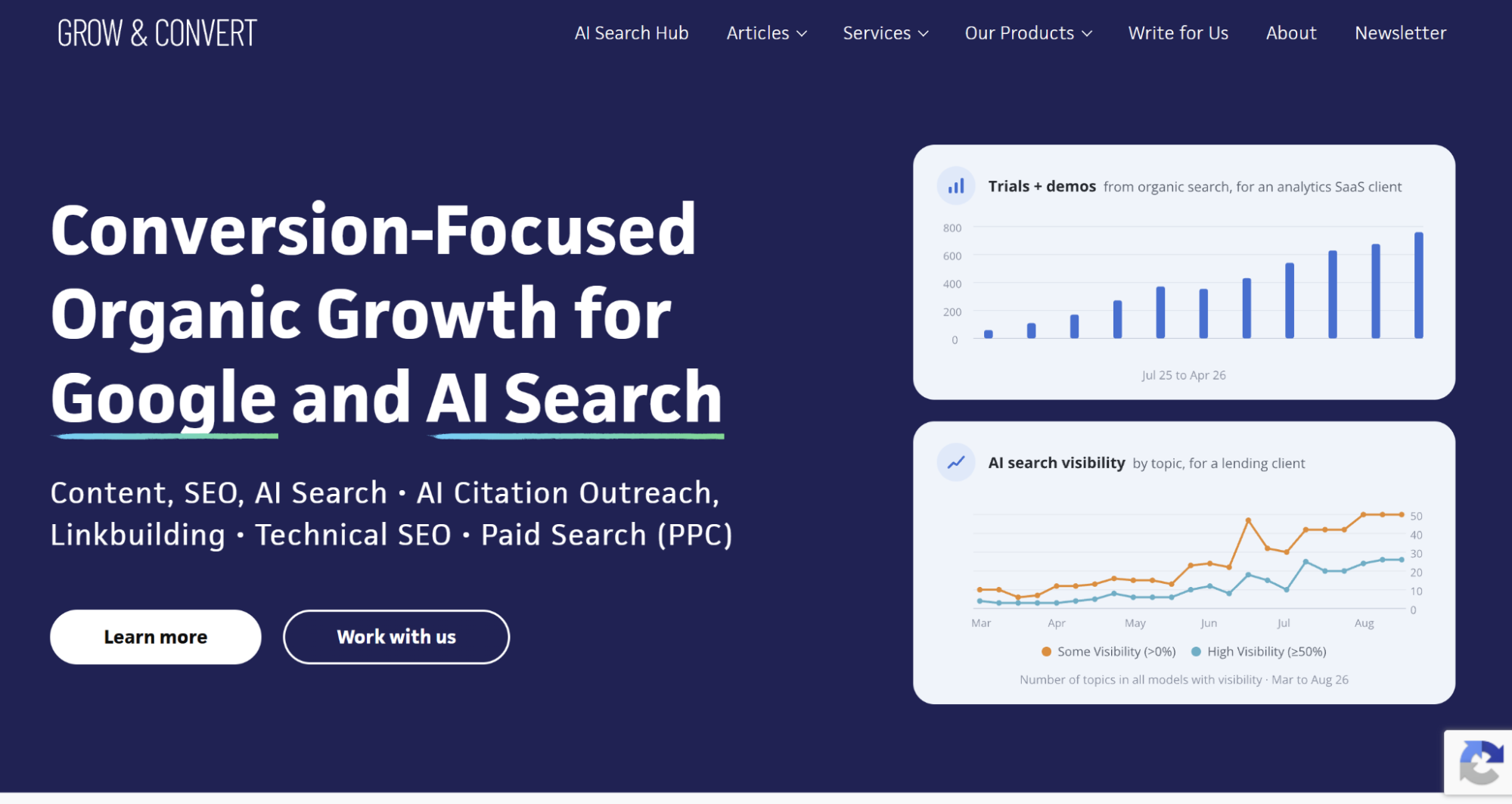
Grow and Convert has spent more than a decade making one argument very consistently: SaaS companies should stop assuming traffic eventually turns into pipeline and start with the searches that indicate somebody may actually buy.
Its Pain Point SEO framework is built around that premise.
Instead of prioritizing keywords primarily by volume, Grow and Convert leans heavily into software-category searches, comparisons, alternatives, use cases, jobs-to-be-done queries, and other terms closer to a commercial problem. The agency then measures trials and demo requests rather than treating traffic as the finish line.
Their writing process also deserves attention. Product and domain expertise is pulled through interviews instead of expecting a freelance writer to reconstruct the company’s knowledge from Google results.
The current offering has expanded into GEO through what Grow and Convert calls Prioritized GEO, but the commercial instinct remains recognizable: identify the searches or prompts with buying relevance, then build content around them.
That makes Grow and Convert a particularly sensible shortlist candidate when your SaaS company has traffic but cannot show enough product signups from it, or when the content calendar has drifted heavily toward top-of-funnel topics because those were easier to find in keyword tools.
4. Omniscient Digital: Best for Senior Organic-Growth Strategy
Omniscient Digital is closer to an organic growth consultancy with execution capacity than a conventional article-production agency.
Its current positioning brings SEO, GEO, and content under one program, with business outcomes such as qualified leads, pipeline, and revenue sitting above traffic in the measurement hierarchy. The company works primarily with established B2B software brands, and its leadership has in-house experience from companies such as HubSpot, Shopify, and Workato.
That strategic bent shows up in the public work too. Omniscient talks openly about prioritization, commercial content, content quality, and deciding which small set of opportunities is actually worth pursuing instead of treating every possible SEO task as equally urgent.
Its case studies are unusually commercial for an SEO/content agency. Smartling, for example, is presented around $3.7 million in pipeline from organic search rather than a traffic increase alone.
For a VP Marketing with writers already on payroll but no coherent organic growth strategy, that model can be attractive. The engagement is likely overkill if all you need is four reliable blog posts every month. It becomes much more relevant when you need senior thinking across SEO, AI search, content architecture, and pipeline.
5. Siege Media: Best for Design-Led Content, Links, and Digital PR
Siege Media comes at SaaS content from a slightly different angle.
Its strongest muscle has historically been creating search-led assets that also earn links, with in-house design and digital PR sitting alongside content strategy. In 2026, Siege positions itself much more explicitly around full-service GEO as well, connecting SEO content, generative search visibility, digital PR, and custom creative.
That combination is useful when the content itself needs to earn attention beyond the company blog.
Think original data assets, visual explainers, tools, statistics pages, interactive content, or other formats where design and promotion are part of why the page succeeds. A SaaS brand trying to grow authority in a crowded SERP may get more from that operating model than from an editorial agency built primarily around prose.
Siege is a larger operation, and its sweet spot tends to be brands with enough budget and search opportunity to justify sustained content and authority work at scale.
6. Optimist: Best for SaaS Companies Wanting a Bespoke Organic-Growth Team
Optimist describes itself today as a full-service SEO and AEO agency for B2B SaaS and technology companies, offering consulting, advisory, and execution.
The interesting part is how the team gets assembled.
Rather than selling the same fixed production package to every client, Optimist builds bespoke teams around the engagement. Its positioning leans heavily into category authority, proprietary frameworks, original data, pipeline, and treating organic growth as a long-term asset rather than a publishing quota.
That can work well for a SaaS marketing leader who needs something between hiring internally and handing the entire function to a large agency. You may need strategy, an SEO specialist, editorial production, and subject-matter-heavy content, but not necessarily all of them at identical intensity every month.
Optimist is also increasingly explicit about SEO and AEO working together, which makes it a relevant option for companies trying to modernize an existing organic program without throwing away the parts of SEO that still work.
7. Skale: Best for SaaS SEO Tied to Pipeline and MRR
Skale is the most SEO-led agency on this list.
Its current positioning is “AI search-first organic growth” for SaaS and technology companies, with SQLs, pipeline, and revenue placed ahead of traffic and rankings as the ultimate measures of the channel.
The service mix reflects that performance orientation: SEO strategy and execution, technical SEO, expert-backed content production, link building, AI-search optimization, and a dedicated AI Brand Mentions service focused on earning inclusion across third-party sources AI engines use.
For a Head of Growth who sees organic search as an acquisition channel rather than primarily an editorial or brand program, Skale is easy to understand. Its public case studies frequently talk in signups, demos, MRR, and AI brand coverage.
The trade-off is equally clear. If your central problem is executive thought leadership or developing a distinctive editorial publication, a content-first agency may be the more natural fit. If the brief is “make organic search produce more qualified pipeline,” Skale belongs on the shortlist.
8. Campfire Labs: Best for Expert-Led Editorial Content for Complex B2B Sales
Campfire Labs has narrowed its focus around B2B SaaS companies with complex sales cycles, which gives its offering a different flavor from high-volume SEO production shops.
The agency has a journalism-heavy editorial background and builds content around SME interviews, original data, narrative, and strong brand storytelling. Its current services include content strategy, thought leadership, SEO articles, benchmark reports, newsletters, case studies, design, and audiovisual content. GEO-specific work, including AI visibility audits, has also entered the mix.
A good use case would be a technical B2B company where the subject itself needs care.
If your buyers are experienced operators who can smell a recycled “10 best practices” article in the first paragraph, Campfire’s interview-led approach is more relevant than a production model optimized around maximum publishing velocity.
Its strength is editorial depth. Companies needing a very heavy technical SEO or off-page operation may still want additional specialist support depending on the scope.
9. Foundation: Best for Research-Driven Distribution and AI Visibility
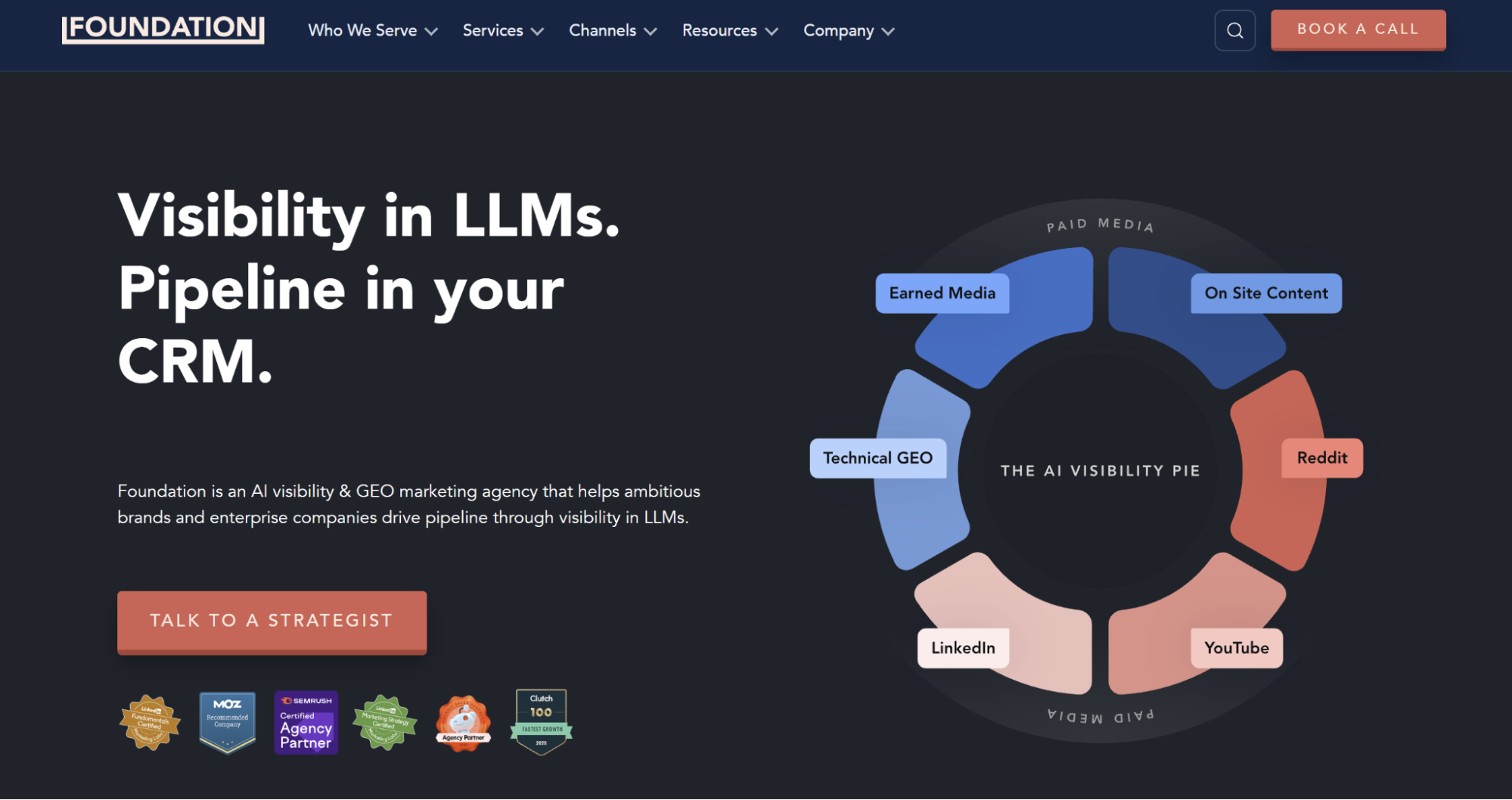
Foundation has probably shifted its positioning more aggressively toward AI visibility than any other agency on this list.
Its current site describes the company as an AI visibility and GEO agency for B2B tech and SaaS, with research and distribution at the center of the model. The team studies LLM citations, query fan-out, Reddit, YouTube, social, and traditional search, then builds distribution across the surfaces feeding those systems.
That distribution bias is the interesting part.
A lot of content agencies still behave as though the company website is the entire playing field. Foundation spends much more time thinking about where content travels after publication, including Reddit threads, LinkedIn, YouTube, earned distribution, repurposed assets, and citation-oriented content.
For a B2B SaaS company that already publishes solid material but has weak reach outside its own domain, that can be a useful complement. It is especially relevant when AI visibility and third-party citation coverage are already boardroom conversations rather than speculative experiments.
Should You Hire an Agency, Build In-House, or Use a Hybrid Model?
There is no universally correct org chart here.
If content is central to your company’s category strategy and you publish enough to keep a senior content lead, SEO specialist, writers, designer, and distribution capability busy, building in-house can make sense. You get tighter product access, faster feedback, and people who live inside the market every day.
The catch tends to arrive in the specialist roles.
You hire an excellent Head of Content, then discover they are also managing technical SEO tickets, link vendors, freelance writers, AI visibility tools, content refreshes, design requests, and PR coordination. At some point, “in-house expertise” turns into one very capable person acting as air-traffic control.
An agency makes more sense when you need several specialist capabilities faster than you can recruit them, or when the workload for each individual specialty would not justify a full-time hire.
The hybrid model is often the healthiest setup we see.
An internal marketing leader owns the customer, product narrative, stakeholder alignment, and commercial priorities. The agency brings the machinery around strategy, SEO, content production, authority, digital PR, or AI visibility. Product and sales experts contribute where their knowledge is genuinely needed without being asked to manage the publishing operation themselves.
What you want to avoid is the worst of both worlds: an agency operating without enough internal access, paired with an internal team that assumes the agency will somehow infer everything it needs.
Questions to Ask Before Signing With an Agency
By the time you reach the sales call, the agency will know how to explain its process.
Ask questions that force it to apply that process to your business.
- What would you prioritize in our first six months, and what would you leave alone?
- Which part of our current content program looks weakest?
- How will your writers learn enough about our product to say something our buyers trust?
- Where do you think SEO and AI-search visibility overlap for us, and where would the work differ?
- What happens after an article gets published?
- Which commercial pages would you support before adding more blog content?
- How do you decide when a page needs links, a rewrite, consolidation, or deletion?
- What would you need from our sales, product, and customer teams?
- Which results would you expect to measure early, and which ones genuinely need time?
- Show us a client where the starting problem looked similar to ours. What did you actually do?
The last question is particularly useful.
Every agency has its favorite case study. You want the one that resembles your mess.
How to Choose the Right Agency for Your SaaS Company
Start by writing down the constraint in one sentence.
“We publish consistently, but organic produces very little pipeline.”
“Our product is technically strong, but the content sounds generic.”
“We rank for the category, but competitors dominate comparisons and AI recommendations.”
“Our content is good, but nobody sees it.”
“We have five years of content debt and no idea what to refresh, consolidate, or kill.”
Each statement points toward a different kind of agency.
Then look for proof from a comparable situation. Similar buyer, similar sales motion, similar category difficulty, similar authority level. Client logos are useful context, but resemblance tells you more.
Pay close attention to the sales process too. A strong agency should diagnose before prescribing. If you have already been handed a 12-month editorial calendar after one discovery call, the strategy is probably more templated than the deck suggests.
And hire for the stage you are trying to reach.
The agency that helped you build the first 50 blog posts may not be the agency you need when the problem becomes category authority, enterprise pipeline, or AI-search visibility. No drama in that. Marketing systems mature, and the bottleneck moves.
Choose a Growth System, Not an Article Supplier
Buying content by the article makes procurement simple. It also encourages everyone to optimize around the wrong unit.
The genuinely useful unit is growth.
Can the partner understand your SaaS product deeply enough to produce credible work? Can it see where the buyer journey has holes? Can it connect content with SEO, authority, distribution, and AI-search visibility? Can it tell you when publishing more would be wasteful? And can it show, with some intellectual honesty, how those decisions are affecting the business?
Those are harder questions than “How many posts do we get?”
And they lead to much better agency relationships.
At Growfusely, that is the kind of relationship we strive for. We work with B2B SaaS companies that want content strategy and production, SEO, AI-search visibility, digital PR, links, and citations pulling toward the same organic-growth goals rather than operating as separate vendors and dashboards.
If your content program is busy but not compounding the way it should, schedule a 1:1 strategy call. We’ll dig into where the system is leaking and whether we are the right team to help fix it.

Pratik Dholakiya is the Founder of Growfusely, a SaaS SEO and AI Search Visibility agency.
