
When people consider getting insurance today, they don’t usually call an agent first. They Google or use an LLM like ChatGPT to weigh their options.
They look up quotes and compare coverage plans. They read reviews online across platforms like Google and Reddit.
SEO for insurance companies puts you in front of these people with the answers they’re looking for. Organic search has become the front door of the insurance buyer journey.
And ranking in search isn’t just about bringing in more traffic. It’s about establishing trust and credibility with potential leads. It’s how you build long-term brand equity.
In this guide, you’ll learn what modern insurance SEO looks like, from core technical essentials and content strategies to local visibility and AI-powered discovery. You’ll also see how SEO for insurance agencies and brokers supports growth at every stage of the funnel.
Why Insurance Companies Need SEO
It’s the age of self-discovery and self-learning. People know they need insurance, and don’t wait for a flyer or cold call. They type questions into Google. Or ask ChatGPT what coverage they need.
Search is where buyers start and where many decisions are shaped. If your insurance company doesn’t appear in those moments, your competitors’ definitely will.
SEO for insurance companies and agents helps you claim that visibility. It gets your brand in front of people actively researching policies, comparing providers, or trying to understand risk.
And that visibility builds credibility. If your content shows up often, answers clearly, and feels trustworthy, you become part of the decision-making process.
Insurance SEO also gives you a long-term advantage. Paid ads disappear when budgets dry up. SEO compounds. The effort you put in today keeps working to pull in traffic, leads, and trust month after month.
If you want a durable growth channel that supports both agents and brokers, it’s SEO for the win.
Foundational SEO Strategy for Insurance
Strong SEO starts with a strong strategy. For insurance companies, that strategy needs to reflect how people search, what they’re trying to solve, and how you can help them decide.
Begin with a full SEO audit. Look at your site structure, page performance, indexing, and on-page elements. Spot technical gaps before scaling your content.
Next, understand user intent. Insurance buyers don’t all search the same way. Some want definitions. Others want comparisons. Many just want to know what’s covered. Match content to their stage in the journey.
Then, build a keyword strategy tailored to your products and services. Focus on high-intent, long-tail terms like:
- “Best term life insurance for new parents”
- “What does general liability insurance cover?”
- “Home insurance quote [city name]”
These are easier to rank and own. Map those keywords to content types that make sense:
- Awareness = blog posts and glossaries
- Consideration = product pages and comparison guides
- Conversion = landing pages and quote tools
The best SEO strategy for insurance companies connects search behavior with business goals. It brings structure to your SEO and content production efforts.
On‑Page SEO
You can’t rank without establishing relevance. That’s what on-page SEO helps you do.
Start with your titles and meta descriptions. These are the first things users see in search results. Make them clear, helpful, and focused on real questions.
Use headers to organize content. Break up pages with H2s and H3s that match how people search. Think:
- “How much does renters insurance cost?”
- “What does umbrella insurance cover?”
This Q&A format helps you show up in both Google and LLMs like ChatGPT.
Write URLs that are clean and readable:
Good: /car-insurance-florida
Bad: /page?id=4732&type=auto
For each page, create content that answers specific search queries. If someone asks what’s included in a policy, ensure your answer comprehensively covers that exact query and nothing else.
Put emphasis on your key service and coverage pages. These are high-intent pages that should rank for bottom-of-funnel terms. Use internal links to guide people from general blog posts to these conversion pages.
Add structured data where relevant. Use schema to highlight insurance products, reviews, and FAQs.
On-page optimization is how you help both users and search engines understand what you offer.
Technical SEO Essentials
Technical SEO is the part users never see but search engines notice right away. Poor technical SEO means your site, even if it has the finest content on offer, may never rank well.
Start with your site architecture. Make sure pages are organized, crawlable, and easy to navigate. No broken links, orphaned pages, or duplicate content.
Mobile-first is non-negotiable. Most people researching insurance do it on their phones. Your site needs to load lightning-fast, look clean, and work across all devices.
Page speed matters. For this, compress images, reduce scripts, and eliminate anything that slows the experience. Use tools like PageSpeed Insights to catch issues early.
Set up your sitemap and robots.txt file. Help search engines find what you want indexed and avoid what you don’t. Use canonical tags to prevent duplicate content problems. Especially if your agency operates in multiple regions or offers similar plans with minor variations.
Make sure your entire site runs on HTTPS. This is the bare minimum today and isn’t just a trust signal but a ranking factor.
Insurance SEO relies on a solid foundation. If the back end of your site is broken, the front end won’t perform, no matter how good your content is.
Content Strategy for Insurance SEO
Content is where SEO meets your customer. It’s what turns searches into sessions and sessions into leads.
In insurance, content should ideally be all about providing valuable education. Create articles that explain terms, cover common questions, and help people understand their options. Think:
- “How deductible works in health insurance”
- “Liability vs. comprehensive auto coverage”
- “Business interruption insurance: what’s covered?”
Build content clusters around key insurance themes. One core page, supported by related posts, guides, and FAQs. This helps with both ranking and readability.
Add real FAQ pages based on what people actually search for. Tools like Google Search Console and AnswerThePublic can help you find these.
Plan your content to guide users from awareness to decision. Blog → explainer → product page → quote form. For this, clear internal links and calls to action (CTAs) sprinkled carefully will help both the users and your business goals.
Content is where SEO for insurance brokers and agents really pays off. It builds trust, answers questions, and shows up at every step of the buyer journey.
Local SEO for Insurance Companies
Most people looking for insurance want something nearby: a local office, a trusted agent, or a regional provider. And so, local SEO for insurance companies is an absolute must.
Start by claiming your Google Business Profile. Fill it out completely. Use the right business categories. Add hours, services, and photos. Try not to leave anything blank.
Target local keywords on your landing pages:
- “Home insurance in Austin”
- “Auto insurance agent near me”
- “Best insurance agency in Tampa”
Keep your Name, Address, and Phone Number (NAP) consistent across directories. Use tools like Moz Local or Yext to manage this at scale.
Encourage customer reviews on Google, Yelp, and industry sites. Respond to all reviews, positive or negative. They signal trust and help rankings. If you work with brokers or independent agents, give them individual profile pages optimized for their locations and specialties.
Local SEO for insurance agents is your best bet in showing up when nearby buyers are ready to act.
Off‑Page SEO & Authority Building
Trust-building doesn’t stop at your website. Search engines keenly look at what others say about you. That’s where off-page SEO comes in.
To make them engines happy, you need to be earning backlinks from credible sources like insurance directories, local news sites, and industry blogs. These links signal authority and help you rank higher.
You can also partner with complementary businesses. A guest article on a finance blog or a feature in a real estate newsletter can drive both traffic and relevance.
Submit your site to trusted directories: NAIC, local chambers, industry associations. Make sure your info is accurate and consistent.
Encourage organic mentions and reviews from every customer (nudge but never be pushy about this). The more people talk about your brand online, the more credible you become in the eyes of search engines.
Digital PR helps big time. Launch an original research report, share anonymized data, or publish a customer success story. Reach out to journalists and industry sites to get featured.
All in all, for insurance SEO to work long-term, you need authority. That comes from showing up not just on your site, but across the web.
AI SEO & Generative Engine Optimization (GEO)
Search is no longer just ten blue links. Tools like ChatGPT, Google AI Overviews, Gemini, and Perplexity are changing how people discover information and how your content gets surfaced.
That’s where AI SEO and GEO (Generative Engine Optimization) come in.
Traditional SEO focuses on ranking in search results. GEO focuses on getting picked up by AI models that generate answers. If your content isn’t structured for AI, it may never appear, even if it’s accurate and helpful enough to be ranking in the traditional ten blue links.
Here’s how to adapt:
- Use clean subheadings and short paragraphs
- Answer specific questions early in the content (TL;DR bullets or a Summary)
- Use schema to help machines understand your page
- Structure content around topics and themes instead of just optimizing for keywords
- Write clearly, concisely, yet comprehensively enough to be quoted
- Write in a Q&A format for informational pages
Your goal is to show up in AI summaries, featured snippets, and conversational responses inside AI tools. Because SEO for insurance companies and agents is now part technical, part editorial, and part generative. Optimizing for both human and machine readers is the new standard.
Measuring SEO and GEO Success
If you’re investing month-on-month in SEO, you certainly want to know what’s working and what’s not.
Start with the basics:
- Organic traffic
- Keyword rankings
- Page-level performance
- Bounce rate and time on site
These give you a fair idea of how many visitors you’re pulling in and for which keywords, and whether your content is engaging enough to stick around.
Then dig deeper:
- Lead quality: where did that form fill or quote request come from?
- Conversion rate by landing page
- Attribution: how did content assist the sale?
Use tools like Google Analytics, Search Console, and a CRM to track the full journey. From first visit to final policy.
For AI SEO and GEO, you basically need to monitor visibility in AI tools. Check if your content appears in Google AI Overviews or gets cited in ChatGPT responses for your desired questions and queries. If it’s not, restructure your content and direct answers to increase the odds.
Set up regular reports for both SEO and GEO. Review what’s improving, what’s stalling, and what needs to be replaced. A good SEO strategy for insurance companies is iterative. The more you learn, the sharper your strategy becomes.
Insurance SEO Agencies
If you’re looking to outsource the SEO headache to an agency that knows its stuff, here are five great options to pick from.
1. Growfusely
Growfusely is a growth‑focused SEO and content marketing agency that helps B2B brands, including insurance providers, build organic visibility, authority, and long‑term search performance.
Our work combines strategic keyword targeting, content planning, on‑page and technical SEO, and emerging practices like AI SEO and GEO to improve rankings and visibility for competitive insurance queries.
Growfusely’s expertise in structured content, search behavior analysis, and organic strategy helps insurance companies and agencies attract qualified traffic and nurture it into leads. We also help insurance companies and founders build their thought leadership via LinkedIn content and digital PR.
Schedule a meeting to have a one-on-one strategy chat with our founder.
2. OuterBox
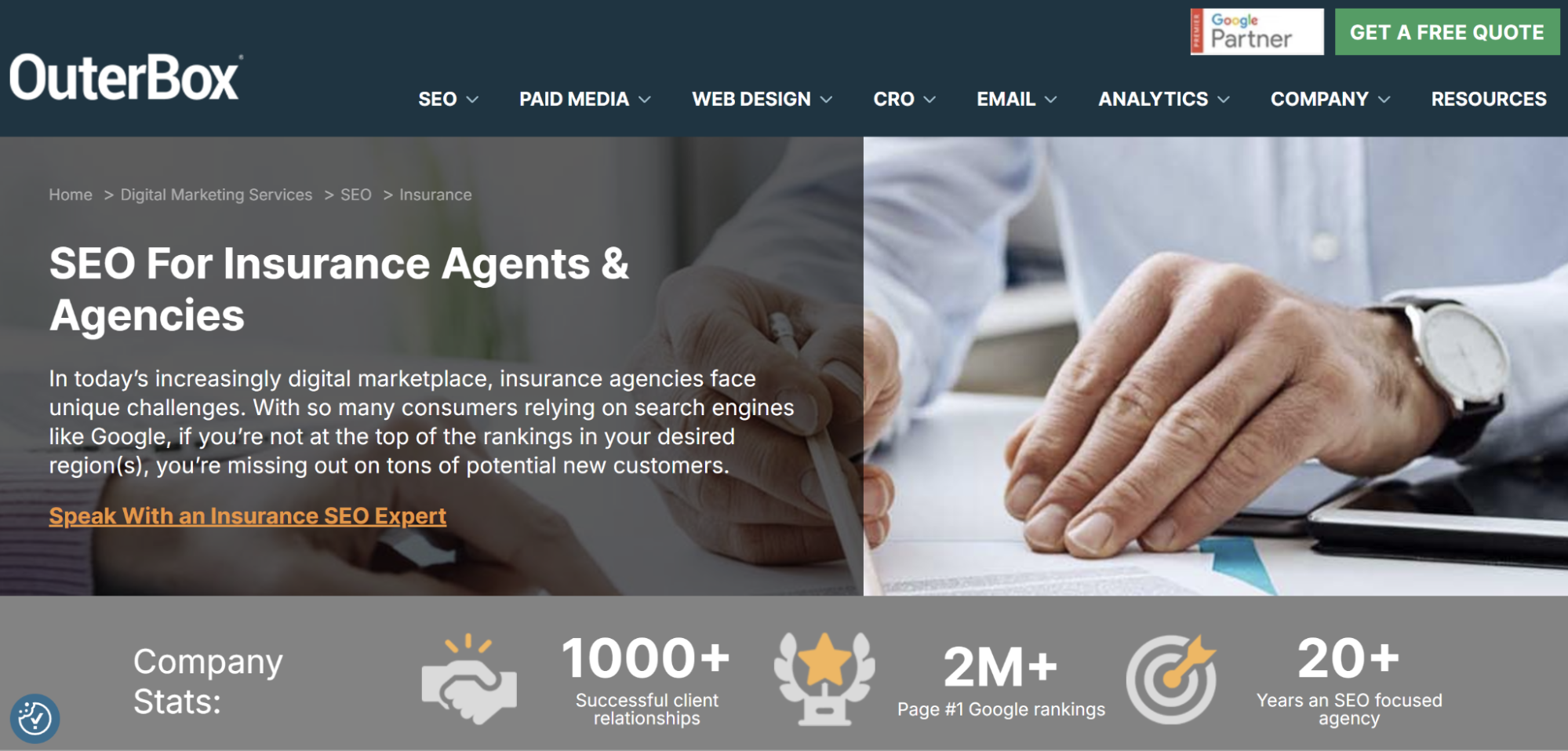
OuterBox is an experienced SEO agency that adapts search optimization for SEO for insurance agencies and SEO for insurance agents at both local and national levels. They’ve worked with a range of insurance clients, using techniques like local SEO, structured on‑page optimization, link building, and technical SEO to improve organic visibility and drive new business. Their focus on tracking and iterative SEO helps agencies compete in crowded search landscapes.
3. SeoProfy
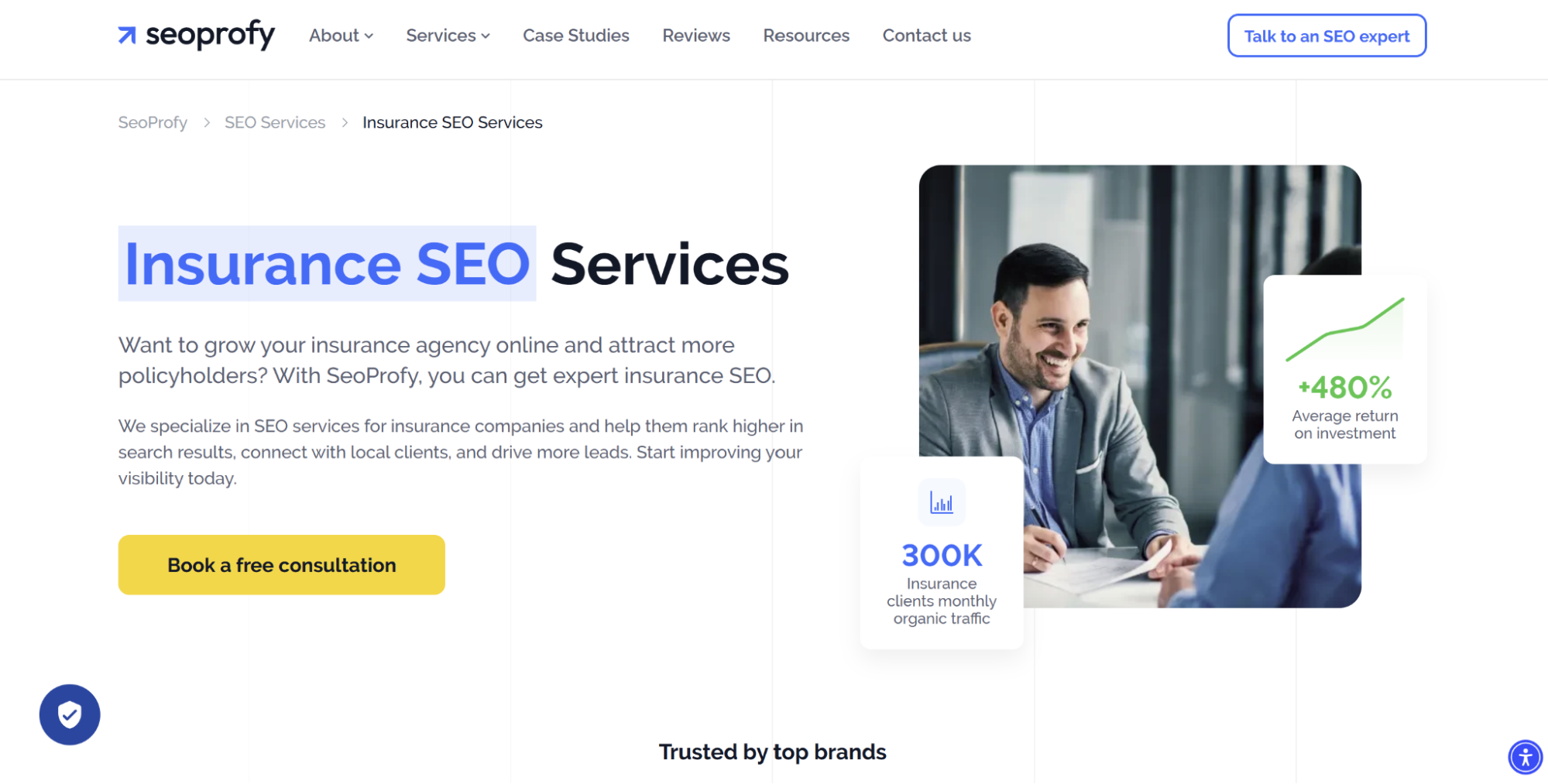
SeoProfy specializes in SEO for insurance companies and brokers, helping them increase visibility and connect with local and national audiences online. Their services include keyword research, content optimization, technical SEO, and lead‑driven strategies tailored to the insurance niche. SeoProfy’s industry focus allows them to align SEO tactics with regulated insurance marketing environments.
4. InsuranceSplash
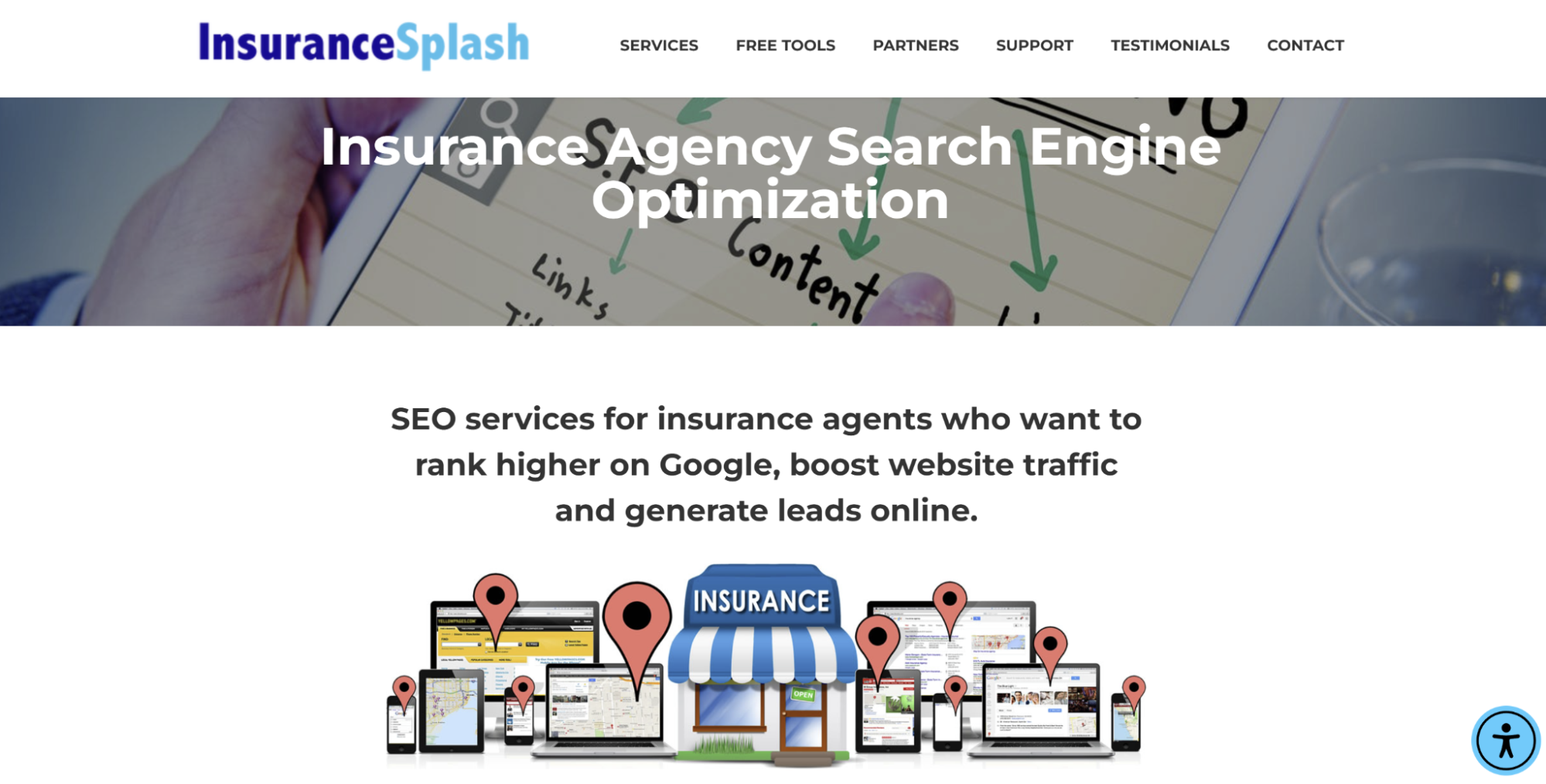
InsuranceSplash focuses on insurance SEO services for small to medium‑sized agencies and agents looking to boost search traffic, generate leads, and improve search visibility without long‑term contracts. Their offerings include local and organic SEO tactics designed to help insurance marketers show up in relevant searches and capture local demand.
5. Thrive Internet Marketing Agency
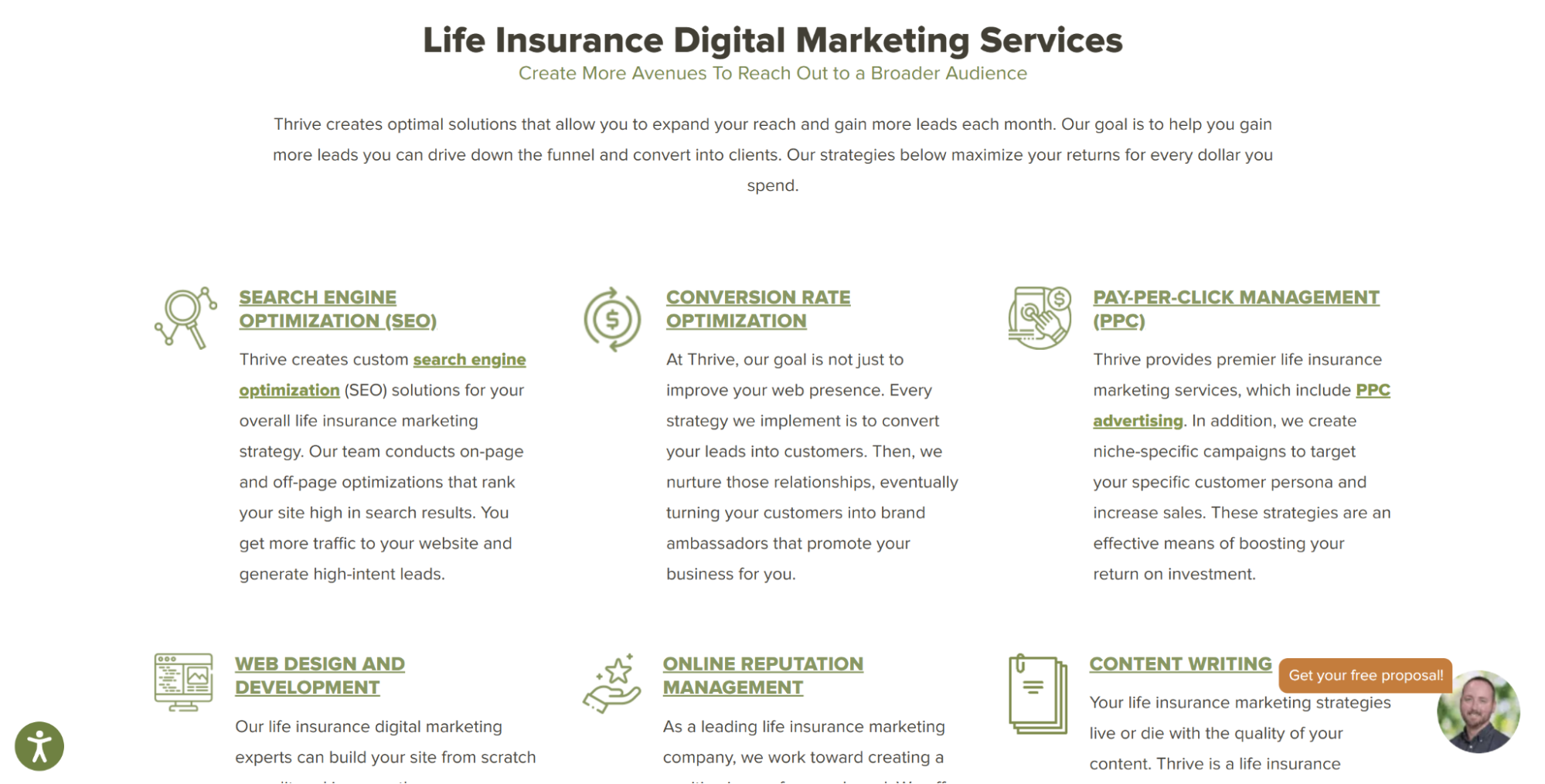
Thrive is a full‑service digital marketing firm based in Texas known for strong SEO for insurance companies and related search‑driven strategies. They combine technical SEO, content creation, local optimization, and search visibility tactics that help both national carriers and local agencies rank higher, attract qualified traffic, and convert organic prospects into leads. Thrive’s approach aligns with insurance industry needs, balancing compliance with measurable growth goals.
Compliance, Governance & Risk Management
SEO for insurance companies doesn’t happen in a vacuum. Every piece of content must comply with advertising rules, industry regulations, and legal standards.
That means you can’t publish whatever ranks: you need checks in place.
First, make sure content doesn’t overpromise. Avoid guarantees, coverage claims, or vague language that could mislead. Always use clear disclaimers and disclosures to safely communicate value.
Build a review system that connects your SEO, legal, and compliance teams. Content should pass through proper checks before going live. Use collaborative tools or workflows to speed this up without skipping steps.
If you’re using schema, AI SEO, or GEO techniques, be extra careful. What you surface in snippets or summaries must reflect the actual product terms.
Regulatory bodies watch insurance marketing closely. A single inaccurate claim can invite audits or fines. That’s why SEO strategy for insurance companies must blend performance goals with governance discipline.
Wrapping Up
SEO is a long-term growth infrastructure. It puts your agency or brokerage in front of the right people at the right time. It builds trust with every search. It attracts high‑intent leads who are already asking the questions you can answer.
From technical fixes to localized landing pages to structured content that shows up in AI summaries, everything you’ve read in this guide helps you build a durable, long‑term advantage.
Whether you’re focused on SEO for insurance agents, brokers, or national carriers, the principles stay the same: be findable, be useful, be compliant.
Are you looking for a partner to help execute it all? Schedule a call with our founder to learn how we help insurance firms scale organic traffic and conversions with strategic, no-nonsense SEO.

Pratik Dholakiya is the Founder of Growfusely, a SaaS SEO and AI Search Visibility agency.
