
In 2010, four engineers in Pune bonded over an unusual hobby: running virtual treasure hunts online. What began as a playful experiment soon sparked an audacious idea.
Krishna Depura, Mohit Garg, Deepak Diwakar, and Nishant Mungali dreamed of bringing that same spirit of engagement to the dull world of corporate training. The quartet came well-prepared: Depura had stints at IIT Roorkee, Microsoft, and PubMatic. Garg brought business chops from ISB Hyderabad, Stanford, and PwC, while Diwakar and Mungali were IIT-trained tech whizzes.
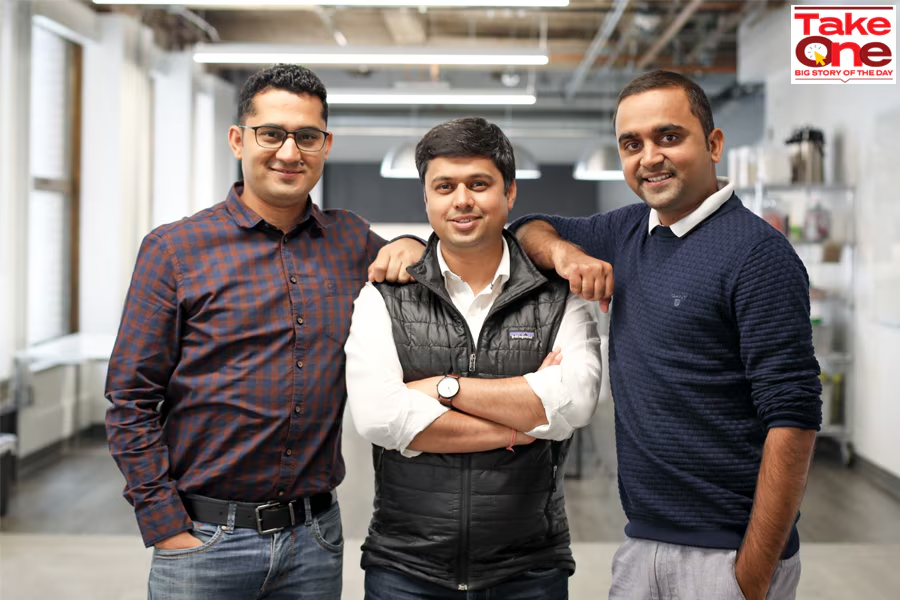
“We thought we had figured out the sweet spot for the B2B product,” recalls Depura. In 2011, they officially founded Mindtickle. It’s playful in name but serious in mission: to “tickle the mind” by making corporate learning as engaging as a game.
The idea was to transform tedious training into interactive experiences. New hires could play through modules like levels in a treasure hunt, earning points for completing quizzes on company culture and policy.
“Employees would get points, learn about the company, and then move on to the next level,” Depura says.
Early validation came quickly. Accel Partners led a seed round in 2012, and pilot customers like Yahoo! and InMobi signed on. The founding ethos was clear: learning should be fun, rewarding, and continuous.
Early Days: MVP, First Wins, and a Hard Lesson
Mindtickle’s minimum viable product (MVP) centered on employee engagement: a gamified onboarding and training tool. The platform quickly proved effective at injecting excitement into orientations and sales bootcamps.
“We realized that employee learning was severely lacking,” recalls co-founder Nishant Mungali. Companies loved the engagement, but to truly add value, Mindtickle needed to go beyond fun quizzes: it had to ensure people actually learned and retained knowledge.
The team began layering richer content and assessments on top of the gamified shell, shaped by feedback from early adopters like Yahoo and InMobi. Still, introducing a novel solution meant “difficulty landing one client, let alone five,” Mungali says. They leaned on personal networks to run successful pilots, turning those early believers into proof points.
Even so, venture capital interest in India remained cool. Enterprise SaaS was nascent, and many investors sat on the fence. Depura later quipped, “Everybody was cheering us from the ringside. But nobody was willing to take a bet on us.”
By 2015, Mindtickle had modest revenue and a growing team, but VCs kept asking them to “come back after 6 months.” They were ahead of their time in India, pitching to customers who weren’t ready.
“We were trying to sell petrol to people riding cycles,” Depura said. Indian businesses saw gamified training as a “vitamin,” not a “painkiller.” That insight would become pivotal.
Pivot to Sales Readiness: Finding the Real Market
In 2015 came the startup’s “aha!” moment. Usage data revealed that a subset of customers (mostly in the U.S.) were using Mindtickle not just for onboarding, but to train sales teams.
The founders dug deeper. Industry forums and LinkedIn revealed a surge in interest around sales enablement. Companies needed to ramp up reps faster and improve performance in the field.
“The pain was in the US market,” Depura says. American firms were hungry for a cure to lagging sales productivity, and Mindtickle could be that painkiller.
So the startup made a bold pivot. It refocused the product on sales readiness: onboarding, training, coaching, and certifying reps. And, it shifted its Go-to-Market to the U.S., even relocating key team members. Depura joked they finally “geared up to sell petrol to those with bikes—and they wanted high speed.”
Within six months, Mindtickle signed several American clients. “For any sales pain, Mindtickle was fast turning out to be an effective pain killer,” Depura recalls.
Small deals turned into six-figure contracts and multi-million dollar agreements. In late 2015, this traction led to their $12.5 million Series A round, led by NEA with Accel participating.
“We got our first validation in the US, not in India,” Depura notes, as a “tsunami of new customers” followed through referrals and word of mouth.
With product-market fit secured, Mindtickle had found its true path forward.
Climbing Up: Product Evolution and Scale
From 2016 onward, Mindtickle evolved rapidly from a niche training tool into a full-fledged sales readiness platform. Gamification remained core, but the platform became far more comprehensive.
Mindtickle’s roadmap began to mirror the entire sales enablement lifecycle: onboarding, training, coaching, content management, and analytics. By 2017, the company began branding itself as a “Sales Readiness” solution, effectively pioneering a new category.
This category-creation mindset became a strategic moat. In 2018, Mindtickle introduced AI and machine learning to power coaching and assessments.
Managers could automatically transcribe and analyze sales reps’ role-play videos, flag keywords, and score performance. These “machine-assisted evaluations” gave sales coaches quantitative insight and targeted feedback.
Virtual role-play functionality let reps simulate sales conversations via video and receive AI-generated improvement tips. Mindtickle also added tools for quick micro-learning content creation, enabling trainers to record and push out short lessons to the field.
New dashboards with heat maps and radar charts helped managers identify reps needing extra coaching. By 2019, the platform offered 60+ pre-built integrations to systems like Workday, Salesforce, Box, and Google Drive—making it easy for companies to plug Mindtickle into their tech stack.
Mindtickle became an all-in-one sales enablement suite, combining learning management, practice simulations, coaching, and performance analytics.
As the product matured, industry recognition followed. In 2018, Aragon Research cited Mindtickle’s “coaching framework with role-specific competency maps” and integrations as differentiators, naming it a leader in Sales Coaching and Learning. Gartner also listed the company among notable vendors in its sales training and coaching reports.
In 2019, Mindtickle raised $40 million in Series C funding led by Norwest Venture Partners to accelerate product innovation and global expansion.
By 2020, the COVID-19 pandemic made remote sales training essential. In-person sessions and ride-alongs were obsolete overnight. Mindtickle’s cloud platform became mission-critical.
“Now you don’t need to build technology. You can buy it, you can subscribe to it,” Depura noted of the SaaS shift. Companies hesitant about third-party tools quickly adopted platforms like Mindtickle to keep revenue teams sharp.
In mid-2020, even amid budget cuts, Mindtickle’s growth continued. That year, SoftBank’s Vision Fund made its first-ever SaaS investment in India by leading a $100 million round in Mindtickle.
Less than a year later, SoftBank invested another $100 million, pushing Mindtickle’s valuation to $1.2 billion.
The product focus also broadened from sales readiness to “revenue readiness,” expanding to roles like marketing and customer success.
In 2021-2022, Mindtickle launched Asset Hub, a Sales Content Management module, to marry training with sales collateral delivery. In November 2022, it introduced “binge-worthy” enablement experiences with Digital Sales Rooms, guided selling workflows called “Plays,” and “Key Moments” insights using conversational intelligence.
“The worlds of sales training and sales content management are converging,” Depura said, noting the company’s effort to bridge both in a single platform.
In 2023, Mindtickle acquired Enable Us, a digital sales room startup, to strengthen its buyer engagement capabilities.
“This acquisition represents the perfect combination of the respective leaders in sales enablement and buyer enablement coming together,” Depura said.
It marked Mindtickle’s transformation into a full revenue productivity platform: training sellers, coaching managers, and empowering buyers through a unified experience.
Growth Trajectory: By the Numbers
As Mindtickle’s product advanced, so did its market footprint. The company’s growth trajectory over the past decade paints a picture of relentless upward momentum.
Customer Base
From those first few pilot customers in 2012, Mindtickle multiplied its clientele dramatically. By 2018, the company had grown its enterprise customer count by 200% year-over-year, including multiple Fortune 500 firms.
As of 2021, Mindtickle reported over 250 enterprise customers, with roughly 80% of revenue coming from the United States (and the rest from Europe and Asia). Just a year later, Mindtickle’s solutions were being used by more than 2,000 enterprises worldwide, including giants like Cipla, Unisys, MongoDB, Merck, Nutanix, and Cloudera.
Many customers started small with a pilot and then expanded company-wide once they saw results. Today, the company serves a broad array of industries: technology, life sciences, finance, and more. Essentially, any organization with a large sales team to train.
Revenue
Mindtickle is privately held and doesn’t disclose detailed financials, but available indicators show remarkable growth. The company’s annual recurring revenue (ARR) is estimated to have climbed from around $40 million in 2020 to $118 million by mid-2023, reflecting roughly 60%+ yearly growth.
In other words, in just three years the startup nearly tripled its top line, which is a testament to the surging demand for sales enablement tools. (For context, Mindtickle’s India entity reported ₹290 Cr revenue in FY2024, roughly ~$35-40 million, but much of its global ARR likely books under its U.S. arm.)
By reaching the $100M ARR milestone, Mindtickle joined an elite club of SaaS companies, and it did so faster than many expected. Notably, this growth has been capital-efficient: while it raised substantial funding, Mindtickle’s revenue multiples suggest it put that capital to productive use.
Funding and Valuation
Mindtickle’s fundraising history mirrors its pivot and growth story. After the 2012 seed round (led by Accel) and some angel funding, the startup’s big break was the Series A in November 2015 ($12.5M led by NEA).
Then came the Series B in 2017 ($27M led by Canaan Partners, with Accel, NEA, and Qualcomm Ventures following-on). The Series C in mid-2019 brought in $40M (led by Norwest).
The pivotal SoftBank-led rounds—Series D in Nov 2020 ($100M) and Series E in Aug 2021 ($100M)—together catapulted Mindtickle’s valuation past the $1 billion mark. In total, the company has raised about $281 million in venture funding to date.
Each round was tied to key inflection points: Series B for product expansion and U.S. growth, Series C for scaling global sales, and the SoftBank rounds for doubling down in a market Mindtickle helped define.
By 2021, investors valued Mindtickle at roughly $1.2 billion, making it one of India’s SaaS unicorns. Despite this hefty valuation, Depura has been candid that the company prioritized growth over short-term profitability.
“We are not profitable. But that’s by design,” he told Forbes India, emphasizing a land-grab approach in a category they were leading.
Team and Geographical Expansion
Mindtickle began as a small Pune-based team and has since grown into a global organization. Following its success in the U.S., the company established a headquarters in San Francisco while retaining Pune as a major R&D center.
It also opened offices in London and other locations to support European clients. Headcount scaled accordingly: Mindtickle roughly doubled its team in 2018 alone, adding over 110 employees that year to support new customers.
By 2020, the company crossed 500 employees, and at its peak around 2022 it reportedly had over 1,000 staff across continents. As of 2023, Mindtickle employs about 700+ people globally, including a sizable engineering team (nearly 40% of staff) and a growing salesforce to drive enterprise deals.
This distributed workforce allowed Mindtickle to tap India’s deep pool of engineering talent while being close to its primary customers in North America. Over time, the leadership bench also expanded beyond the founders: seasoned executives in sales, marketing, and finance (from companies like Salesforce and Oracle) joined to lead the next phase of growth.
Go-to-Market Evolution
Early on, Mindtickle’s go-to-market was founder-led and focused on direct sales to tech companies willing to try an innovative product. Post-pivot, the company invested heavily in a U.S.-based enterprise sales team and customer success function.
Mindtickle also built a partner network: by 2018, it had 25+ channel partners (training consultancies and sales coaches) who brought Mindtickle into large client engagements. This helped extend its reach to Fortune 500 firms in industries like pharma and finance.
The sales cycle often started with a small use-case (like onboarding one regional sales team) and, once success was proven, scaled to thousands of users across the enterprise.
Mindtickle’s referenceable customer list and high user engagement figures (often 80-90% completion rates for training programs) became powerful sales tools in themselves. Additionally, the company’s thought leadership in “sales readiness”, including publishing frameworks and hosting events, helped educate the market and solidify Mindtickle’s reputation.
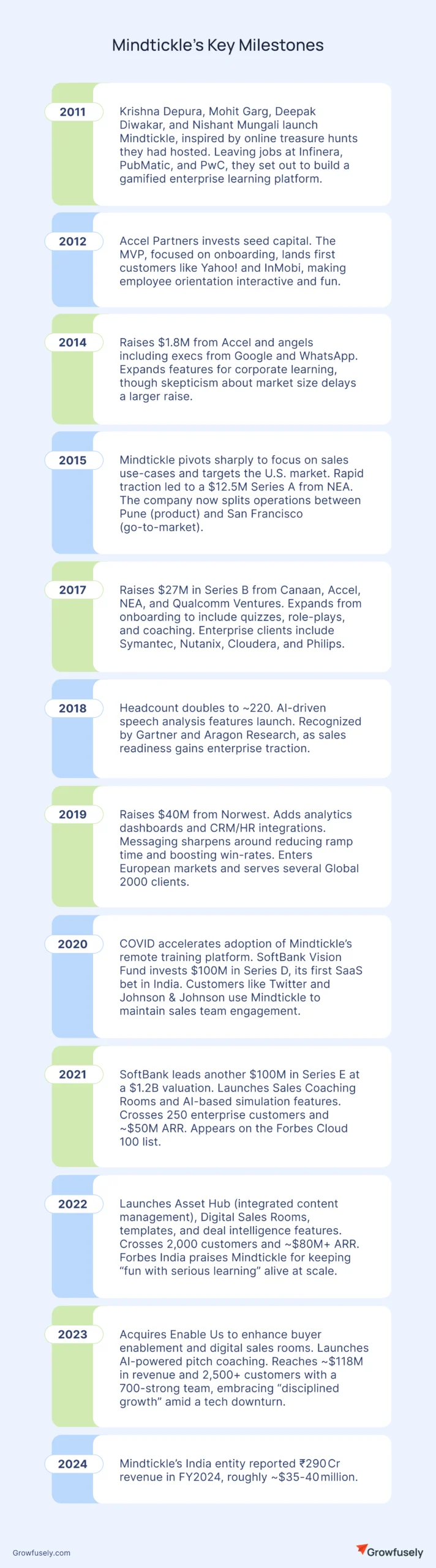
Below is a timeline of Mindtickle’s key milestones, highlighting how the journey unfolded year by year:
Challenges on the Journey: Pivots, Competitors, and Growing Pains
Mindtickle’s rise has not been without challenges. Building a company from a playful idea into a global SaaS leader required navigating multiple hurdles.
1. Educating a New Market

In the early days, Mindtickle’s biggest hurdle was market education. Gamified corporate learning and “sales readiness” were unfamiliar ideas. The team leaned on their CXO network to gain early adopters and slowly built credibility.
Over time, sales readiness became mainstream. As Canaan’s Joydeep Bhattacharyya said in 2017, “Sales readiness is the single most important metric every public company CEO is paying attention to… Mindtickle is the leader in this new area.” But that recognition took years of evangelism.
2. Pivot and Focus
Mindtickle’s original strategy of targeting Indian corporates didn’t scale. In 2015, the founders made a critical pivot to focus on U.S. markets and sales use-cases. It was a difficult reset after four years of work but proved transformative.
The company carefully transitioned existing customers and reoriented its product. The shift taught the team a lasting lesson: finding product-market fit sometimes means redefining your market entirely.
3. Competition
As the category grew, Mindtickle faced serious rivals: Highspot, Seismic, Showpad, SalesHood, plus giants like Oracle, SAP, and Microsoft. Its edge came from a unified platform and engaging UX.
“Mindtickle’s unique combination of gamification, automation, and a strong analytics framework” set it apart, said Depura. Competitors often tackled only parts of the sales enablement puzzle, but Mindtickle connected training, coaching, and analytics into a single feedback loop.
Adoption among sales reps, a group notorious for skipping training, was high, thanks to contests, points, and leaderboards. As one enablement manager put it, “Mindtickle is the first training program our reps want to use.”
Even with capital-rich rivals innovating fast, Mindtickle expanded its capabilities and doubled down on customer success to retain an edge.
4. Scaling People and Culture
Growing to 700+ people across geographies brought organizational strain. The founders hired experienced leaders (CMO, CFO, Head of People) and formalized operations. However, maintaining a startup-like culture proved difficult.
By 2022, some employees cited cultural shifts and growing bureaucracy. Glassdoor ratings dipped to around 3/5. The company responded by reaffirming its values, especially “Our people matter most”, and took pride in fostering entrepreneurship.
Mindtickle alumni have gone on to launch over 15 startups. This “Mindtickle mafia” is both a talent drain and a testament to the company’s legacy. Leadership embraced it, positioning Mindtickle as a founder factory.
5. Managing Growth vs. Efficiency
In 2022, the macro downturn forced Mindtickle to prioritize sustainability. Like many late-stage startups, it enacted targeted layoffs to control costs and realign for long-term growth.
By 2023, Mindtickle emerged leaner, focused on productivity rather than headcount. It was a common shift for SaaS companies maturing past their hypergrowth phase.
6. Pandemic and External Shocks
COVID-19 was both a crisis and a catalyst. Lockdowns initially stalled sales and forced the team to sell, demo, and onboard remotely: “eating their own cooking.”
As remote selling became the norm, demand for Mindtickle surged. The challenge wasn’t demand. It was execution at scale.
Depura observed in 2021 that Indian companies, once hesitant about SaaS, now readily embraced it. The crisis validated Mindtickle’s relevance and pushed the team to stay nimble.
Through it all, the founders leaned on resilience: pivoting when needed, going global early, and weathering downturns. Patient capital from Accel and SoftBank helped.
As SoftBank’s Munish Varma said, “Mindtickle has consistently delivered ahead of plan across all metrics.” But behind those metrics were tough calls and long nights.
On a 4 A.M. Zoom call in 2020, SoftBank’s Masayoshi Son challenged Depura: “Whatever you want to achieve in five years, why can’t you do that in one year?” That pressure pushed the team to think bigger and move faster, without losing their grounding.
Mindtickle’s Moat: Strategic Pillars of Differentiation
Despite competition, Mindtickle has built a defensible position in its domain. Several strategic pillars form its moat.
1. Unified Platform Approach
From early on, Mindtickle chose breadth by integrating multiple functions (training, coaching, content, analytics), whereas others offered point solutions. This one-stop-shop approach means customers can replace a patchwork of LMS, coaching tools, and content repositories with Mindtickle’s all-in-one platform.
Its deep integrations with CRMs and HR systems make Mindtickle a seamless part of the workflow. Once embedded, it’s sticky; switching out would disrupt multiple enablement processes at once.
2. Engagement and Gamification DNA
Mindtickle’s genesis in gamification gave it a user experience edge. The platform includes game-like elements (points, badges, leaderboards) and a friendly interface that “consumerized” enterprise training.
This drove unusually high adoption rates among sales reps, a group famous for sidestepping corporate training. High engagement translates to better data and better outcomes, which reinforces customer loyalty.
Mindtickle turned training from a chore into a competitive sport, leveraging human psychology to ensure completion. That’s a difficult cultural moat for competitors to replicate.
3. Data-Driven Insights and the Readiness Index
A core part of Mindtickle’s moat is its ability to tie learning activities to business outcomes. Its analytics and proprietary frameworks (like the Sales Capability or Readiness Index) allow sales leaders to measure how rep knowledge and skills correlate with performance.
By quantifying readiness, Mindtickle elevated training from a fuzzy HR initiative to a strategic KPI. As the system collects more data, its benchmarks and AI models improve, creating a data network effect.
4. Continuous Innovation (AI and Beyond)
Mindtickle has shown a knack for incorporating emerging tech faster than rivals. It introduced AI/ML features (for coaching feedback, voice analysis) ahead of many peers.
It embraced the shift to virtual selling with features like Digital Sales Rooms. For example, it added an AI-driven pitch practice tool where a rep can rehearse a sales call with an AI persona acting as the customer, something Krishna Depura has enthusiastically talked about. This innovation keeps the product “sticky” and draws enterprises that want a future-proof solution.
5. Customer Success and Outcomes Focus
Mindtickle’s moat also lies in how it engages customers. It built a strong Customer Success arm that helps clients design programs and drive adoption.
In one case, deals where reps used “mutual action plans” had 3X higher win rates. Tangible results like that fortify trust. Satisfied customers become evangelists, leading to referral business. Mindtickle is seen as a critical partner, not just a vendor.
6. Vision and Category Leadership
Mindtickle plays a role as a category creator in “sales readiness.” The team has consistently defined what effective sales enablement looks like.
By coining concepts and educating the market, Mindtickle often sets the narrative others follow. As “revenue enablement” gains traction, it’s already positioned at the forefront.
Its story of turning training from vitamin to painkiller has become the industry’s prevailing narrative.
In summary, Mindtickle’s moat is the composite of product depth, an engaging user experience, data-driven insight, rapid innovation, and strong execution on customer success. This combination has made it, as SoftBank’s Sumer Juneja remarked, an “essential part of any sales organization” that takes sales productivity seriously. While competitors can copy features, replicating this holistic ecosystem is no easy feat.
Lessons for Founders: The Takeaways from Mindtickle’s Journey
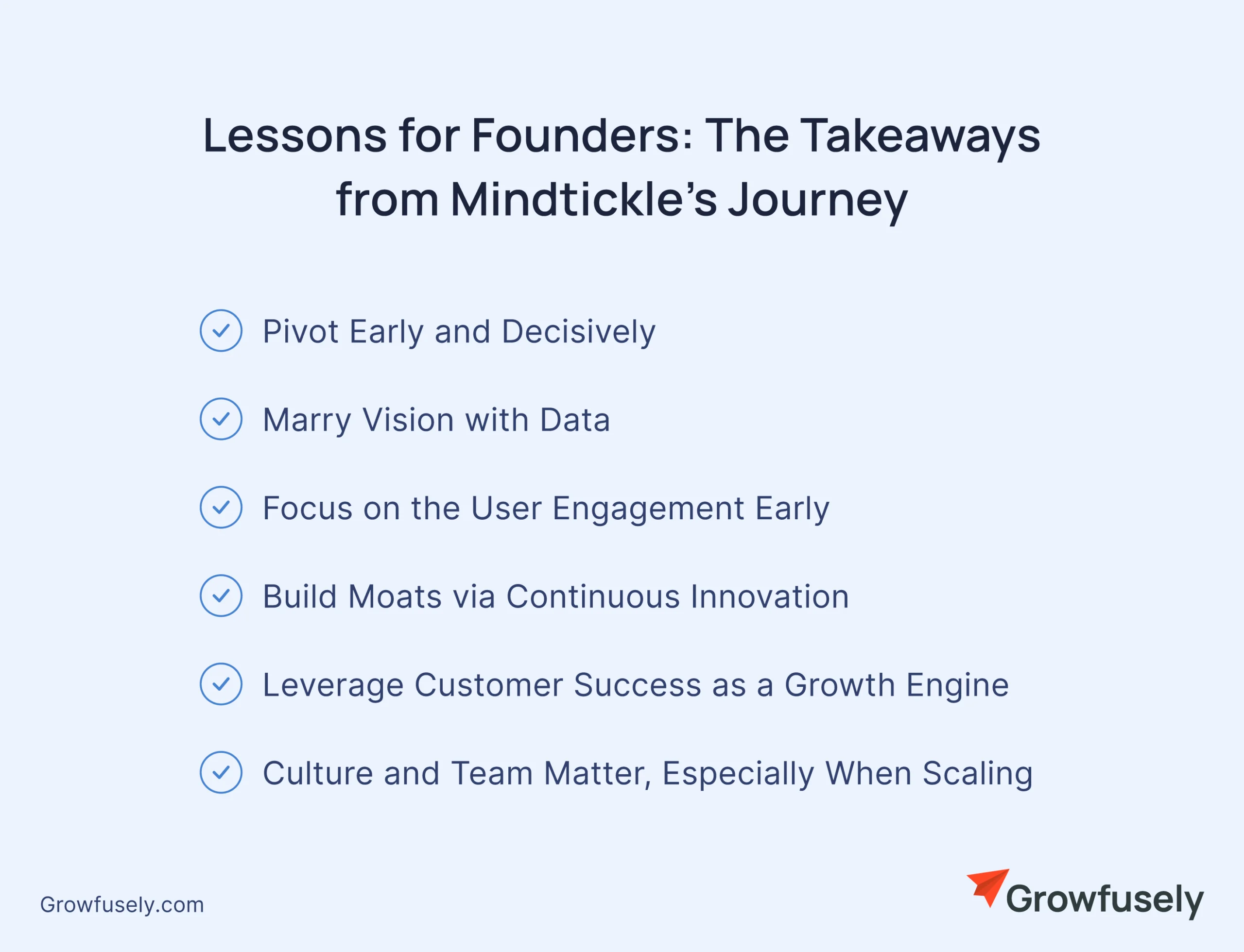
Mindtickle’s rise offers practical lessons for SaaS founders navigating growth, product-market fit, and scaling.
1. Pivot Early and Decisively
Mindtickle’s leap from HR in India to sales enablement in the U.S. wasn’t a small shift. It was a bold pivot that unlocked scale. The founders followed usage signals and weren’t afraid to abandon their first market for a larger, more urgent problem.
The takeaway: your first market might not be your final one: follow the painkiller, not the vitamin.
2. Marry Vision with Data
Mindtickle’s founders had a grand vision of engaging corporate learning, but they also grounded it in data. They used customer usage patterns and LinkedIn research to guide their pivot.
They built analytics into their product to prove effectiveness, which won over skeptics. This combination of storytelling and proof was potent.
3. Focus on the User Engagement Early
Gamification wasn’t a gimmick. It drove stickiness among sales reps. High adoption led to real results, which made renewals a no-brainer.
The lesson: in enterprise SaaS, if the end user doesn’t love the product, expansion won’t happen.
4. Build Moats via Continuous Innovation
Mindtickle did not rest after finding initial success. The team kept pushing the envelope, adding AI capabilities, expanding into adjacent areas like content management and buyer enablement, and acquiring talent/tech when needed. This relentless innovation built layers of moat around the business.
In tech, staying still means falling behind; Mindtickle’s story encourages founders to always ask “what’s next?” and to preemptively solve tomorrow’s customer problems.
5. Leverage Customer Success as a Growth Engine
Mindtickle’s growth was fueled heavily by referrals and expansions within existing accounts. They treated customers as partners, tailored solutions to their needs, and showcased customer wins in their marketing.
For founders, this highlights that nurturing existing customers can drive low-cost growth (through upsells and word-of-mouth) in a way pure sales and marketing spend often can’t. Satisfied customers can become your best salespeople.
6. Culture and Team Matter, Especially When Scaling
Mindtickle’s journey underscores the importance of building a strong team culture early, as it will be tested under growth. The founders were known for being humble, approachable, and fostering entrepreneurship within the team.
As your startup scales, hiring the right leaders to complement the founding team (as Mindtickle did by bringing seasoned execs on board) is crucial. There will be hiccups (e.g., Mindtickle had to deal with some cultural strain and layoffs in later years), but a resilient culture can help weather those times.
Closing Thoughts
In the words of Accel investor Dinesh Katiyar, who backed Mindtickle early, “the team was smart enough to make a course correction” when needed. That humility and learning mindset pervades Mindtickle’s saga.
From a part-time hobby to a billion-dollar company, Mindtickle’s journey shows that success in startups is rarely a straight line. It’s a story of pivots and persistence, customer-centric innovation, and scaling with soul.
Mindtickle’s tale is far from over, but it already offers a rich script for aspiring founders: Keep your eyes on the prize (enable your customers to succeed), be willing to reinvent yourself in pursuit of product-market fit, and never lose the playful spark that sets you apart.

Pratik Dholakiya is the Founder of Growfusely, a SaaS SEO and AI Search Visibility agency.
