
In 2009, two seasoned technologists—Samir Bodas and Monish Darda—were on the brink of comfortable retirements when a new idea pulled them back in.
Bodas, the former CEO of Aztecsoft, and Darda, an executive from BladeLogic, shared an itch to build “something consequential” rather than quietly fade out.
Introduced through a mutual connection at Darda’s previous startup Websym, the pair bonded over a glaring gap they had observed in the enterprise software world.
Despite advances in CRM, ERP, and other systems, one foundational area remained broken: managing contracts.
Contracts, the lifeblood of commerce, were still handled in a fragmented, manual way, often signed and forgotten in file cabinets.
“Before, when you signed the contract, you put it in a cupboard and only if you ran into trouble…you drew it out. Otherwise, you didn’t care,” Darda recalls of the status quo they set out to change.
Thus, Bodas and Darda founded Icertis in Pune, India, with a simple but bold vision: to turn these neglected legal documents into living strategic assets.
“Nothing is more foundational than contract management as every dollar in and every dollar out of a company is governed by a contract,” Bodas later reflected.
The founders weren’t driven purely by profit, as Darda notes, “We decided to build a company, not for making money but to build something consequential”.
Their startup would tackle a mission few others had attempted: bring contracts into the cloud era and unlock the business value trapped within them.
Early Years: Bootstrapping and First Breakthroughs
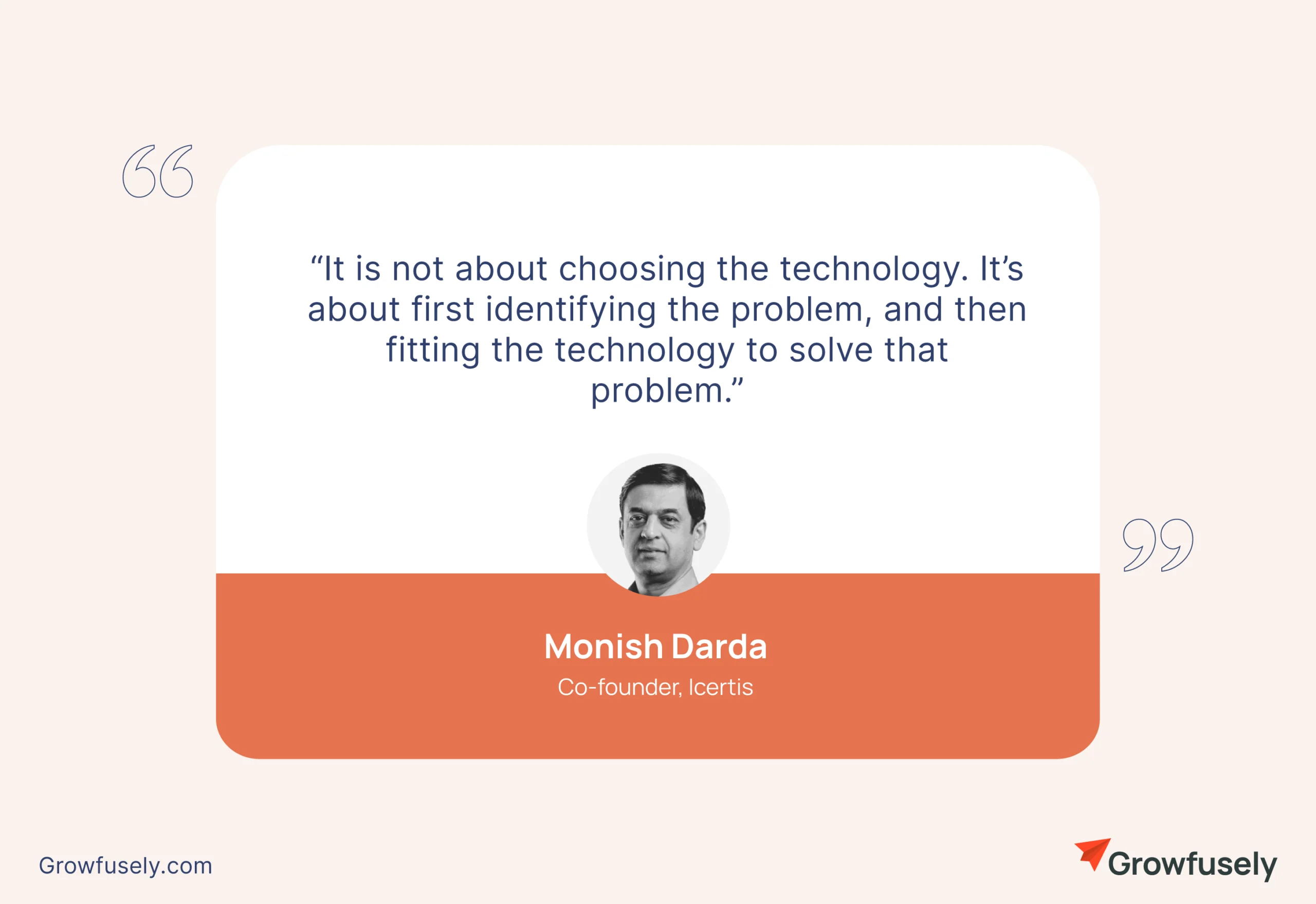
Like many enterprise SaaS startups of its era, Icertis began humbly.
In its first years, the company functioned as an IT services firm, crafting custom cloud solutions for enterprise clients.
But the founders kept gravitating towards the contract management problem.
By 2012, after a few years of sharpening their understanding, they pivoted fully to a product focus: a cloud-based Contract Lifecycle Management (CLM) software built from the ground up.
Rather than retrofitting an old on-premise tool, Bodas and Darda engineered their platform natively on Microsoft’s Azure cloud, which was a forward-looking move at a time when many enterprises still hesitated to trust the cloud.
Their conviction soon paid off. In 2012, Icertis landed a landmark early customer in Microsoft itself, which was searching for a scalable, user-friendly way to manage its thousands of contracts.
Icertis developed a new Contract Lifecycle Management product (ICLM) on Azure, and Microsoft deployed it globally.
“Of all the vendors we evaluated, the Icertis CLM product had the best architecture, the most inspired user interface, and a compelling approach to managing the contract lifecycle,” said Microsoft’s Associate General Counsel, after rolling it out company-wide. This validation from an industry giant gave Icertis a crucial boost in credibility.
Through 2013 and 2014, Icertis steadily built on this traction. The small Pune-based team expanded operations to Europe and across India (opening offices in Mumbai, Delhi, and beyond) to support new customers.
The founders, meanwhile, doubled down on their chosen niche. In 2014, “we finally zeroed in on contract management and have not looked back since,” Darda recalls.
It was a risky bet at the time: “Our journey has been very interesting. We started when CLM was very fractured and a category that was into document management”, Darda notes of those early days.
Many potential investors and clients needed convincing that contracts deserved their own dedicated software.
Funding did not flow easily at first. Icertis raised a small seed round in 2012 to get started, but Bodas and Darda largely bootstrapped growth from early revenues and kept the company scrappy through these formative years.
“For Icertis, convincing Fortune 500 companies to entrust their contracts—arguably some of their most valuable assets—to a young, cloud-native startup was a monumental challenge,” Bodas admits of the uphill battle.
Enterprises worried about security and were skeptical that contract management warranted a specialized solution at all. To overcome this, Icertis prioritized building trust by hardening its cloud platform with rigorous security (achieving early ISO and HIPAA certifications) and delivering stellar customer support to prove a small Indian startup could meet global standards.
Product Evolution: From Managing Contracts to “Contract Intelligence”
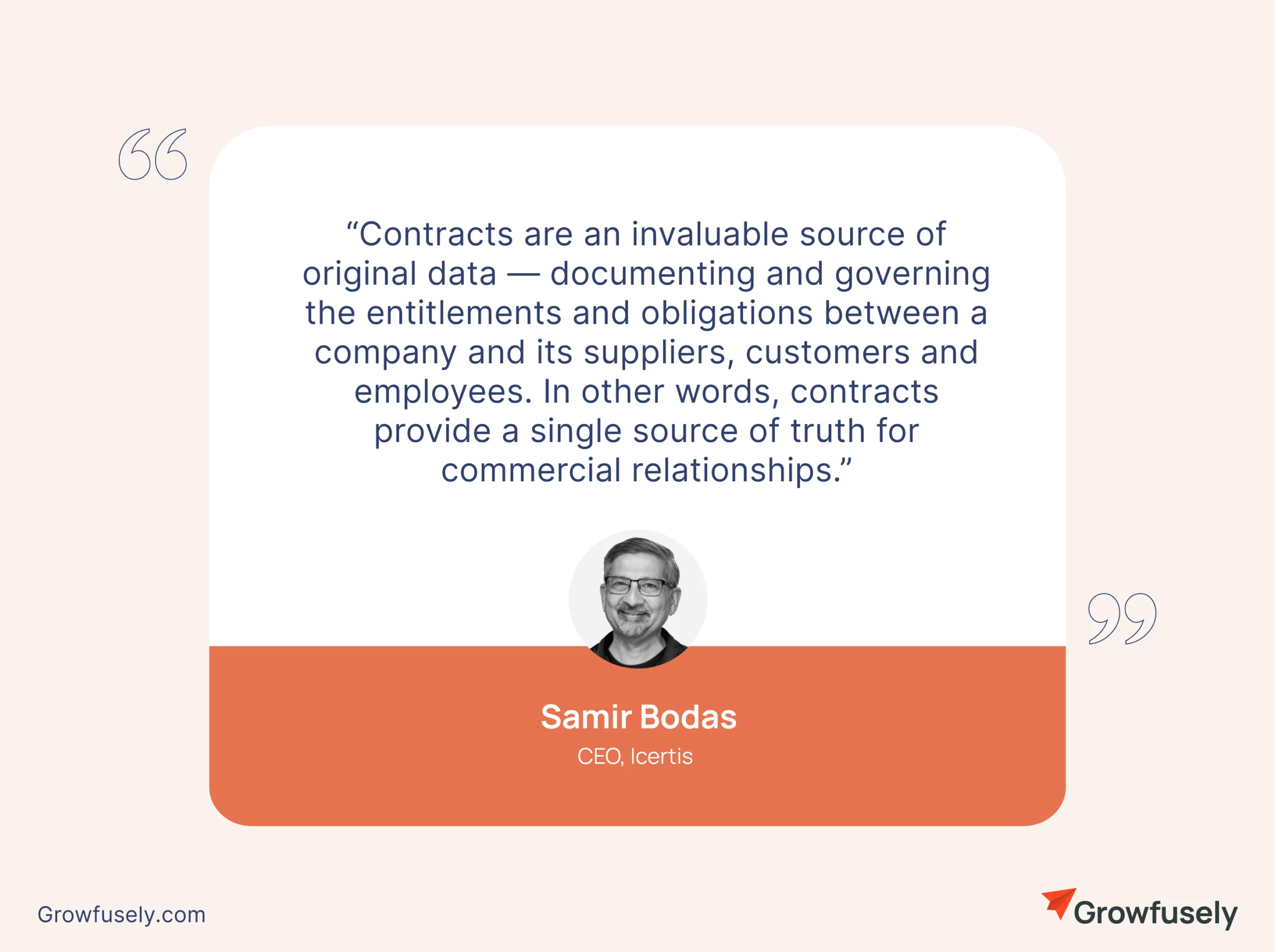
What began as a tool to digitize contracts has, over the years, blossomed into a full-fledged AI-driven contract intelligence platform.
Icertis’ flagship product, known today as Icertis Contract Intelligence (ICI), started with the basics: a central cloud repository to store all an enterprise’s contracts, with workflows to draft, approve, and track them.
Early on, Bodas insisted that the software be “extraordinarily easy to use, highly configurable, quick to deploy, and readily integrated” with ERP and CRM systems. This usability focus helped Icertis stand out against clunky legacy contract tools.
Over time, the platform’s capabilities deepened. By 2015, Icertis could handle all types of contracts—sales, procurement, NDAs, HR, you name it—in one place.
It added features to track whether contract obligations were met, send renewal alerts, and ensure compliance with regulations. As its customer base grew, the system learned to accommodate industry-specific contracts across 40+ languages and 90+ countries.
The real transformation, however, came with the infusion of artificial intelligence.
Years before “AI in contracts” was trendy, Icertis began investing in machine learning and natural language processing to extract insights from contract text. CEO Bodas describes Icertis as “forging and leading a new category of technology called contract intelligence, which uses AI to automate processes and deliver insights with structured, connected contract data”.
In practical terms, Icertis can now read and analyze contracts at scale: flagging risky clauses, modeling contractual relationships, and answering complex questions from contract data.
For example, when inflation spiked recently, companies turned to their contracts for relief: “Do our contracts have clauses to adjust prices for inflation? How often can we raise prices, and by how much?” Icertis can deliver those answers instantly by mining the language in agreements.
By 2023, AI had permeated every layer of the Icertis platform. Three out of four new deals that year included Icertis’s AI capabilities.
The company even launched “Icertis Copilots,” one of the first generative AI copilots for enterprise contracting, to help users draft and negotiate contracts with the aid of large language models.
“For us AI has allowed us to bring the intent of the contract into the real world,” Darda explains, noting that the goal now is not just digitization but to “convert [contracts] into intent”, making sure the business purpose of every agreement is fully realized in practice.
In essence, Icertis evolved from a system of record for contracts into a system of insight and action, turning static documents into what Bodas calls “an untapped source of invaluable business value.”
Growth Trajectory: Revenues, Funding, and Global Expansion

From its modest start in Pune, Icertis has grown into a global SaaS powerhouse. The company’s revenue has soared year after year, crossing $100 million in annual recurring revenue by the end of 2020, and reaching $250 million ARR by early 2024.
As of mid-2025, Icertis was approaching the $350 million ARR mark, putting it well on the path toward “unicorn status” in revenue (not just valuation). The table below highlights some key milestones in Icertis’s journey.

Challenges and Turning Points
Every startup journey has its trials by fire, and Icertis is no exception. One of the earliest challenges was market education: essentially, convincing customers (and investors) that dedicated contract management wasn’t a luxury but a necessity.
When Icertis started, “contract management” was a little-known term outside legal circles.
Many businesses didn’t realize how much value lay hidden in those dusty contract folders. The Icertis team often found themselves evangelizing the idea that “contracts are not just legal pieces of paper; they materially affect the business,” as Darda puts it.
They hammered home how streamlining contracting could reduce costs and risks. For instance, showing a German auto giant in 2015 that better contract processes could shave months off its new car development cycle.
Another ongoing challenge was competition. Early on, Icertis faced inertia from legacy software giants like SAP, Oracle, and IBM, which offered clunky contract modules as part of larger suites.
As the CLM market heated up in the late 2010s, a wave of startups (e.g. Apttus, which became Conga; SirionLabs; ContractPodAI; LinkSquares) also jumped in with automation-fueled offerings.
Icertis responded by staying “in pole position”: expanding fast, raising capital, and continually upping its tech game.
Its partnerships with behemoths like Microsoft and SAP turned would-be competitors into collaborators (Microsoft Azure hosts Icertis; SAP resells it), which blunted some competitive threats.
By 2022, analysts noted that Icertis “dwarfs” most rivals in size and scope, though the company remains wary of complacency. “You cannot keep doing what you did over the last 10 years for the next 10,” Microsoft CEO Satya Nadella cautioned Icertis’s leaders during a visit, underscoring the need to keep evolving.
Icertis also weathered internal growing pains. Scaling from a scrappy startup to 2,000+ employees globally brought the usual trials: hiring and retaining top talent, maintaining culture, and building a global sales engine. “Talent is the biggest challenge,” Bodas admitted in 2021 amid the post-pandemic tech hiring frenzy.
To attract and keep “Icertians,” the company cultivated a strong culture (guided by FORTE values: Fairness, Openness, Respect, Teamwork, Execution) and offered flexibility like remote work options.
Remarkably, a core group of around 30 early employees stayed with Icertis for over a decade, providing continuity through its growth spurts.
Perhaps the most perilous period came with the COVID-19 pandemic in 2020. As businesses hit pause on new spending, Icertis saw some deals slow down. “We went through a tough phase during Covid,” Darda acknowledges.
But far from sinking the business, the crisis became a catalyst. Companies suddenly needed digital contract management to cope with disrupted supply chains and remote work.
The CLM category “came out very strong and businesses realised it is not only about compliance and risk…It’s also about cost… and business continuity in the worst scenarios,” Darda says of the post-COVID boost. Icertis emerged from 2020 stronger than ever, even attaining the coveted $100M ARR milestone during that turbulent year.
A notable strategic pivot for Icertis was its decision to reinvent its narrative from “contract management” to “contract intelligence.”
This wasn’t just marketing spin, but a response to the recognition that basic CLM was becoming table stakes. “What used to be the bread and butter of traditional CLM – generating a clause or interpreting a contract – all of this is table stakes now,” Darda observes in the wake of new AI tech.
By repositioning itself as an AI-centric platform that not only tracks contracts but optimizes and learns from them, Icertis opened up a wider total addressable market.
This constant self-reinvention: “we didn’t just want to automate contracts, we wanted to unlock their power across the enterprise,” as Darda said, kept the company a step ahead of both giants and startups.
It is a playbook of turning potential threats (like commoditization of CLM features) into opportunities (offering intelligent insights and automation no one else could match at scale).
Global Footprint, Indian Roots
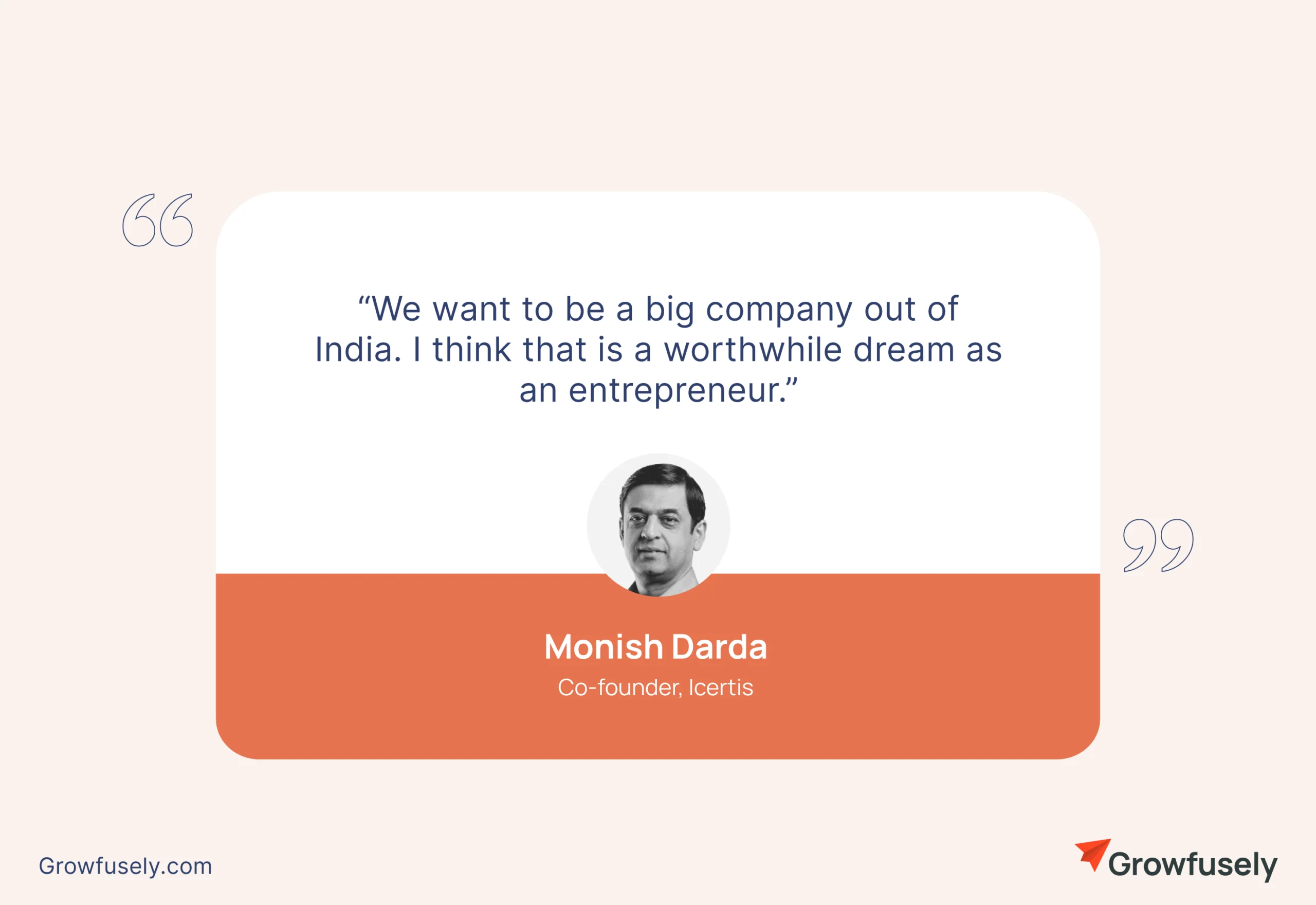
Today, Icertis straddles the globe, with a dual identity that is both proudly Indian and decidedly global. The company is headquartered in Bellevue, Washington, strategically placing it close to key enterprise clients and investors in the U.S. tech ecosystem. Yet its largest office remains in Pune, India, where Monish Darda is based and where the bulk of engineering talent resides.
In fact, of Icertis’s ~2,700 engineers in 2022, about 2,000 were in India, making it one of the biggest SaaS R&D centers in the country. This balance of U.S. front-office and Indian back-office has been key to Icertis’s ability to scale. It taps into India’s deep pool of skilled developers while engaging closely with Fortune 500 customers onshore.
“Despite being founded in Pune, we had a global mindset from day one,” Bodas has noted, emphasizing how Icertis set up operations in North America, Europe, and Asia-Pacific early on.
Icertis’s success has been a flag-bearer for Indian SaaS on the world stage. Alongside peers like Zoho and Freshworks, it proved that a product built with significant India-based talent can compete at the top of a global enterprise software category. The company became a unicorn in 2019. Notably, one of the first SaaS unicorns with Indian roots.
And by 2022, it was held up as a model “centaur” (over $100M ARR) emerging from India. At the same time, Icertis’s impact in global markets is unmistakable: its software is used by corporate giants across 90+ countries, and it counts one-third of the Fortune 100 as customers in 2025. Whether it’s Airbus in Europe, Johnson & Johnson in the U.S., or Cognizant and Airtel in Asia, Icertis has become virtually synonymous with contract management excellence worldwide.
Notably, Icertis’s India presence isn’t just a cost arbitrage story; it’s a strategic advantage. The Pune team’s size means Icertis can iterate rapidly and innovate faster than competitors. “We are the only company in the world which has 400 engineers focused on this problem [as of a few years ago]…which makes us a better partner for our clients,” Darda pointed out when Icertis was still mid-scale.
By 2022, that engineering headcount had expanded more than fivefold. This depth of talent has helped Icertis adapt its platform to diverse industries, from pharma and manufacturing to tech, often ahead of others.
It’s also contributed to Icertis’ ranking as a Leader in Gartner’s CLM Magic Quadrant for five consecutive years, the kind of consistency only possible with sustained product development muscle.
The Road Ahead: Toward $1B ARR and an AI-Driven Future
As Icertis enters its late teenage years as a company, it stands at an inflection point: “The next target is to be a $1 billion ARR firm in the next 4-5 years,” says Monish Darda, eyes firmly on the future. Achieving that nearly 4x growth will require Icertis to execute flawlessly, but leadership is optimistic.
They point to a still largely untapped market: “33 of the Global 100 are our customers, which means we still have 77 more to reach out to,” Darda notes, highlighting the headroom remaining even among the world’s biggest companies.
And that’s just the Fortune 100. The broader Global 2000 and mid-market also offer room for expansion as digital contracting becomes a mainstream need.
Icertis’s game plan for hitting the $1B ARR mark involves a mix of deepening its product, expanding markets, and strategic moves. The product will continue to be at the forefront of the AI revolution in contracting. “In this economic downturn, we believe contracts…will emerge as the go-to asset,” Bodas argues, positioning contract intelligence as the “fifth system of record” in the enterprise (after the likes of ERP, CRM, etc.).
The company is investing heavily in agentic AI, moving beyond insights to automated actions. As a launch partner for OpenAI on Azure, Icertis signaled its intent to ride the wave of generative AI and embed it deeply into business processes. The newly unveiled “Icertis Vera” initiative (2025) hints at an AI layer that could autonomously ensure that “the entire environment understands and complies with the rules of business set out in your contracts.”
Geographically, Icertis plans to double down on major markets and expand into other markets, according to Darda. It has already planted flags in North America, Europe, Asia-Pacific, and even Australia, but localized go-to-market efforts could unlock new industries and regions.
The company is also growing its partner ecosystem, teaming up with global consulting firms (Deloitte, PwC, KPMG, etc.) and cloud platforms (SAP, Microsoft) to reach customers it couldn’t reach alone.
Such alliances could be key in convincing conservative industries (government, healthcare, etc.) to adopt contract intelligence at scale.
Another lever Icertis is poised to pull is acquisitions. Flush with over $500M raised and a healthy balance sheet, the company has signaled it will use M&A to fill technology gaps and vertical expertise. As the CLM/LegalTech space consolidates, Icertis could serve as a natural acquirer of innovative smaller players, further cementing its leadership. This echoes the path of other enterprise software leaders who bulked up via acquisitions on the way to IPO.
Speaking of IPO, industry watchers have speculated about Icertis going public, especially after peers like DocuSign (which offers a CLM product via acquisition) and Freshworks did so. While Bodas has hinted that an IPO is a matter of “when, not if,” he’s also been clear that the company is not rushing it. With the recent leadership transition, and Bodas handing day-to-day reins to Anand Subbaraman, Icertis likely wants to hit key milestones (perhaps that ~$1B ARR or sustained profitability) before stepping onto the public stage.
Fifteen years in, the Icertis story reads like a playbook for entrepreneurial success. And it’s still being written. It began with two co-founders who saw potential in the mundane and dared to claim “contracts are the foundation of commerce…managing them intelligently unlocks value across the enterprise”. It gained momentum through perseverance, customer-centricity, and timing (catching the cloud wave and later the AI wave at just the right moments). It’s a journey that has taken Icertis from a small Pune office to the halls of the world’s largest corporations, transforming how deals are done and remembered.
The next level, if all goes to plan, will see Icertis as not just a leader but the de facto platform for the world’s contracts, a company possibly worth tens of billions and inspiring the next generation of SaaS founders from India and beyond. “If we can say over the next 10 years that we have managed to build a Salesforce from India, we would be extremely proud,” Darda said, laying out the long-term vision.

Pratik Dholakiya is the Founder of Growfusely, a SaaS SEO and AI Search Visibility agency.
