The modern enterprise runs on conversations.
They happen in contact centers, sales calls, support escalations, and handoffs between teams. They carry the highest-stakes signals a business has: intent, risk, churn, compliance exposure, and next-best actions. Yet for large organizations, most of those signals disappear when the call ends.
This gap is why a different kind of enterprise AI has become urgent: AI that doesn’t just summarize conversations, but changes what happens next.
Uniphore has been building for that moment, starting in customer service and contact centers, then expanding into a platform of applications, agents, and workflows for enterprise operations.
The Problem: Why Contact Centers Became the Enterprise’s Breaking Point
1. The Workforce Is Unstable, and the Work Keeps Getting Harder
Contact centers have always been high-churn environments. But recent research snapshots show how intense the turnover problem remains.
Metrigy’s contact-center staffing research, for example, reports turnover rising from 21.8% (2022) to 28.1% (2023) and projecting 31.2% (2024).
That matters because turnover doesn’t just increase hiring costs; it resets competence. It means more new agents handling complex interactions with less context, while supervisors spend more time coaching and less time improving systems.
2. The Math of Quality Assurance Doesn’t Scale
The contact center industry has long relied on a simple quality model: record calls, sample a subset, score them, and coach agents.
The problem is statistical and operational: human QA can’t listen to everything. Multiple industry writeups note that traditional QA often reviews only a small slice of interactions. This is commonly described as ~1–3% of total call volume, because manual evaluation is time-consuming and expensive.
Even if you don’t love the exact percentage, the direction is consistent: most conversations, where the real failures and risks hide, go unreviewed.
The result is a system that is reactive by design: it finds issues late, and it often coaches based on incomplete evidence.
3. Every Minute Is Money, and Costs Compound at Scale
Contact centers are operationally expensive even before you add modern tooling sprawl. One reason: the cost per call adds up fast when you’re dealing with massive volume.
Qualtrics, summarizing industry sources, notes estimates that put the average cost per call in the $3–$6 range, with some estimates nearer $7, depending on the business and complexity.
When you combine high call volumes, long handle times, repeat contacts from unresolved issues, rising labor costs, and constant retraining from turnover, you get a machine where even small improvements are.
These improvements can be as little as minutes saved, fewer repeats, and better routing, thus creating an outsized ROI.
4. The “AI Tool Problem”: Pilots Don’t Fix Systems
The post-LLM era has made it easy to demo call summaries, sentiment labels, and “agent assist” popups.
But in real operations, teams struggle with a deeper issue: AI features that don’t connect to workflows.
- A summary that doesn’t update the CRM
- An insight that doesn’t trigger follow-up
- A compliance risk that doesn’t route to the right queue
- A recommendation that isn’t grounded in enterprise knowledge
This is the gap Uniphore increasingly frames as a platform challenge: what it calls a unified stack across data, knowledge, models, and agentic workflows, applied first to customer-service operations.
Enter: Uniphore
Uniphore’s public positioning today is explicit: it sells a Business AI Suite with prebuilt apps and agents for functions like customer service. Further, it offers a broader Business AI Cloud described as a “sovereign, composable, secure” platform for deploying AI agents on enterprise knowledge and data.
On its customer-service product pages, it describes the scope in practical contact-center language: secure interaction recording, intelligent self-service, real-time agent assistance, and conversation intelligence, i.e., the pieces that sit directly on the operational pain.
And in partner/investor ecosystem narratives, the same theme shows up: Uniphore as a company attempting to unify “agents, models, knowledge, and data” so businesses can deploy AI agents in production, not just in pilots.
From an Academic Lab to Enterprise Operations: Uniphore’s Origin Story
Uniphore did not begin as a Silicon Valley startup chasing the latest enterprise trend. It began in 2008, inside the academic ecosystem of IIT Madras, where co-founders Umesh Sachdev and Ravi Saraogi were working on speech and language technologies long before “conversational AI” became a category.

Source (L to R: Umesh Sachdev, Co-founder and CEO, and Ravi Saraogi, Co-founder and President, Asia Pacific)
At the time, speech recognition was largely treated as a research problem or a narrow transcription task. Uniphore’s early work took a more applied view: spoken language, especially in enterprise environments, was not just text to be converted, but intent to be understood and acted upon.
The founders focused on building systems that could function reliably in noisy, real-world settings, call centers, customer support lines, and service operations, where accents vary, stakes are high, and errors carry consequences.
This grounding shaped the company’s early trajectory. Instead of starting with analytics dashboards or abstract AI tooling, Uniphore went where volume and friction were unavoidable.
They aimed for large contact centers handling millions of customer interactions. These environments provided both the hardest technical constraints and the clearest business incentive. Simply put, they offered improvement in call handling, compliance, or resolution efficiency translated directly into operational impact.
How Uniphore Took Shape
Uniphore’s ambition stopped looking like a “good AI product idea” and started looking like an enterprise company once it anchored itself in the U.S. market. Though the company retains deep roots in India (including an office at IIT Madras Research Park), it is headquartered in Palo Alto, US, a signal of where its go-to-market muscle sits.
Since its inception, Uniphore has attracted a lot of capital to build it. In April 2021, Uniphore announced a $140 million in Series D funding and said it expected to reach $100M in contracted annual recurring revenue (ARR) in fiscal 2022.
In less than a year, Uniphore raised a $400 million in Series E funding at a $2.5 billion valuation. By the end of 2023, Uniphore’s leadership was making a more operational claim. In a Moneycontrol interview, CEO Umesh Sachdev said the company had crossed $100 million in contracted ARR in the prior year, alongside growth rates he characterized as strong despite broader SaaS slowdowns.

Then, in October 2025, Uniphore announced it had closed a $260 million Series F, with strategic participation from NVIDIA, AMD, Snowflake, and Databricks, along with existing investors like NEA and March Capital.
These milestones show how Uniphore “took shape” as a category contender by building the ingredients enterprises typically demand before they standardize on a platform. They had US proximity, long sales-cycle stamina, and enough capital to keep expanding while talking about reliability and governance.
What Uniphore Offers: Turning Conversations into Operational Systems
At a high level, Uniphore sells something enterprises struggle to buy piecemeal: a way to move from conversations as raw data to conversations as systems that drive work.
At the application layer, Uniphore sells a Business AI Suite focused primarily on customer-facing operations, especially contact centers. Its publicly documented capabilities include:
- Secure interaction recording for voice and digital channels
- Real-time agent assistance that surfaces guidance during live calls
- Conversation intelligence to analyze interactions for quality, compliance, and performance
- Intelligent self-service designed to deflect routine inquiries before they reach human agents
These products target persistent operational issues such as limited QA coverage, inconsistent agent performance, and high handling costs.
Beneath these applications sits the Business AI Cloud, which Uniphore describes as a sovereign, composable, and secure platform for deploying AI agents on enterprise data. The platform is designed to integrate with existing systems such as CRMs and knowledge bases, allowing outputs like summaries, risk flags, or follow-up actions to flow into systems of record rather than remain isolated insights.
The structure reflects Uniphore’s broader strategy. Instead of selling standalone AI features, the company emphasizes end-to-end workflows: capturing conversations, understanding them, and triggering actions inside enterprise systems.
In practice, this positions Uniphore as operational infrastructure rather than a point solution.
The Uniphore Impact: From Recorded Conversations to Operational Leverage
Uniphore’s impact is best understood in operational shifts.
In its public disclosures, the company reports serving more than 1,500 enterprise customers globally, across various industries. Uniphore claims deployments in high-volume customer environments where interaction scale makes manual oversight impractical.
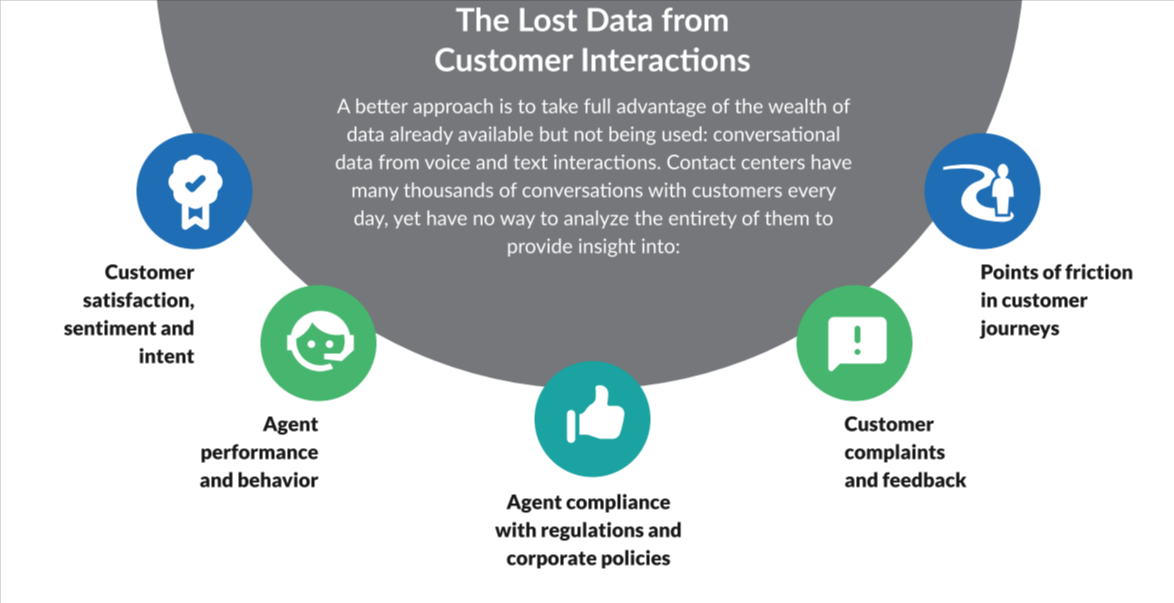
Customer case materials and executive interviews indicate three recurring changes after deployment:
1. Expanded Quality Visibility
Instead of manually sampling a small fraction of calls, organizations can analyze a much larger portion of interactions. This reduces blind spots in compliance and performance monitoring, particularly in regulated sectors.
2. Real-Time Intervention
With live agent assistance, supervisors and systems can guide agents during calls rather than correcting issues afterward. The operational value lies in preventing escalations, reducing repeat calls, and improving first-contact resolution.
3. Automation of Post-Call Work
AI-generated summaries and structured outputs reduce manual documentation effort and help update downstream systems more consistently.
In various interviews, CEO Umesh Sachdev has stated that the company crossed $100 million in contracted ARR, reflecting enterprise adoption beyond pilot programs.
The measurable impact varies by deployment, but the pattern is consistent: fewer manual processes, broader visibility into conversations, and tighter integration between customer interactions and enterprise systems.
Why Is Uniphore Hard to Replace?
Enterprise software is rarely defensible because of its features. It becomes defensible when it embeds itself into daily operations.
For Uniphore, that embedding happens at three structural layers.
First, interaction capture.
When an enterprise standardizes on a platform for secure recording across voice and digital channels, that system becomes part of its compliance and governance architecture. Replacing it is not just a technical swap; it affects audit trails, regulatory workflows, and risk management processes.
Second, workflow integration.
Uniphore’s applications are designed to push outputs—summaries, flags, recommendations—into existing systems such as CRMs and knowledge bases. Over time, those integrations shape how supervisors monitor performance, how agents document calls, and how quality teams review compliance. Removing the platform would require redesigning those downstream processes.
Third, data accumulation.
As conversation intelligence systems process interactions at scale, they build historical context tied to performance, patterns, and operational metrics. That longitudinal data layer becomes operational memory.
Switching costs in enterprise AI are not contractual; they are procedural. Once a platform influences compliance, QA, documentation, and reporting workflows, replacing it involves retraining teams, rebuilding integrations, and revalidating controls.
In that sense, defensibility is less about model accuracy and more about operational entrenchment.
Uniphore’s “Business AI” Repositioning and What it Signals
In recent years, Uniphore has shifted its positioning from a conversational AI vendor to a Business AI company. The change reflects a broader reality within the enterprise: AI features alone are no longer enough.
As organizations moved beyond pilot projects, many discovered that standalone tools like summaries, sentiment analysis, and copilots delivered limited value when disconnected from enterprise systems and governance frameworks. Uniphore’s repositioning centers on deploying AI agents that operate directly on enterprise knowledge, data, and workflows.
In its public messaging, the company emphasizes secure deployment, system integration, and operational orchestration rather than model novelty. This aligns with how large enterprises evaluate technology: not on experimentation, but on standardization and control.
The shift signals a wider industry transition. As generative AI capabilities become more accessible, differentiation increasingly depends on integration depth and operational reliability. As the number of agentic platforms grows, independent testing environments such as Agent Arena can also help teams compare how different AI agents perform on practical tasks before committing to a production stack.
Uniphore’s “Business AI” framing places it in the infrastructure layer of enterprise AI, where long-term scale determines relevance (not short-term demos).
Summing Up
Uniphore’s story is not about chasing AI trends, but about choosing where AI actually matters operationally. By starting in contact centers, one of the most complex, regulated, and high-volume environments in the enterprise, the company anchored itself in real economic and execution pressure.
Over time, that focus shaped a broader platform ambition: treating conversations as a system input that can drive workflows, compliance, and performance across the enterprise. Its evolution into a Business AI platform reflects how large organizations now approach AI adoption, prioritizing integration, governance, and repeatability over experimentation.
In that sense, Uniphore represents a wider shift in enterprise software. As AI becomes ubiquitous, the winners will be those that embed quietly into operations, reshape how work happens, and prove their value not in demos, but in daily use.

Pratik Dholakiya is the Founder of Growfusely, a SaaS SEO and AI Search Visibility agency.
