
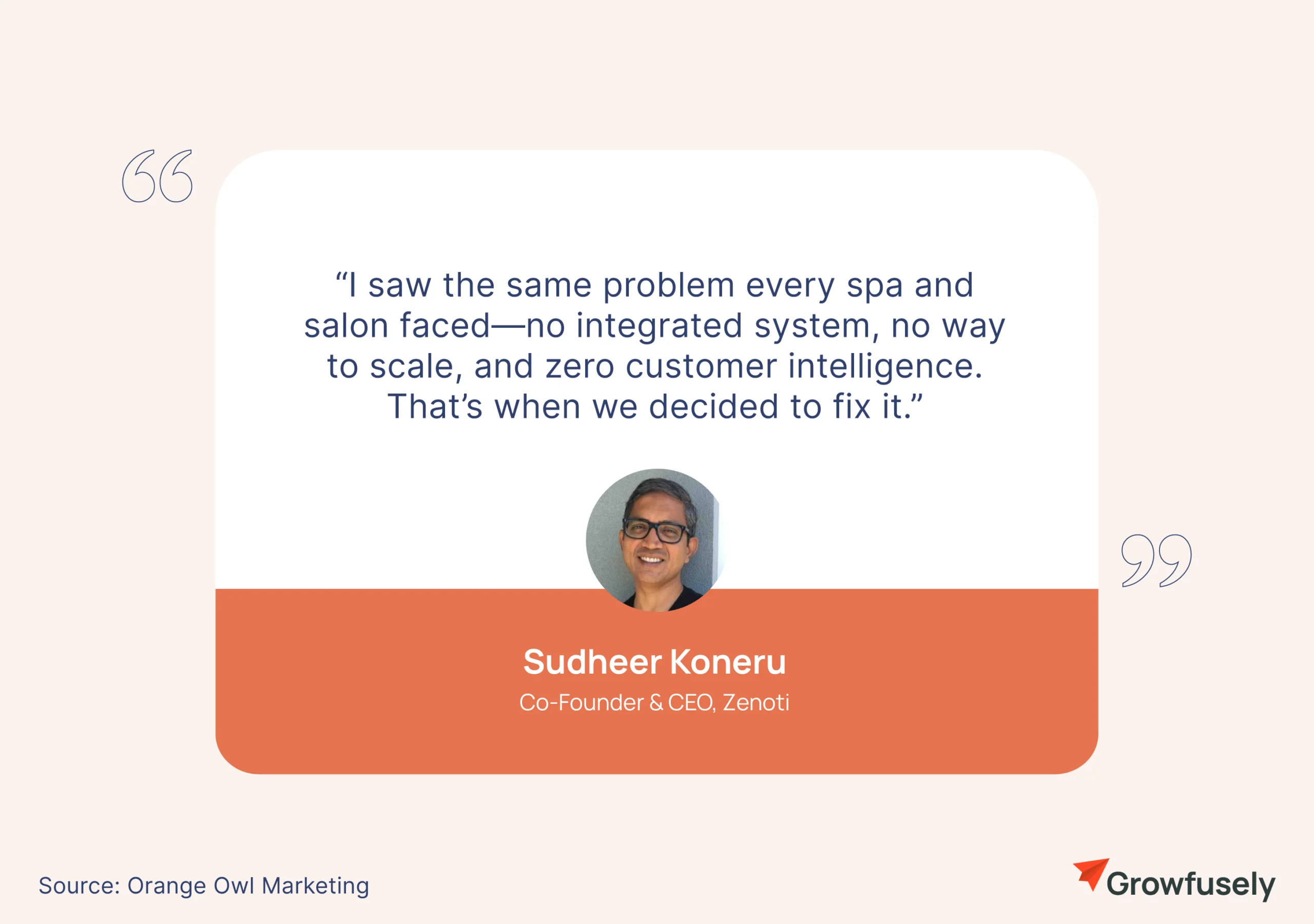
In 2010, a software company was born not in a boardroom but inside the messy reality of running salons and spas. Sudheer and Dheeraj Koneru were trying to scale their family’s wellness business in Hyderabad when they hit a wall.
The problem? The tools of the time were heavy, scattered, and built for tasks that didn’t exactly cater to the industry they were in. They wanted something that worked the way beauty and wellness businesses actually worked.
So, they decided to build it themselves. And their simple solution to a real problem became known as ManageMySpa.
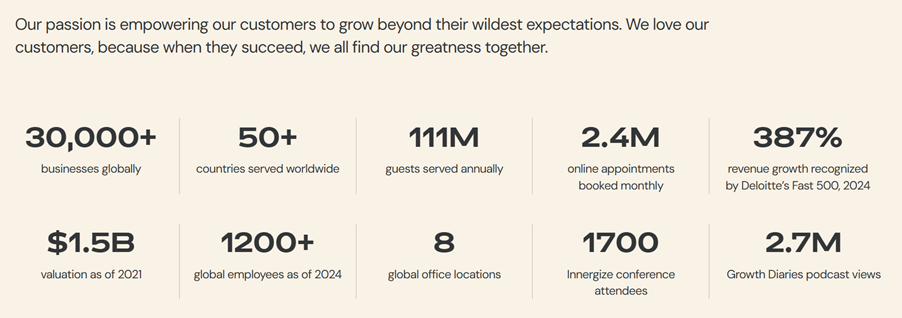
A few years later, with renewed ambition and a sharper vision, ManageMySpa renamed itself to Zenoti. Of course, with it came a bigger stage: 30,000+ businesses served globally, 50+ countries served worldwide, headquarters moved to Bellevue, Washington with 8 global office locations, and more.
The software evolved from a local fix into a unified platform that helps spas, salons, med-spas, barbershops and fitness centers run almost every part of their business, from bookings to billing, from staff to customer relationships. All of this, in one place.
Today, Zenoti powers tens of thousands of businesses and has climbed into the rare class of SaaS unicorns with a valuation north of $1.5 billion. Big names in beauty and wellness trust the platform to handle their operations and customer experiences.
Zenoti’s journey is more than a software story. It’s the story of entrepreneurs who looked around at the tools others take for granted, saw they weren’t built for the wellness businesses, and decided to do it better. This choice reshaped how an entire industry manages itself.
What Is Zenoti?
Zenoti is best understood by watching how people actually use it during a working day. It is not a “growth engine” or a sparkly dashboard, but more like the nervous system of a salon/spa, keeping things aligned so the talent can focus on clients.
But what differentiates it from its competitors?
Most beauty and wellness businesses run on time, people, and relationships. Zenoti sits at the center of all three. It pulls appointments, staff schedules, payments, and client records into the same space so teams are not constantly jumping between systems.
In practice, it feels less like software and more like shared memory for a business. For example, if a receptionist leaves, the knowledge does not vanish with them. Or if a manager changes, the rhythm of operations does not collapse overnight.
What matters here is reliability, not spectacle. It can be said that when Zenoti works well, the day flows better. But when it doesn’t, users feel the friction immediately.
How Teams Use Zenoti
At the front desk, Zenoti serves as the day’s control panel. Receptionists check clients in, shift bookings around, and manage last-minute changes without shouting across the room or drowning in sticky notes. Online bookings feed incoming information directly into the same system instead of creating a chaotic data pool.
For managers, the platform is mainly about visibility. They can see who is working, who is overbooked, and where gaps are forming before things unravel. In an industry where schedules can change every hour, that clarity keeps small problems from becoming full-blown crises.
For therapists, stylists, and aestheticians, Zenoti functions like a running story of each client. Data related to past services, preferences, sensitivities, and habits can be stored in one place. As a result, conversations feel warmer and less transactional, even on busy days.
For finance and operations teams, it becomes the place where money and memberships make sense. Packages, prepaid plans, and recurring programs sit in one system instead of scattered spreadsheets that nobody fully trusts.
Marketing teams use it less like a “campaign machine” and more like a reminder system. Appointment nudges, follow-ups, and simple offers happen without extra tools or complicated integrations.
How Zenoti Transforms the Workplace
The biggest shift that Zenoti has brought about is more emotional in nature than technical. By this, we mean front desks feel less frantic because information is not fragmented. Staff arguments about bookings or commissions tend to drop when everything is visible in one place. And processes still move speedily, while feeling less fragile.
Multi-location brands experience a different kind of order. Every branch follows the same playbook, workflows, and data structure. This consistency keeps culture intact as the business grows.
Owners start seeing patterns they previously missed. Slow afternoons, peak hours, loyal clients, and seasonal dips become clearer. Decisions come from observation rather than instinct alone.
Clients, too, experience this, but indirectly. They notice smoother checkouts, fewer mix-ups, and staff who seem to remember them. Nothing ostentatious happens on the surface, but the experience feels smoother and more intentional.
Many tools promise speed or scale, but Zenoti wins on familiarity and steadiness. Teams get used to how it thinks, organizes information, and fits their routines.
It reflects the realities of beauty and wellness work instead of holding up an idealized version of it. Packed weekends, slow midweek hours, last-minute cancellations, and constantly shifting rosters are treated as normal, not exceptions.
Most importantly, businesses tend to keep using it not because they were sold, but because it gradually becomes hard to imagine running without it.

Why Call It “Zenoti” Though?
If you go back to the early days, the company wasn’t always called Zenoti. It began as ManageMySpa, a name that told you exactly what the software did: manage spa operations.
But that name did more than describe a function. It boxed the company into one corner.
As the product grew to support salons, med-spas, fitness studios, yoga centres, and other wellness businesses, the name felt too narrow in scope. The team wanted a name that didn’t limit what the platform could become or represent. This shift in thinking led to adopting a new name in 2015, and it was Zenoti.
There isn’t a simple dictionary definition for “Zenoti,” but the shift from the literal ManageMySpa to this new name marked a change in vision. It was a move away from describing what the software did to suggesting how it could fit into the ebb and flow of a business’s day.
The new name was less about spas and more about the broader wellness ecosystem Zenoti aimed to serve. It sounded neutral, a bit open-ended, and less about one kind of business. That mattered as the company began pitching into global markets and diverse wellness formats.
In other words, the name change was less about branding theatrics and more about giving the product room to grow without sounding like a one-trick pony.
The Founders and How It All Started
When you hear the story of Zenoti from a headline, it often comes out as “one of India’s SaaS unicorns,” but the lived story is more interesting and rooted in real-life experiences.
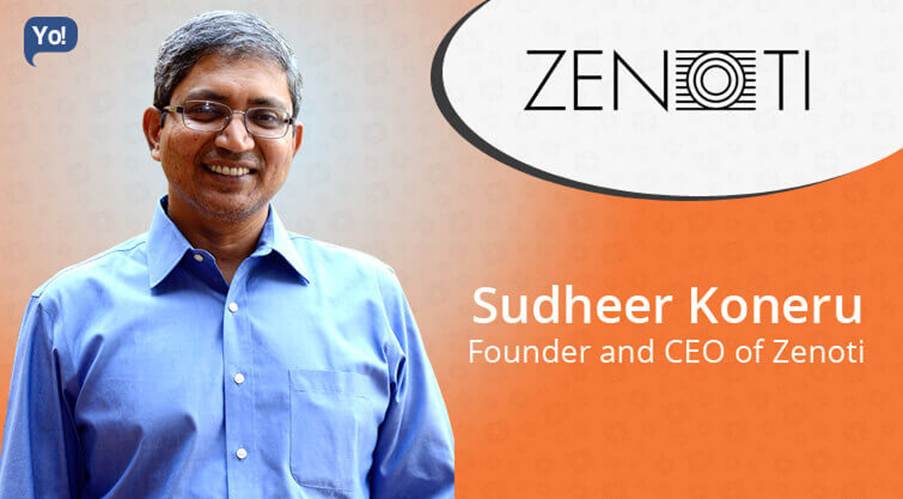
Sudheer Koneru is the person most people connect with Zenoti, and for good reason. He had spent years in deep tech long before this chapter. He studied computer science at IIT Madras and later at The University of Texas at Austin.
Later, he worked at Microsoft for about eight years, then led teams and products at Intelliprep and SumTotal Systems. By his late 30s or early 40s, he had pretty much ticked all the boxes people hang on resumes: enterprise experience, leadership roles, and successful exits.
And then he actually tried to stop. At around 40, Sudheer stepped back from the relentless pace of tech life, spending time on yoga, meditation, and wellness retreats. That period was less about ego and more about settling into what mattered to him.
It wasn’t long before he and his brother Dheeraj (who shared an interest in wellness and technology) invested in a chain of gyms, spas, and salons. Sudheer expected it to be fun, a sort of passion project. But it quickly became educational.
Running those businesses exposed him to a problem he already understood intellectually, but had not felt viscerally: there was no good software to run these places. At least not in a way that actually helped people manage bookings, staff, payments, and clients across multiple locations without chaos.
The tools that existed were dated, heavy, fragmented, or built for something else entirely. This realization came from late nights trying to fix scheduling errors or reconcile disordered accounts.
So, Sudheer and Dheeraj went back to what they knew best, i.e., building software. They started with a simple thesis: if this is hard for us to manage, it must be harder for thousands of other businesses too.
This thought led to building a cloud-based platform tailored for this neglected segment. Early versions focused on what users did every day: booking, staff management, check-ins, and other tasks that made the day run less painfully.
Other co-founders like Anand Arvind, who came with a background in product leadership, joined the team to help shape the product’s architecture. Dheeraj brought his own blend of tech and operational experience, especially around scaling and sales. Together, the founding team combined enterprise software chops with first-hand industry pain.
Sudheer often talks about wanting a product reliable enough that a front desk person, a manager, and an owner could all trust it without endless training. And this perspective, grounded in actual daily frustration, is what differentiated Zenoti from the start.
Rather than build a unicorn, or a category leader, or a global SaaS brand, the new founders set out to build something that worked better than the alternatives. And this insistence on solving real problems began shaping everything that followed.
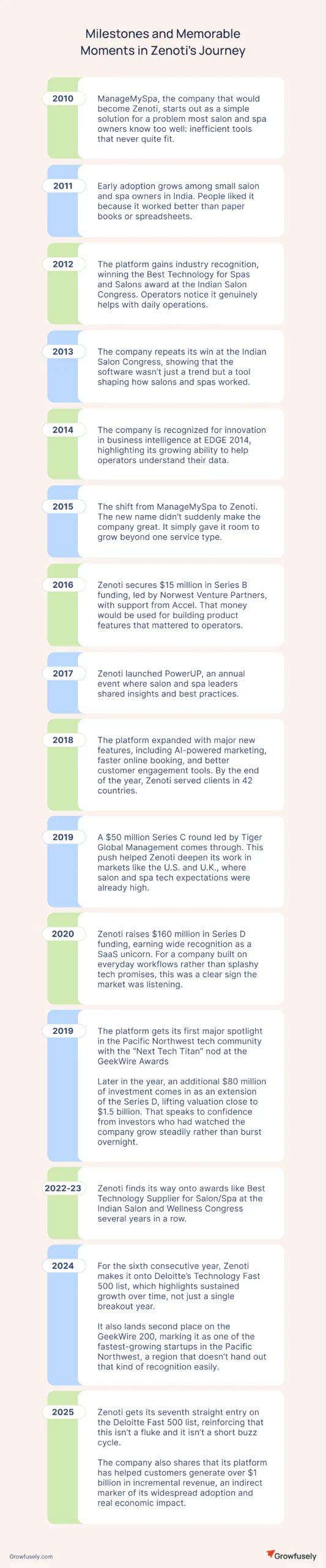
Milestones and Memorable Moments in Zenoti’s Journey
Here’s a quick timeline of the key accolades earned by the company over the years since its inception.
What Zenoti’s Journey Teaches About Building a Business
1. Pick one area and study it properly
Zenoti did not try to sell software to everyone who owns a computer. It chose beauty and wellness and stayed there. That discipline is rare and powerful. Depth beats breadth every time, especially in SaaS. When you know one industry cold, your product starts to feel less like software and more like common sense. That is where trust comes from.
2. Build for everyday problems, not headlines
Nothing about Zenoti was designed to look flashy on LinkedIn. It grew because it made ordinary days easier for receptionists, managers, and therapists. Real businesses do not need spectacle. They need fewer headaches. The best products win by reducing friction, not by promising miracles.
3. Your first users should be people you actually understand
Zenoti emerged from founders who had lived inside salons and spas, not from consultants studying them remotely. That matters. When you feel a problem personally, you design differently. You fix the annoying little things, not just the big impressive ones.
4. Consistency scales better than cleverness
Zenoti did not explode overnight. It climbed steadily. Year after year, location after location. That slow, reliable growth proved more durable than any quick spike. Businesses that grow this way tend to last longer and age better.
5. Systems shape culture more than slogans
When every location runs on the same platform, behavior changes quietly. Fewer arguments, clearer schedules, better records, smoother service. Over time, that creates a calmer workplace culture. Tools do not just manage work. They shape how people treat each other.
6. The best success stories often start sideways
Zenoti did not begin as a grand SaaS vision. It started as a practical fix for a real family business. That sideways beginning turned out to be its biggest advantage. Some of the strongest companies are born not from ambition, but from irritation with the way things are.
Conclusion
Zenoti started as a simple fix for problems no one else seemed to notice. Over time, it grew into something bigger than the founders probably imagined.
For the people running salons and spas, it’s not about the awards or the funding. It’s about the day-to-day work: schedules that line up, clients who don’t get double-booked, staff who know what to do without constant oversight. That is the real impact.
Its story shows that consistently solving small, persistent problems can add up. Understanding the people using your product matters more than we realize. And sometimes the biggest breakthroughs don’t feel like breakthroughs at all; they feel more than meaningful changes in the system.

Pratik Dholakiya is the Founder of Growfusely, a SaaS SEO and AI Search Visibility agency.
