The most common question B2B marketing leaders ask me today:
How do we rank higher in ChatGPT? What does it take to rank in Perplexity?
The question itself reveals the problem.
AI search platforms don’t have a SERP. There’s no position one, no page two, no ranked list to climb. However, most marketers are still applying the old mental model to a system that doesn’t work with positions, placement, and optimization for a specific slot.
At Growfusely, we spend real time brainstorming this with clients before we can do anything useful together. This article is exactly the conversation we have, but written down.
TL;DR
AI search platforms don’t have a SERP. There’s no position to climb, so “ranking in ChatGPT” is the wrong goal to chase.
AI systems answer through two pathways: parametric knowledge (what the model learned during training) and real-time retrieval (what it fetches when a query needs current or comparison-based information). About 60% of ChatGPT responses come purely from parametric knowledge, with no retrieval at all.
Ranking, retrieval, synthesis, and recommendation are four different mechanisms. Optimizing for one doesn’t guarantee progress on the others.
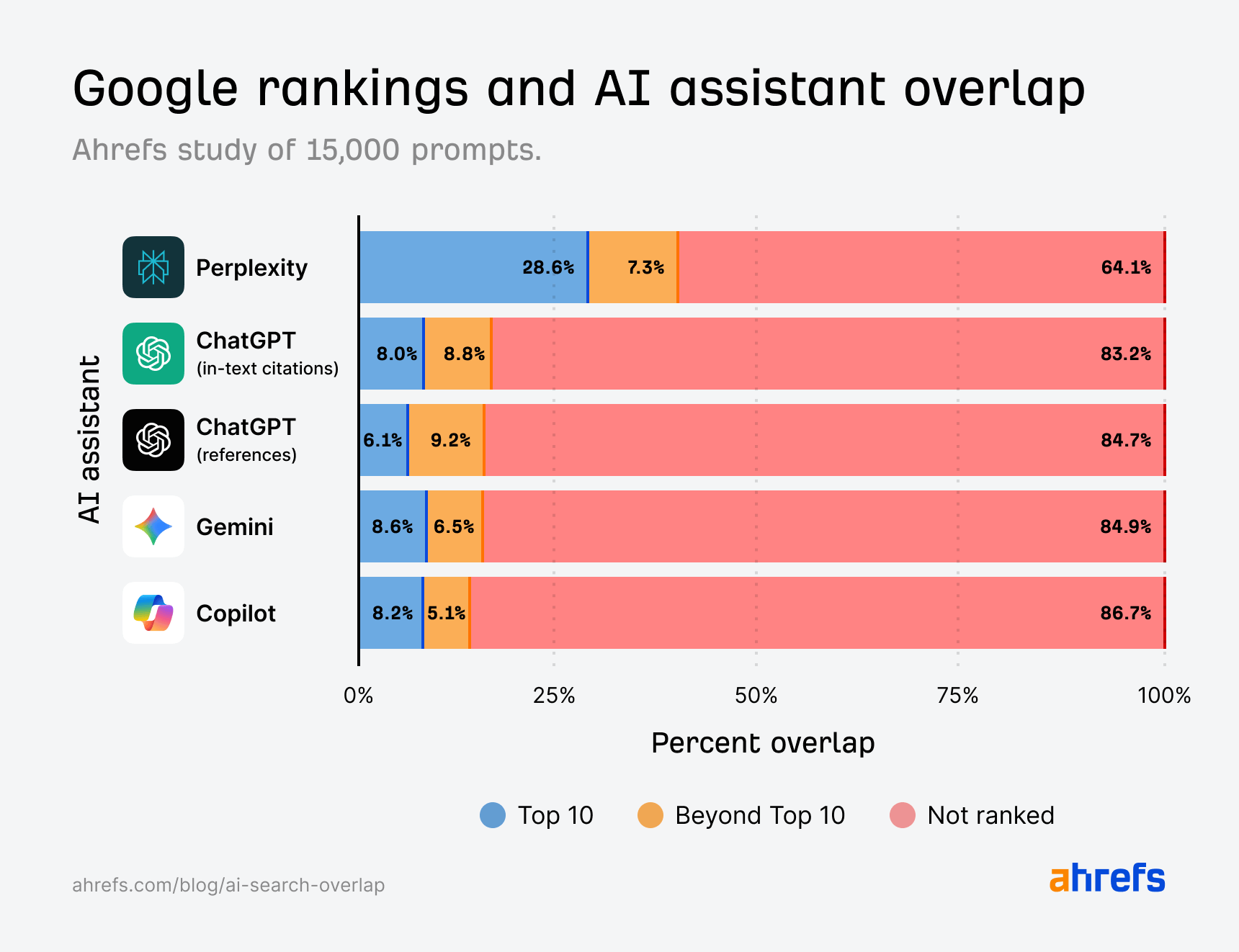
Ranking number one on Google doesn’t get you cited in AI answers. Only 12% of AI citations come from the top 10 Google results.
GEO and AEO tactics help AI extract your content once found. They don’t earn the external trust that gets you found in the first place. 89% of AI citations come from earned media, not owned content.
AI visibility requires authority, corroboration, entity consistency, and expertise signals, all working together across content, PR, and founder voice.
It’s a three-team problem, not a content team problem, and it compounds over months, not weeks.
Let’s Understand What AI Systems Actually Do
Before discussing what AI visibility entails, it will be helpful to learn what AI systems actually do when they respond to a query. It’s fundamentally different from what a search engine does.
Two Knowledge Pathways
AI systems respond to queries through two distinct mechanisms, and understanding the difference changes how you think about visibility entirely.
Parametric knowledge – the information a model absorbed during training. Think of it like long-term memory. The model doesn’t search for anything for this; it already knows it. Roughly 60% of ChatGPT responses come purely from this internal knowledge, with no web search triggered at all.
For these queries, brands that weren’t mentioned frequently across credible sources during the model’s training period simply don’t exist in the answer, no matter how well optimized their website is today.
Real-time retrieval – What the model fetches from the web when it needs current, specific, or comparison-based information. This typically triggers queries involving prices, dates, or direct comparisons.
When retrieval gets triggered, the model doesn’t run a single keyword search the way Google does. It breaks the question into several smaller, related searches and runs them simultaneously.
Ask “what’s the best AI and search visibility agency,” and the model might separately look up “top search visibility agencies 2026” and “SEO agencies for B2B brands,” then combine what it finds into one synthesized answer.
That’s the key shift.
A search engine matches a query to an index. An AI system decomposes a question, gathers from multiple angles, and writes a new answer from what it finds.
Retrieval, Synthesis, and Recommendation Replace Ranking
These four terms get used loosely in most AI visibility conversations, but they describe different concepts.
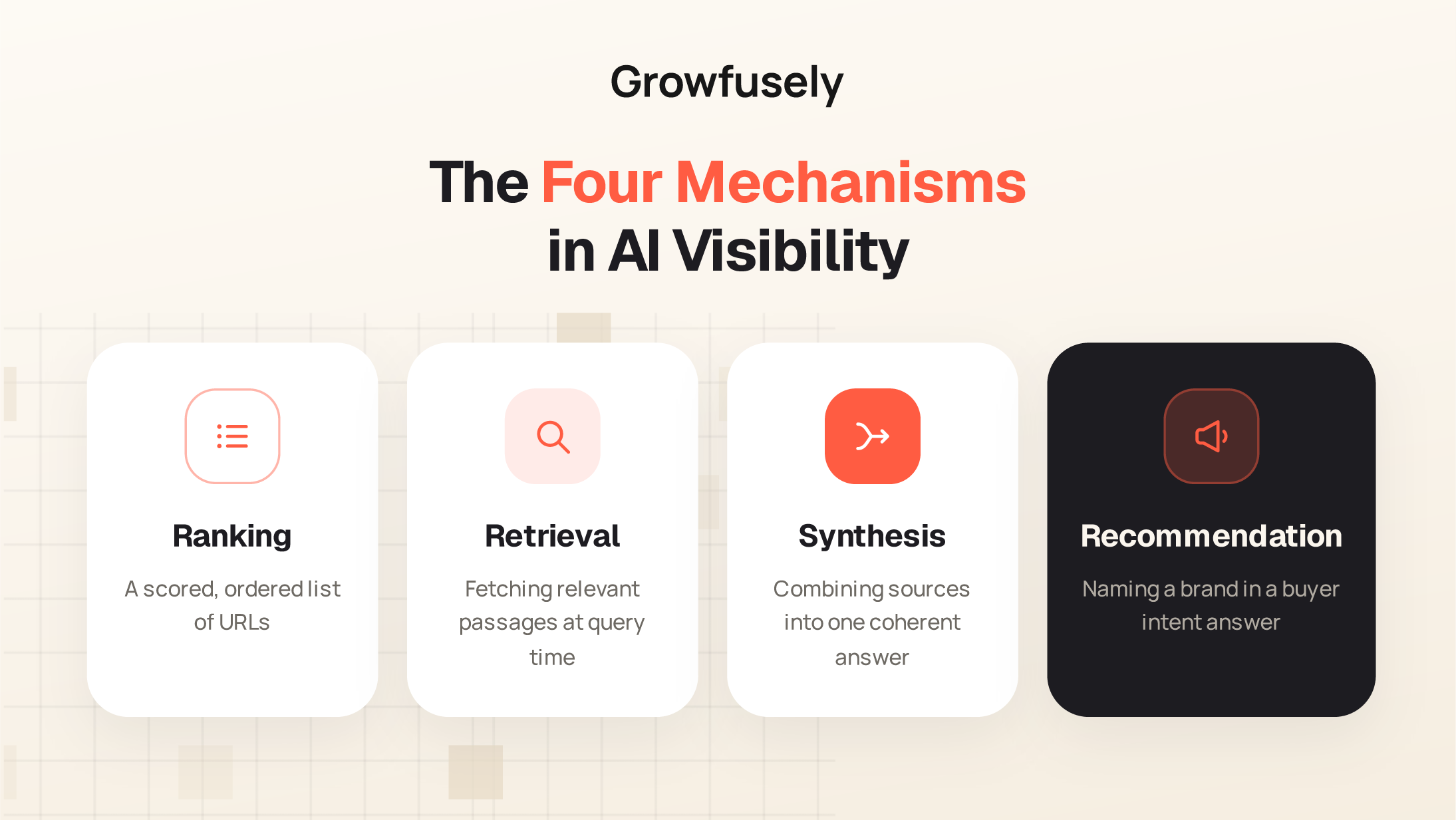
Ranking is a scored, ordered list of URLs, the output a search engine produces.
Retrieval is the process of fetching relevant passages from indexed content at the moment a query is asked.
Synthesis is how the model combines what it retrieved with what it already knew into one coherent answer.
Recommendation is when an AI system names a specific brand or product in response to a buyer intent query.
A brand can be retrieved without being recommended.
It can be synthesized into an answer without ever being named directly.
Optimizing for one doesn’t guarantee progress on the others, and most AI visibility strategies fail because they treat all four as a single problem with a single fix.
Common Misconceptions
Ranking number one on Google will get me into AI answers
This is the assumption most B2B teams carry into AI visibility work, and the data dismantles it quickly.
Ahrefs analyzed four major AI assistants, ChatGPT, Gemini, Copilot, and Perplexity, and found that only 12% of URLs cited by AI tools rank in Google’s top 10 for the same query. The other 88% come from content that ranks lower, or from sources Google rankings don’t predict at all.
AI retrieval and Google ranking are related, but they respond to different signals.
Backlink volume, page authority, or exact match keyword optimization do not move a brand into an AI citation. Those signals move rankings. They don’t reliably move retrieval.
Publishing more content will improve our AI visibility
AI systems don’t reward the brand that publishes the most. They reward the brand that is most clearly understood and most consistently corroborated across independent sources.
This connects back to parametric knowledge.
If a brand isn’t represented as a recognized, consistent entity in a model’s training data, a content sprint on your own domain won’t change that quickly.
The model’s internal picture of a brand is shaped by how often and how credibly it was mentioned across the web over time, not by how much that brand published recently on its own site.
GEO and AEO tactics are all that’s needed
Structuring content for extraction, using the FAQ schema, writing the answer first, all of this is genuinely useful. None of it should be skipped.
But these are content layer interventions, and content layer interventions alone aren’t enough. 89% of AI cited links across ChatGPT, Gemini, and Perplexity were earned media, not owned content. A brand with tactically perfect content will still get bypassed in favor of a competitor with stronger external validation, even if that competitor’s content structure is weaker.
GEO and AEO best practices help AI extract your content once it’s found you. External authority is what earns the model’s trust to surface you in the first place.
AI visibility is a content team problem
It’s a three-team problem, and treating it as one team’s responsibility is why a lot of otherwise solid AI visibility efforts stall.
Content needs to produce extractable, high information gain material. Your digital PR needs to build external entity authority, the citations and mentions that happen off your own domain. Analytics needs to track Share of Model, how often your brand actually appears in AI answers, alongside AI referral patterns.
When these three functions operate in isolation, each one can execute well individually, while AI visibility still doesn’t move. The coordination between them is the actual work.
We can measure AI visibility the same way we measure SEO
AI citation doesn’t show up cleanly in standard analytics. Publishers like Reuters and The Guardian are mentioned constantly across AI platforms, yet see less than 1% of their traffic arrive from those platforms. The influence is real. The attribution is almost entirely invisible to GA4.
This means the measurement model itself needs to change, not just the dashboard you’re looking at. Tracking sessions and conversions alone will systematically understate how much AI visibility is actually shaping buyer decisions before they ever reach your website.
What AI Visibility Actually Requires
If ranking isn’t the mechanism, what actually determines whether a brand gets surfaced and recommended?
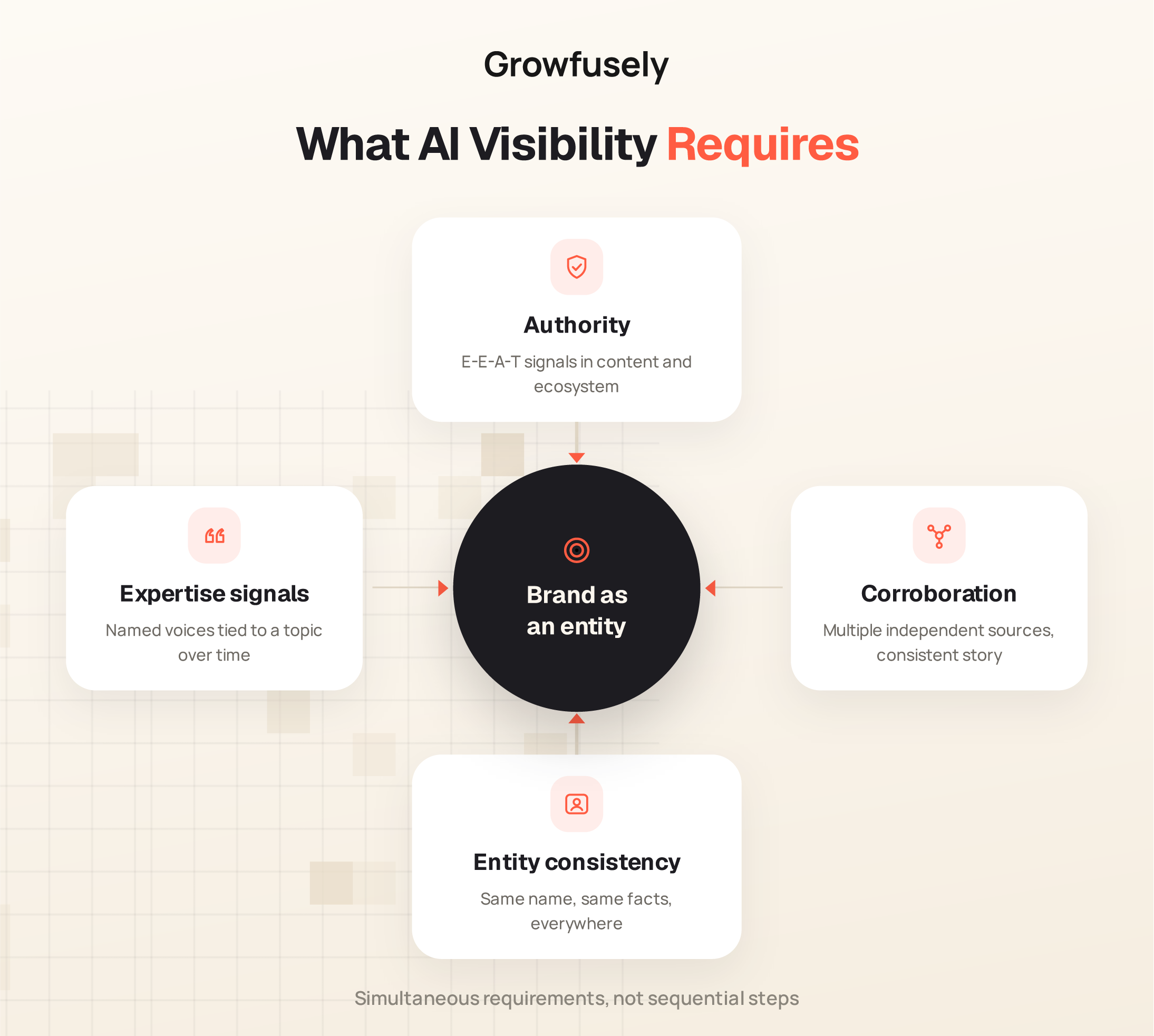
Four things, and each of these operates at the level of the brand as an entity, not the page as a document.
Authority
AI systems weigh E-E-A-T signals, experience, expertise, authoritativeness, and trustworthiness, demonstrated both in the content itself and across the broader ecosystem around the brand.
Named authors with real credentials, original research, and specific examples all build the kind of authority AI systems can recognize and weigh.
Corroboration
AI systems don’t trust a single source in isolation. They look for multiple credible, independent sources describing a brand in consistent terms. If your positioning shifts depending on where someone encounters it, AI systems have nothing stable to anchor to.
For instance, if your G2 profile says one thing, your press coverage says another, and your own site says a third, AI will find it tough to trust the brand.
Entity Consistency
LLMs track entities, brands, people, products, concepts, and the relationships between them. When your brand name, product description, and category language are described inconsistently across platforms, AI systems can end up confused about who you actually are. This produces inconsistent, low-confidence recommendations or none at all.
Entity consistency isn’t a branding preference. It’s a technical requirement for being recognized accurately.
Expertise Signals
Founders and executive voices that show up consistently across industry publications build what’s sometimes called entity association.
This is a stable link between a named person and a topic domain. Over time, that association makes both the person and the company they represent more citable, because the model has learned to connect that name with that subject.
This is why at Growfusely, we treat founder visibility as its own strategic channel, not as an extension of the content calendar. A founder’s byline and a company blog post on the same topic carry different weight, both to AI systems and to the humans reading them.
AI Visibility Is a Long Game, Not a Campaign
There’s one more thing worth being honest about, because it changes how teams should set expectations from the start.
Entity authority and external corroboration build over months, not weeks.
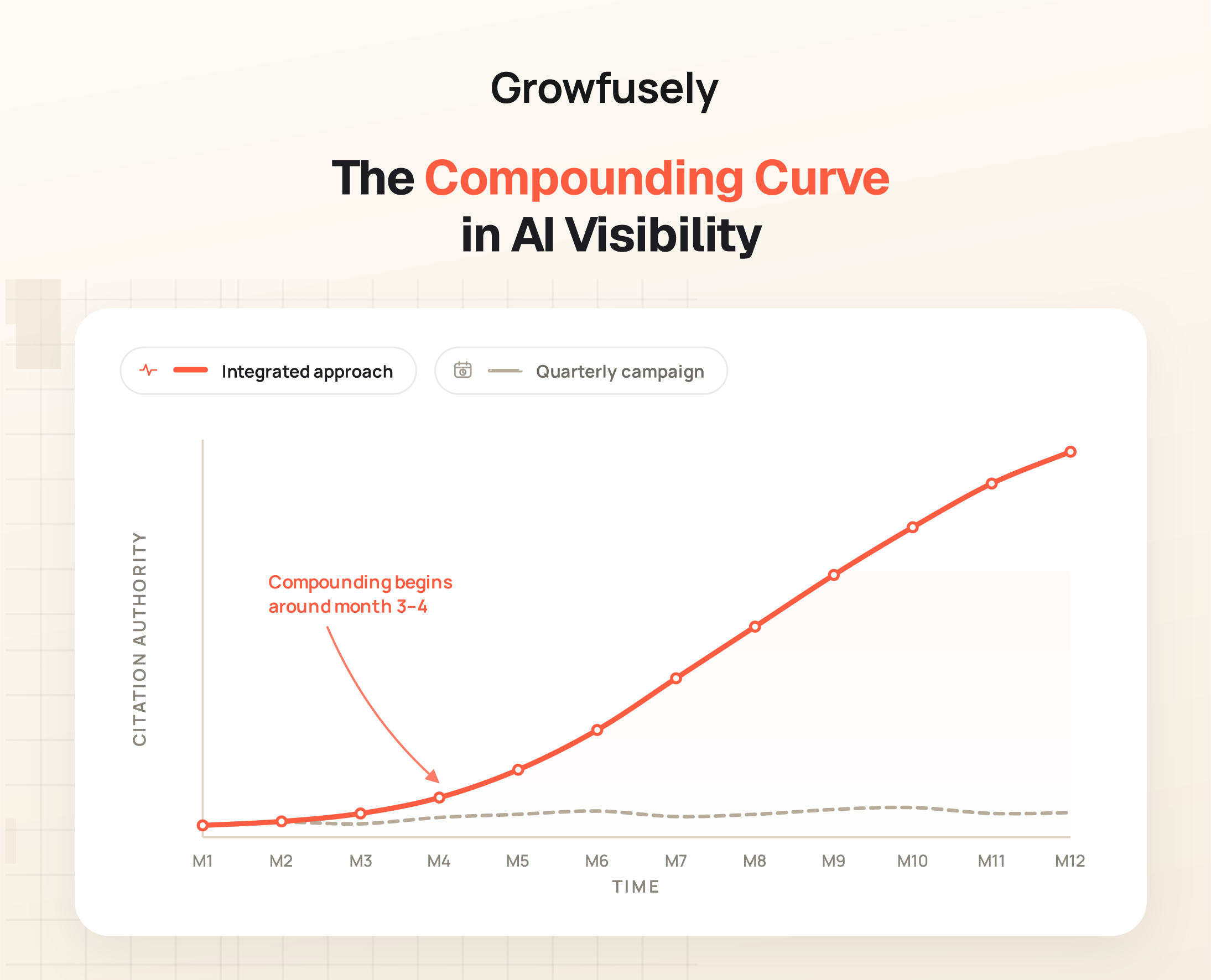
This isn’t a content sprint or a one-time technical audit. Citation authority accumulates the way domain authority did in early SEO; each placement, each independent mention, each accurately indexed piece of content adds to a signal that AI systems weigh more heavily over time.
That means the measurement timeline needs to shift, too. The early indicators aren’t traffic spikes. They are directional, brand search lift, a gradual increase in direct traffic, and a growing mention rate when you manually check how AI platforms describe your category.
*Illustrative only. The chart reflects the directional pattern Cited and Authority Tech describe in their analysis, not measured data from a specific campaign.
AI visibility isn’t a one-quarter initiative. It requires consistency across content, PR, and founder voice for the compounding advantage to actually show up. Brands treating it as a quarterly campaign will get quarterly results. Brands building it as infrastructure are the ones whose advantage becomes hard to close later.
The question isn’t whether to start building this. It’s whether to start now or later.
Summing Up
The question we started this post with, “how do we rank in ChatGPT,” was never quite the right one to ask.
The better question is whether the broader digital ecosystem, AI systems, peer communities, earned media, and expert voices recognize your brand as a credible, consistent, authoritative answer in your category. That’s a harder question to sit with, but it’s the one that actually determines whether you show up.
At Growfusely, this is where our AI search visibility work starts, building the entity authority and corroborated presence that gives AI systems enough confidence to recommend a brand.
Not ranking tactics. Structural credibility.
If this gave you a clearer picture of how AI visibility actually works, we’d be glad to talk through what building that credibility could look like for your brand. Get in touch with our team to experience AI visibility in action.


 About Growfusely
 White LabelMake us your (hidden) helping hand in delivering high-quality work to your SaaS clients.
 TeamCheck out the faces (and their backstories) behind our brand.
 Partner With UsJoin forces with us and earn a recurring monthly commission.
 Careers We're HiringJoin our growing team of passionate content marketing geeks.
 SEO & AI Search VisibilityBoost your search engine rankings with a blend of compelling content and technical tweaks.
 Content Strategy & ProductionFuel your brand awareness and user acquisition with strategic content creation and distribution.
 Authority & CitationsEarn relevant, high-quality backlinks from top websites in and around your niche.
 SaaS InfographicsLearn battle-tested best practices on all things SaaS marketing — visually.
 SaaS InterviewsRead our tête-à-têtes with SaaS marketing experts on achieving content-driven organic growth.