“Palo Alto, California, United States.” That’s what Nilesh Patel’s LinkedIn location reads in mid-2022, which is a far cry from a decade earlier, when it simply said “Bengaluru, India”.
The journey between those two lines is the story of LeadSquared, a software startup born in India that grew against the grain into a global SaaS success. And it all began with a farmer’s son from Indore who had a knack for coding and a drive to build something big.
Nilesh Patel grew up in a farming family in Madhya Pradesh and studied engineering in Delhi, where he “used to program a lot” despite not being a computer science major. Landing a job with IBM in 1999, he moved to Pune and then Bangalore, making friends like Sudhakar Gorti (who joined IBM with him) along the way.
On weekends, Patel, Gorti, and their circle (including Prashant Singh and others) would brainstorm about doing something more than their day jobs. By the early 2000s, they took the entrepreneurial plunge. Their first venture, Proteans, provided software product development services to clients in the U.S. and Europe, growing to a 350-strong team and over 100.
In 2010, they sold Proteans to Symphony Teleca, giving the founders both a successful exit and valuable experience in building a business. By 2011, fresh off that acquisition and a year spent with the acquirer, Patel and his friends were itching to build a product company of their own. They had seen how services worked; now they wanted to build a software product-first business in the sales and marketing domain.
In August 2011, Patel teamed up with Sudhakar Gorti, Prashant Singh, and a former colleague, Sukhbir Kalsi, to start a new venture called MarketXpander Services. The idea was to help other businesses with lead generation and customer acquisition. It was essentially a marketing agency, but one that would pave the way for a product.
Over 15 months, their small team ran hundreds of campaigns and generated tens of thousands of leads for clients worldwide, learning firsthand the pain points in sales and marketing operations. It was in those trenches that the spark for LeadSquared was born.
“The market was full of horizontal CRMs built solely for tracking sales reps; empowering them and driving sales productivity was a mere afterthought,” Patel observed of the software landscape back then. Businesses were cobbling together multiple tools to manage marketing, lead capture, and sales, and struggling to make them work in sync.
Patel and his co-founders saw an opportunity for an integrated platform that would eliminate these silos. They were all passionate about sales and marketing, and they wanted to build easy-to-use yet powerful software that could help businesses streamline their sales and marketing operations.
Bootstrapping the Early Days: A Slow Burn to Product-Market Fit
In 2012, they began developing this product, and by mid-2013, the first version of LeadSquared was officially launched. The name itself embodied their ambition: to multiply a business’s leads and sales outcomes exponentially, essentially squaring the leads. As Patel later quipped, “the goal is to keep growing the company, and squaring the lead.” This is a nod to how every sales lead could have exponential value when nurtured properly.
LeadSquared’s early days were, by necessity, frugal. The company was essentially bootstrapped, funded by the founders’ own money and modest angel checks from friends and well-wishers. “We are probably one of the few companies that managed to raise ₹17 crore from angels,” Patel recalls.
This informal network of funding (roughly $2-3 million) kept the lights on in the first few years and gave LeadSquared breathing room to iterate on its product without institutional pressure. Growth was steady but unspectacular at first: the company’s operating revenue was just a few lakh rupees in its formative years, rising to ₹11 crore in FY2016-17 and ₹19 crore in FY2017-18.
As a software-as-a-service business, LeadSquared was playing a long game, acquiring customers gradually and reinvesting in its platform.
One reason for the cautious start was the search for product-market fit. Patel and team had entered a crowded arena of CRM and marketing automation, but they noticed an underserved niche. Many of their first clients were education businesses: coaching classes, training institutes, colleges, and a nascent wave of edtech startups.
“I still distinctly recall meeting BYJU’S around October 2014 and within months we were selling to a few dozen customers in education,” Patel says. The education sector’s needs matched what LeadSquared offered: a simple way to track and follow up with thousands of inquiries and leads, and ensure none slipped through the cracks.
By 2015, education had become a power user of LeadSquared, and the timing was fortuitous. “Our product was more suitable to education for some reason. So that took off for us. That is the time edtech grew rapidly, and we were lucky we were already established by then,” Patel notes.
By catering to high-growth customers like BYJU’S (which would later become a tech unicorn in its own right), LeadSquared rode a wave of rapid adoption in that vertical. At one point, education and edtech clients made up nearly 40% of LeadSquared’s business, according to Patel, giving the startup much-needed traction.
During these early years, the founders wore multiple hats. Prashant Singh, co-founder and Chief Operating Officer, focused on delivery and operations, while Sudhakar Gorti (the tech backbone of the team) quietly built out the product’s capabilities. Without big VC money, they kept the team small and efficient.
It was only around 2015 when LeadSquared crossed 100 paying customers that the startup began scaling its team and offerings more aggressively. A major milestone was the launch of LeadSquared’s mobile app, designed to empower “feet-on-street” field sales teams with features like route planning, geo-tracking, and real-time lead notifications.
This move set LeadSquared apart from generic CRMs: it acknowledged that in markets like India, sales often happen not just online or on phone calls, but in-person, and that digital systems must support these on-ground realities. The mobile app became an instant hit with B2C businesses that employ thousands of field users, and it foreshadowed LeadSquared’s eventual positioning as a platform for high-velocity sales in both online and offline channels.
Another early pivot came from listening closely to customers. Many of LeadSquared’s first users were small and mid-sized businesses, but as some of those customers grew rapidly, they demanded more from the software. “When we started, we catered to high-growth businesses that grew very fast and changed frequently as well. What they needed was flexibility,” Patel explains. “Due to this, flexibility came into our DNA.”
LeadSquared built a reputation for being unusually adaptable, adding custom fields, new integrations, and workflow tweaks quickly to meet client needs. “It’s not easy for everybody else to do that,” Patel adds, hinting at larger competitors who were less nimble. This flexibility helped LeadSquared hang on to fast-growing clients who might otherwise graduate to bigger-name CRMs. It also taught the team an important lesson: focus on customer experience and outcomes over just features.
By 2016-17, the product had matured from a basic lead management tool into a broader sales execution and marketing automation suite. LeadSquared introduced an Automation Workflow builder and a library of ready integrations (its App Marketplace) so that businesses could connect all their lead generation channels in one place. They also formed their first dedicated Customer Success team to proactively help enterprise clients achieve results with the platform, a move that paid off in retention and upsells.
From there on, new features rolled out at a steady clip: Smart Views (a streamlined work queue for salespeople) to help reps focus on tasks without switching screens, built-in telephony and contact center integrations to log calls and follow-ups, and advanced analytics and custom reporting.
Each addition was driven by a use-case-first approach. “LeadSquared has been built using a vertical-centric, use-case-first approach, rather than keeping features at the center,” Patel says of the philosophy. The result was a configurable platform that could adapt to a customer’s processes, rather than forcing the customer to adapt to the software.
Even as the product evolved, LeadSquared remained a scrappy operation financially. Patel likes to joke that they never lacked incoming cash because customers were funding the company, not venture capitalists. “Growth was never a challenge. We always used to be on tenterhooks,” he says, describing how demanding clients pushed them to improve.
What was a challenge was convincing outside investors that an India-focused SaaS business could go big. Throughout 2017 and 2018, Patel knocked on VC doors only to hear a litany of doubts:
“How much does the US contribute to your sales?”
“SaaS companies can’t go big in India.”
“You don’t seem to have a global vision.”
The team’s decision to prioritize India and other emerging markets first was seen as a negative by many venture capitalists who expected an enterprise software startup to target America early. “Investors liked our team, praised our work but shied away from investing,” Patel recalls, calling the fundraising process “ridiculous” and frustrating.
At one point, he lamented, “Arey interested ho to paisey kyon nahin daalte ho?” which translates to “if you’re interested, why not put in the money”. For a while, “there were no takers for our story,” he says.
Evolving into a Full-Fledged CRM Suite
Despite the slow start with investors, LeadSquared continued to gain customers and accolades. By 2018, the company’s focus on marketing automation was garnering industry recognition. LeadSquared won Frost & Sullivan’s “Marketing Automation Company of the Year” award in 2018, and its burgeoning clientele in higher education surpassed 500 institutions.
The platform was no longer just about capturing leads. It was managing end-to-end customer journeys. From a student’s first inquiry about a course to their enrollment and onboarding, LeadSquared could automate emails, trigger follow-up calls, assign tasks to counselors, and ensure nothing fell through the cracks. This deep dive into the education vertical proved a template for how LeadSquared would tackle other industries.
Over time, the startup expanded into financial services, healthcare, real estate, automotive sales, and more, often tailoring features for each sector’s nuances. For example, in lending and banking, LeadSquared built workflows for loan application processing and verification. In healthcare, it helped hospitals manage patient inquiries and appointments. “Every country is unique and each would have some uniqueness around its sales model,” Patel explains, “In India, there are a lot of offline and online combinations… We made a product that could be deployed at scale in field situations as well, using one system for the entire customer journey.”
This one-stop approach of handling leads coming from a website, a call center, a field agent, or a partner referral on a single platform became a key selling point. It wasn’t just a CRM anymore. It was a sales execution platform that could glue together all the disparate pieces of a high-velocity sales operation.
Technology-wise, LeadSquared kept pace with the times. By 2019, it launched LAPPS, a Low-code Application Platform that allowed developers in client companies to build custom extensions and solutions on top of LeadSquared without learning new languages. This was crucial for larger enterprises that wanted to integrate LeadSquared deeply into their own apps and tools.
The company also invested in advanced automation capabilities. In 2020, as remote work hit, LeadSquared rolled out features to support digital onboarding and paperless processes. For instance, self-serve application portals for students applying to universities or customers applying for loans. These moves capitalized on the sudden need for fully online workflows during the COVID-19 lockdowns.
Later, in 2021, LeadSquared unveiled an AI-based sales assistant named “Carter” to help sales reps prioritize leads and tasks, and a conversational messaging platform called “Converse” for WhatsApp-style engagement with prospects.
Throughout this evolution, LeadSquared’s core mission remained “to make high-velocity sales simpler and more predictable.” The platform aimed to “take away the guesswork” from sales execution: “no matter how complex the customer journey,” as the team liked to say.
Unlike traditional CRMs that primarily served B2B sales with long cycles, LeadSquared deliberately positioned itself for B2C and B2B2C scenarios with rapid, high-volume sales transactions. This meant ensuring the system could handle big daily volumes of inquiries, follow-ups, and field updates without downtime. “When you run a business at massive scale, if you lose one day of sales, you lose 3% of revenue,” Patel points out, highlighting why their clients needed a robust, mission-critical system.
LeadSquared’s engineering team focused on reliability and speed. By 2021, the company proudly noted that its mobile app alone was empowering over 200,000 field sales users across India, and that number would grow further as more businesses digitized their on-ground teams.
The evolving product did not go unnoticed. LeadSquared consistently ranked as a high-performer on G2 Crowd peer reviews (earning accolades in Asia-Pacific and enterprise segments in 2021). NASSCOM, India’s tech industry body, featured LeadSquared as an “Exemplar” in its Enterprise Software matrix as early as 2016-17, validating the startup’s potential among much larger players.
In essence, by the time LeadSquared approached its tenth year, it had transformed from a niche marketing tool for small businesses into a comprehensive CRM suite for sales, marketing, and service, with a particular strength in workflows for emerging-market business models. “Our story is vertical applications. Our product is not CRM-to-CRM comparison,” Patel told TechCrunch in 2022, underscoring that LeadSquared succeeds by deeply understanding each industry it serves rather than trying to be a generic CRM for all.
Scaling Up: Growth and Global Expansion
By 2019, with a solid product and growing revenue, LeadSquared finally caught the attention of institutional investors willing to bet on its vision. In May 2019, the company raised a Series A round of $3 million from Stakeboat Capital, a private equity firm, with Silicon Valley-based angel Jyoti Bansal (fresh off his $3.7B AppDynamics exit) also chipping in.
This marked the end of LeadSquared’s long self-funded chapter and the start of a new growth phase. The timing was impeccable: LeadSquared closed the fiscal year 2020 at ₹59 crore in revenue (approx $8 million) and was accelerating fast. Just months later, in December 2020, it raised a Series B of $32 million led by Gaja Capital with participation from Stakeboat and Bansal. This infusion gave LeadSquared the firepower to expand geographically and bolster its team.
Early 2020 had also seen LeadSquared take a long-awaited step: opening its first U.S. office, in New Jersey. For years, Patel had resisted the pull of America, focusing on the Indian market that everyone else overlooked. But with a fresh round of funding and encouragement from Gaja Capital (which specifically was looking for Indian SaaS companies with global potential), LeadSquared began hiring a sales team in North America and signing up its initial U.S. clients.
Still, through 2020 and 2021, India remained the growth engine. The company’s annual recurring revenue effectively doubled year-on-year. It went from ₹33 crore in FY2018-19, to ₹59 crore in FY2019-20, then ₹100 crore in FY2020-21, and ₹200 crore in FY2021-22, roughly $25.6 million in the year ending March 2022.
Remarkably, even as of mid-2022, 90% of LeadSquared’s revenue came from India. The critics who said “SaaS can’t go big in India” were being proven wrong, one fiscal year at a time.
The company’s customer base swelled into the thousands. By June 2022, LeadSquared had over 2,000 customers across sectors like education, healthcare, financial services, real estate, and marketplaces. Notable names included giants and high-growth firms: Byju’s (the edtech decacorn), Amity University, OLX, Dunzo, Practo, Kotak Securities, Amazon Pay, Poonawalla Fincorp, and many more.
This diverse client roster showed how far LeadSquared’s reputation had traveled from its first dozen education clients. The startup also grew its presence, opening offices or partnerships in the Middle East, Southeast Asia, Africa, and Australia by 2021. With the International Finance Corporation’s (IFC) backing, LeadSquared set up shop in emerging markets where the sales processes are often similar to India’s: high-volume, partially offline, and ripe for digital transformation.
Headcount too saw a sharp rise. From a lean crew of well under 100 employees in the mid-2010s, LeadSquared grew to about 1,200 employees by 2022, spread across product development, customer success, and regional sales teams. The company consciously hired “fearless sales rainmakers and market-makers,” as Patel’s quirky LinkedIn tagline put it.
He believes great salespeople can come from anywhere. “You don’t have to have a chip on the shoulder to sell software… we hire from diverse backgrounds… For me, if people are funny, I definitely hire them,” Patel said, half-seriously, about building the team culture.
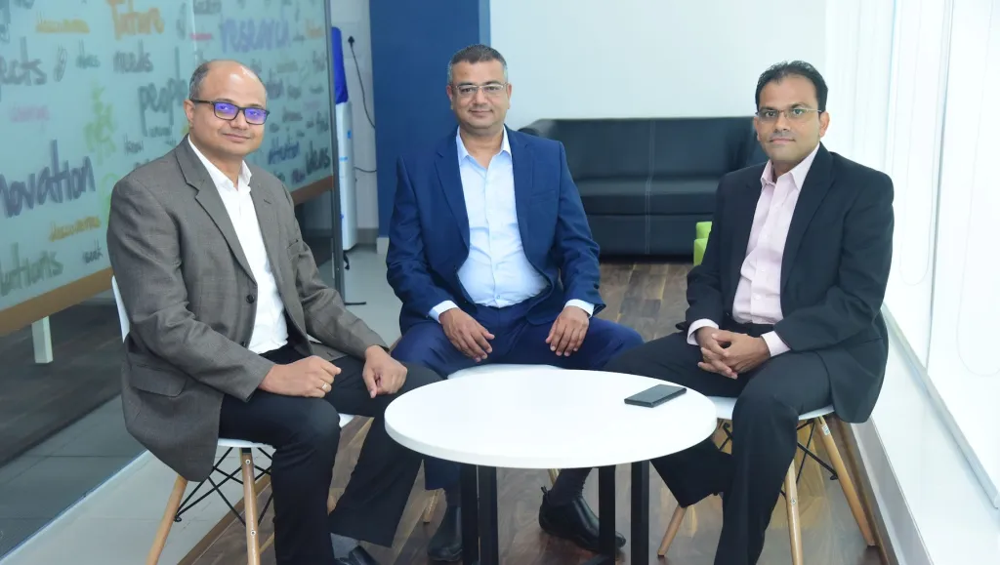
Under the hood, each founder took on a distinct role: Patel as CEO steered strategy and culture; Prashant Singh as COO oversaw operations and customer delivery; Sudhakar Gorti, officially CTO (former), guided the engineering until later handing over to a new tech leadership as the company scaled.
Together, they built a company known not just for its product, but for profitable growth. Indeed, unlike many fast-growing SaaS peers, LeadSquared kept a close eye on efficiency. Through 2021, the startup was near breakeven, choosing sustainable scaling over blitzscaling. “LeadSquared has shown a remarkable ability to scale and grow efficiently. Its core SaaS metrics are unique and best-in-class in the industry,” observed Sumir Chadha of, one of the firm’s new backers.
That validation culminated in June 2022, when WestBridge Capital led a $153 million Series C investment in LeadSquared, valuing the company at $1 billion. LeadSquared had become one of the rare Indian SaaS unicorns, and notably, one that reached the milestone without a single Silicon Valley VC in the mix. “Perhaps a first-of-its-kind in India, LeadSquared has entered the coveted unicorn club without any VC funding!” Forbes noted.
The round, which also included Gaja and Stakeboat increasing their stakes, brought LeadSquared’s total raise to about $188 million. More importantly, it handed Patel’s team a large war-chest to execute their global ambitions. “With this financing, we will double down on growth investments in India and North America, start building in APAC and EMEA, add new offerings to our product portfolio and fund acquisitions.
To support our growth, we plan to double our headcount in the next 18 months,” Patel announced after the deal. He also, finally, added a Silicon Valley address to his bio, preparing to relocate part-time to the Bay Area to be closer to the action in the U.S. market.
Growth Trajectory: Revenues, Funding, and Global Expansion
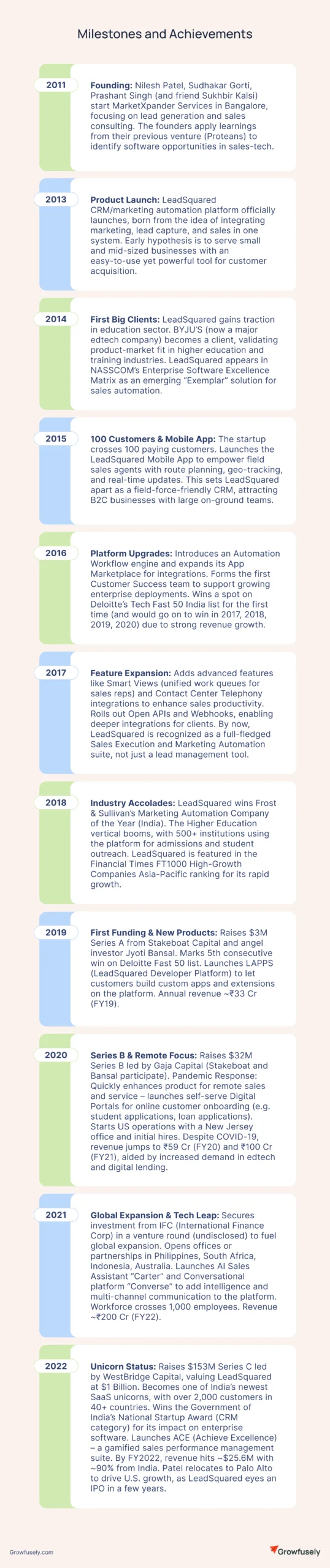
Below is a timeline of LeadSquared’s key milestones over the years, charting its path from a tiny agency to a unicorn.
Challenges and Turning Points
No startup reaches the unicorn milestone without weathering storms, and LeadSquared had its share of challenges and inflection points.
1. Winning in an Unconventional Market
One of the earliest challenges was convincing skeptics that a world-class SaaS business could be built by focusing on India first. Most Indian SaaS companies that achieved scale (think Zoho or Freshworks) derived a bulk of their revenue from the U.S. or Europe.
LeadSquared’s strategy was the opposite: dominate the home market’s untapped opportunity before expanding outward. This led to years of pushback from venture capitalists. Patel recalls repeatedly hearing that “SaaS companies can’t go big in India”, which he felt was a myopic view.
It was a challenge not just to execute in India, but to evangelize the very idea of India as a viable market for SaaS. In hindsight, LeadSquared’s success has become a case in point that a large domestic market, when approached with the right product, can produce a big outcome.
As Imran Jafar of Gaja Capital noted, they liked LeadSquared’s strategy “to focus on no-code, verticalised solutions to solve the specific needs of each industry vertical, which is where the SaaS industry will evolve to”. By sticking to its convictions, LeadSquared eventually attracted investors who shared its vision.
2. Navigating the Funding Gauntlet
Even after gaining traction, raising institutional capital was a slow process. Patel frankly admits that he found the fundraising dance grueling and “ridiculous”. For a long time, he was pitching growth capital to scale up, but “there were no takers for our story” because the story didn’t fit the usual template (no U.S. presence, no flashy VC firm on board). This nearly changed the company’s fate as by early 2019, Patel had almost resigned himself to not raising VC money at all.
The turning point came when a few bold investors stepped up: first Jyoti Bansal with an angel check in 2017, then Stakeboat in 2019, then Gaja in 2020. They were more like private equity players than traditional venture capital, which meant they valued sustainable models. This unique funding journey, heavy on angel and PE money, light on VC, allowed LeadSquared to preserve a frugal, profitability-oriented culture. “LeadSquared has entered the unicorn club without any VC funding,” a Forbes article headline proudly declared in 2022.
While that’s a bit of a purist stance (in reality, the company did raise external capital, just not classic Silicon Valley venture rounds), it speaks to the pride the founders take in having built the business on their own terms.
3. Product Hurdles and Competition
On the product front, LeadSquared faced the constant challenge of differentiating itself in a market full of bigger competitors. Giants like Salesforce, Oracle, and Microsoft dominated enterprise CRM, while newer entrants like HubSpot and Zoho catered to smaller businesses.
Rather than go head-to-head, LeadSquared doubled down on its niche: high-velocity sales environments with a mix of online/offline processes. “Most competitors offer CRM for B2B mostly. We do B2C or B2B2C,” Patel emphasizes.
This meant that sometimes LeadSquared lost deals where a client wanted a very U.S.-style, traditional CRM, but it won deals where clients needed flexibility and industry-specific features. The product had to keep evolving to stay ahead. For instance, when WhatsApp emerged as a key channel for customer outreach in countries like India, LeadSquared quickly built integrations for WhatsApp campaigns and two-way messaging (eventually leading to the Converse module). When clients started asking for in-depth analytics on sales team performance, LeadSquared developed ACE (the gamified goal-setting and analytics suite) in 2022.
The team’s willingness to “stay nimble and keep upgrading and tweaking its offering to meet high demand” was tested constantly. As Patel metaphorically described, “Kaafi clients left indicator de ke right turn le lete they”. That is, many clients would signal left but suddenly turn right, meaning their needs changed unpredictably.
Serving such customers kept LeadSquared on its toes, but it also meant the product was battle-hardened by the time it entered more developed markets.
4. Scaling Pains
Rapid growth after 2018 brought its own pains. Scaling a SaaS business is not just about adding servers but about scaling people and processes. LeadSquared had to transition from a founder-driven sales approach to a multi-team go-to-market engine. Patel divided the sales organization into inside sales (for the straightforward, lower-ticket deals) and field sales (for complex, larger clients) as the teams grew.
They also started building a partner channel program, recruiting referral partners and resellers in new geographies. Finding the right talent was a challenge, but the company embraced a strategy of hiring for attitude and training for skills (hence Patel’s lighthearted criteria like a sense of humor in interviews).
Internally, roles had to be clearly defined to avoid chaos. “We have learned to improve on describing roles more clearly… as the performance demands from individuals change,” Patel said about this growth stage. By the time of the unicorn round, LeadSquared had also brought in seasoned senior leaders (for example, a President for North America, a new CTO, etc.) to supplement the founding team. The ability to professionalize without losing agility was key to maintaining momentum.
5. The COVID-19 Curveball
The pandemic in 2020 was a moment of truth. When the first lockdowns hit in March 2020, many of LeadSquared’s clients, especially educational institutes and smaller businesses, were suddenly at risk. “I thought that the pandemic at best would be a three-four month thing,” Patel admits, recalling his initial disbelief about the looming crisis.
His well-wishers warned him not to take it lightly: “Beta, halke mein mat lo. Nipat jaoge,” they said (Don’t take it lightly, you could be wiped out). Fortunately, LeadSquared’s leadership team acted quickly, hitting what Patel calls the “panic button.” They went into cash-conservation mode, chasing down receivables from clients to shore up reserves and tightly controlling expenses. This prudent step ensured the company had enough buffer if things went south.
Then, as it turned out, demand for LeadSquared actually surged in certain sectors. With people stuck at home, edtech platforms like BYJU’S and Unacademy saw explosive growth, and they relied on LeadSquared to handle the influx of student leads.
Similarly, banks and insurers accelerated their digital sales efforts, leaning on LeadSquared’s onboarding workflows. What could have been a devastating year ended up as a breakout year, and LeadSquared doubled its revenue in FY21 and again in FY22. The crisis validated one of the startup’s core value propositions: enabling remote and digital sales processes. It also left the team stronger and more confident about navigating uncertainty.
6. New Tests After the Unicorn Status
In the post-2022 era, as a larger company with significant funding, LeadSquared faces the challenge of balancing growth with financial discipline. The influx of $153 million has allowed it to scale faster, but also introduced pressures to eventually deliver a return, possibly via an IPO or strategic exit down the line.
The broader market downturn in tech valuations in late 2022 and 2023 has likely tempered some of the initial euphoria. In FY2022-23, LeadSquared’s revenue growth slowed to about 32%, while losses widened due to aggressive expansion investments.
Recognizing this, the company reportedly course-corrected in FY2024-25, reducing its net loss by 45% while still growing revenue by a modest 13%. This indicates a pivot towards more sustainable growth, a familiar ethos for LeadSquared.
Moreover, the cooling of the once-red-hot edtech sector (with giants like BYJU’S facing struggles by 2023) presented a new challenge: LeadSquared had to further diversify its customer base to depend less on any single industry. The good news is that by now the company has strong footholds in finance, healthcare, and other areas, so it is less vulnerable to one sector’s slump.
Conclusion: Lessons from the LeadSquared Journey
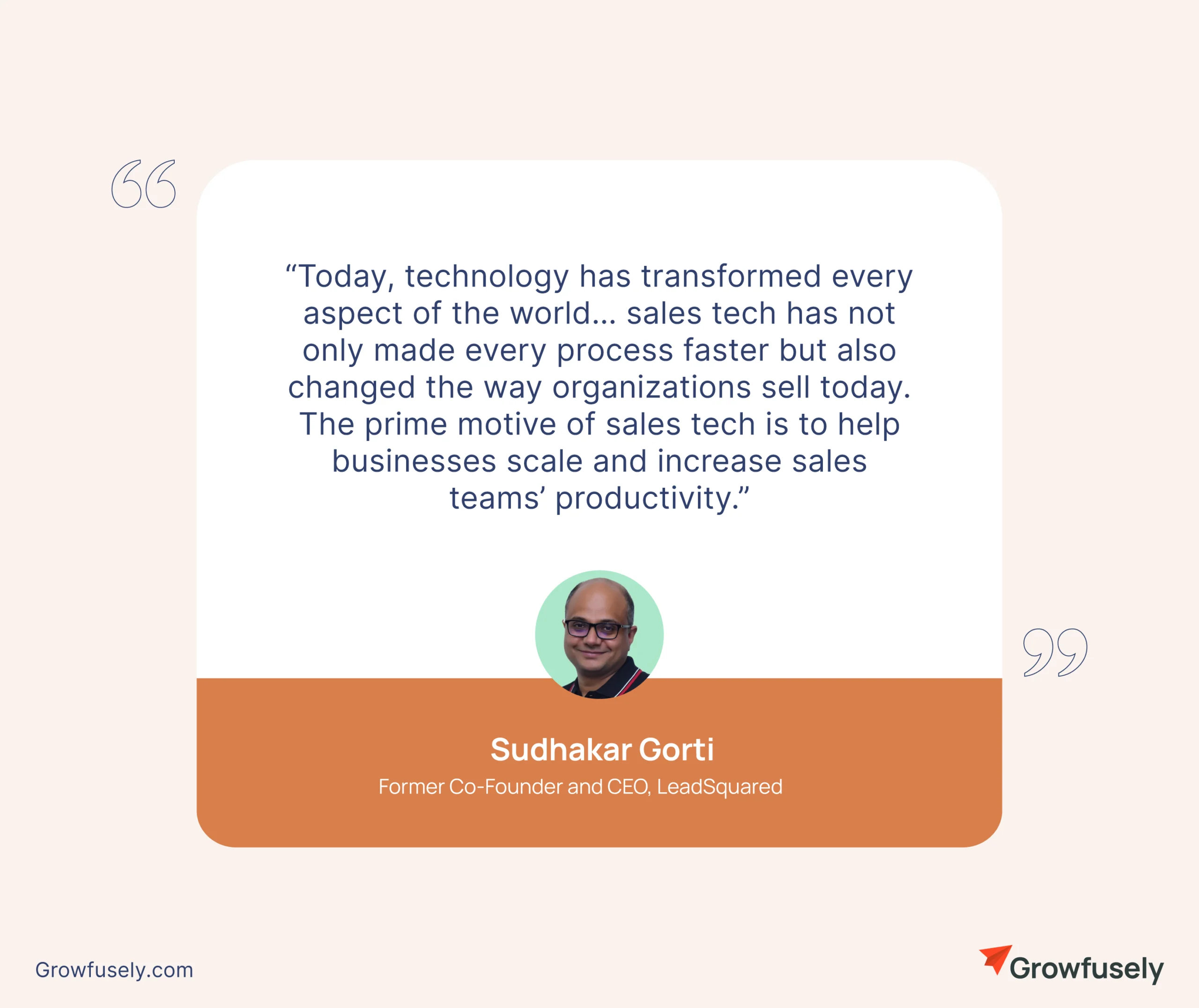
Through these trials, LeadSquared’s leadership has shown a consistent pattern: listen to the customers, stay flexible, and don’t be afraid to plot your own course even if it defies conventional wisdom. As Sudhakar Gorti, the former co-founder and CTO, puts it, technology and automation in sales are fundamentally about making businesses more efficient and scalable.
LeadSquared’s rise from a bootstrapped Bangalore startup to a global SaaS unicorn offers a trove of insights for entrepreneurs and observers alike.
First and foremost, it underscores the power of deep focus on a problem. Patel and his co-founders zeroed in on the inefficiencies in sales processes (especially in high-volume consumer sales) and stayed with that problem for over a decade, refining their solution. In doing so, they built a competitive moat through domain expertise. As Patel noted, their product isn’t just a generic CRM; it’s a verticalized engine tuned to how different industries operate. The takeaway for founders is to immerse themselves in their customers’ world, as sometimes the winning play is not to go broad, but to go deep.
Secondly, LeadSquared’s story validates a path that is often underrated: scaling sustainably without rushing to raise big VC rounds. By financing early growth through revenue and angel support, the company avoided the trap of chasing vanity metrics. This gave them time to reach a genuine product-market fit and a solid business model before pouring fuel on the fire.
It’s a reminder that in SaaS, retention and customer success can be more important than flashy customer acquisition. When LeadSquared finally raised larger rounds, it did so from a position of strength, with real metrics and a clear use of funds.
Another lesson is about market selection and timing. LeadSquared went against the grain by focusing on India in the 2010s, when few believed Indian businesses would pay for SaaS. But the bet paid off as India’s digital adoption inflected upwards. The founders correctly read that “business-to-consumer services were finally beginning to emerge and thrive” in South Asia, and those early adopters desperately needed tools to manage their growth.
By being in the right place at the right time (and yes, a bit of luck as Patel humbly says, “we found ourselves to be lucky to be there”), LeadSquared became the default choice for a generation of new-age Indian companies scaling their sales teams. Entrepreneurs can glean that sometimes an undervalued market can turn into a goldmine if the macro conditions shift in your favor, but you need the conviction to stick it out.
The journey also highlights the importance of adaptability in product and strategy. LeadSquared started as a marketing automation tool, morphed into a sales CRM, added field service capabilities, then AI, then vertical solutions. This wasn’t pivoting in the radical sense, but rather evolving. The team’s mindset that “flexibility came into our DNA” allowed them to serve dynamic, hyper-growth clients.
For SaaS founders, this shows that your product roadmap shouldn’t be set in stone, it should be guided by your most demanding customers (the ones who put the left indicator on but turn right!). If you can keep up with them, you’ll likely stay ahead of the market.
Culturally, LeadSquared’s story is about humility and long-term thinking. Despite an impressive résumé from his first startup, Nilesh Patel approached the second innings without hubris. He built a team that complemented each other’s strengths and stayed focused on value creation over valuation. Even when the company achieved unicorn status, Patel was quick to downplay the badge and emphasize sustainable growth and eventual profitability.
Finally, LeadSquared teaches us about the globalization of SaaS from outside the traditional hubs. The company is now expanding confidently in North America, but it did so after perfecting its playbook at home. With over 2,000 clients and counting, and recognition like Gartner’s 2024 Magic Quadrant (where LeadSquared debuted as a Niche Player in B2B Marketing Automation), the firm stands as proof that innovation in enterprise software can come from anywhere.
As we look ahead, LeadSquared’s next chapter will be about how well it can transplant its success to new soils. But if the past is prologue, the leadership’s emphasis on fundamentals will serve it well.
In a line, LeadSquared’s journey can be summed up as execution over hype. It’s a story of how three friends in Bangalore built a sales-tech powerhouse by staying true to their customers’ needs and their own principles. As they like to think of it: every lead, when nurtured and “squared,” can turn into a revenue engine. The same could be said of the company itself: given the right care and strategy, a small lead (or startup) can grow into something exponentially larger.
LeadSquared has squared its leads many times over, and its story is an inspiration to SaaS founders that with grit, focus, and a whole lot of patience, they too can turn a spark into a bright, lasting flame.


 About Growfusely
 White LabelMake us your (hidden) helping hand in delivering high-quality work to your SaaS clients.
 TeamCheck out the faces (and their backstories) behind our brand.
 Partner With UsJoin forces with us and earn a recurring monthly commission.
 Careers We're HiringJoin our growing team of passionate content marketing geeks.
 SEO & AI Search VisibilityBoost your search engine rankings with a blend of compelling content and technical tweaks.
 Content Strategy & ProductionFuel your brand awareness and user acquisition with strategic content creation and distribution.
 Authority & CitationsEarn relevant, high-quality backlinks from top websites in and around your niche.
 SaaS InfographicsLearn battle-tested best practices on all things SaaS marketing — visually.
 SaaS InterviewsRead our tête-à-têtes with SaaS marketing experts on achieving content-driven organic growth.