Unlike the old days, manufacturing buyers now begin supplier research online. Before they speak to sales, they search for solutions, compare vendors, and review technical capabilities.
Engineers look for materials and specifications. Procurement teams evaluate supplier reliability. Operations leaders assess performance in real-world environments. Much of this research happens before your team is even aware of the opportunity.
That shift makes SEO for manufacturing companies a core growth channel. If your company doesn’t appear during early research, your competitors gain that visibility and advantage.
SEO supports more than traffic. It helps build technical credibility. When your pages rank for relevant queries, buyers see your company as a reliable source of expertise.
Plus, manufacturing sales cycles are often long. Buyers revisit resources across weeks or months before requesting an RFQ. Strong search visibility helps you stay present during that process.
In this guide, you’ll learn what modern SEO for manufacturers looks like. We’ll cover strategy, technical essentials, content planning, and how AI SEO and GEO are shaping supplier discovery today.
Why SEO Matters for Manufacturing Companies
Recent stats suggest that in B2B industries like manufacturing, SEO delivers an average 748% ROI, as 70% of decision-makers prefer independent, self-service research. In fact, it is the top B2B marketing tactic, used by 49% of marketers.
Search plays a major role in how manufacturing buyers discover and evaluate suppliers. If your company doesn’t appear during this research phase, you may never enter the consideration set.
SEO for manufacturing companies helps you stay visible while buyers shortlist options. Ranking for relevant queries signals credibility and experience before the first interaction.
Organic visibility also compounds over time. Paid campaigns stop when budgets pause. SEO continues to bring in qualified traffic across product and application searches.
Whether you operate locally or across markets, strong SEO for manufacturers supports discovery throughout long evaluation cycles. It helps you reach buyers when they are actively researching solutions.
Unique SEO Challenges in Manufacturing
Manufacturing websites face a few SEO challenges that differ from other industries.
Products are often complex. Buyers search by application, material, tolerance, or compliance standard rather than by product name. Your content needs to reflect how engineers and sourcing teams actually research solutions.
Large product catalogs create another issue. Similar SKUs or filtered navigation can generate duplicate pages that confuse search engines. This affects visibility if not handled through proper SEO management for manufacturers.
Technical accuracy is a major concern. Specifications, certifications, and performance claims need to be correct. Balancing that detail with clear, search-friendly content can be difficult.
Competition adds to the challenge. Many buyers rely on established suppliers or large distributors. That makes it harder for newer companies to gain visibility without structured SEO strategies for manufacturers.
Addressing these issues early helps your SEO solutions for manufacturing companies perform more consistently over time.
Foundations of an SEO Strategy for Manufacturing Companies
Strong results start with a clear plan. A good SEO strategy for manufacturing companies reflects how buyers search, what problems they are trying to solve, and how your products fit into their workflow.
Begin with an SEO audit. Review your site structure to see how product categories, applications, and industries are organized. Check which pages are indexed and which are not using Google Search Console. Identify duplicate product pages created by filters or similar SKUs. Fix broken links and review page speed for high-traffic product or solution pages.
Next, understand buyer intent. Engineers may search for compatibility or performance limits. Procurement teams often look for supplier reliability or compliance standards. Many buyers search by application rather than product name. For example, they may search for a solution used in food processing or HVAC systems.
Build a keyword strategy around:
Product-level terms tied to specific components
Application-level queries related to real use cases
Industry-specific searches such as automotive or HVAC
Problem-based queries like corrosion resistance or load capacity
Use these insights to create or optimize pages such as:
Product detail pages for commercial intent
Application pages for industry-specific use
Troubleshooting guides for informational searches
This approach supports national SEO for manufacturers targeting domestic markets and international SEO for manufacturers expanding globally.
SEO consulting for manufacturing companies often begins with mapping these keywords to content that supports both early research and RFQ-stage decisions.
On-Page SEO for Manufacturing Companies
On-page SEO helps both buyers and search engines understand what each page offers.
Start with page titles and meta descriptions. Make sure they clearly reflect the product, application, or solution described. Avoid vague labels like “Our Capabilities.” Use terms tied to real use cases where possible.
Use headers to organize information logically. Break product pages into sections such as specifications, applications, certifications, and industries served. This helps engineers scan quickly for relevant details.
URLs should stay clean and descriptive. Avoid long parameter strings or generic page names. For example, a URL tied to a specific application can improve relevance for that query.
Add schema markup where relevant. Product schema or FAQ schema can help search engines interpret technical details and improve visibility in search results.
Trust signals can be incredibly powerful. Mention certifications, compliance standards, or testing results where appropriate. These details support SEO for manufacturers by reinforcing credibility.
Following these best SEO practices for manufacturers improves clarity and helps pages rank for high-intent searches.
Technical SEO Essentials
Technical SEO helps search engines access and understand your site, especially when product catalogs grow over time.
Start with site architecture. Organize products by category, application, or industry so both users and crawlers can navigate easily. Avoid burying key product or solution pages several layers deep.
Check crawlability. Filters and faceted navigation often create duplicate URLs for similar SKUs. Use canonical tags to signal the preferred version of each page.
Page speed also matters. Engineers and sourcing teams may browse on mobile devices while on-site. Optimize image sizes and reduce unnecessary scripts to improve load times.
Maintain updated XML sitemaps so search engines can find important pages. Monitor indexing status through Search Console to catch errors early.
Content Strategy for Manufacturing SEO
Manufacturing buyers search for answers, not marketing copy. Your content should reflect that.
Start by creating pillar pages around core product categories or industries served. For example, if you manufacture HVAC components, build a central page around that category. Include an overview of capabilities, materials used, and performance benchmarks. This page should link to supporting content such as installation guides, compatibility notes, or industry-specific applications.
Support these pillars with topical clusters. Create articles that explain how products perform in different environments. For instance, write about material suitability in food processing plants or durability in outdoor installations. Troubleshooting content also works well. Address common issues like wear, corrosion, or load limits based on real customer queries.
Service or solution pages should match buyer intent. Include detailed specifications, compliance standards, and industries served. Add diagrams or application examples where possible so buyers can evaluate fit quickly.
FAQ sections can capture long-tail searches. Answer questions related to installation steps, maintenance requirements, or certification criteria.
Following these best SEO practices for manufacturers helps align content with supplier evaluation and supports stronger SEO management for manufacturers over time.
Link Building & Authority Growth
Backlinks help search engines assess credibility. In manufacturing, they also signal industry relevance to buyers evaluating suppliers.
Start by targeting trade publications or industry associations in sectors you serve. Many accept contributed articles or technical notes from members. Submit process improvements, material comparisons, or application insights that align with their audience. Include a relevant link back to a product or application page on your site.
Partner with distributors or suppliers on joint case studies. For example, document how an integrated solution improved uptime or reduced maintenance. Publish this on both company websites with cross-links to improve visibility.
List your company in trusted industry directories. Many buyers consult association listings when shortlisting vendors. Make sure your profile includes updated contact details and a link to a relevant landing page.
Digital PR can also support SEO for manufacturing companies. Share data from internal testing or performance benchmarks with niche media outlets or technical blogs. Coverage often leads to citations and backlinks.
SEO management for manufacturers improves when authority grows through credible, industry-specific mentions.
Local SEO for Manufacturing Companies
You may be serving defined regions, even if you ship nationally or globally. Buyers often prefer suppliers within reach for faster delivery, service support, or onsite collaboration.
Start by optimizing your Google Business Profile (GBP). Make sure your contact details, service areas, and categories are accurate. Buyers often use these listings to validate credibility before reaching out.
Create location-specific landing pages for real service areas. Include regional industries served, certifications, or project examples where possible. Avoid duplicating the same content across different city pages.
Ensure consistency in your name, address, and phone number (NAP) to match across directories, association listings, and supplier networks. This supports national SEO for manufacturers as well as companies expanding into new markets through international SEO for manufacturers.
AI SEO & GEO (Generative Engine Optimization)
Search behavior is always changing, and it is doing so again. As you know, buyers are no longer relying only on traditional search results. All of us now ask AI tools like ChatGPT and Gemini for supplier recommendations or quick comparisons.
That is where AI SEO and GEO come in. SEO for manufacturing companies should now account for how AI systems interpret technical content. Pages with clear headings, concise explanations, and structured data are easier for these tools to summarize.
Semantic relevance matters more than keyword repetition. Cover topics fully. Explain applications, materials, and compliance standards in plain language.
AI tools can also help your planning. They reveal common buyer questions and gaps in your current content. So, AI tools help you rank on AI search.
SEO strategies for manufacturers that consider both search engines and answer engines are more likely to stay visible as discovery habits evolve.
SEO Agencies for Manufacturers
If you need SEO services for manufacturers that drive measurable organic visibility growth, check out these five SEO agencies that deliver.
1. Growfusely
Growfusely is a growth-focused SEO agency that works with B2B and technical companies, including manufacturers, to build sustainable organic pipelines. Our approach combines technical SEO, keyword strategy, and authority-focused content tailored to how engineers and procurement teams research suppliers.
For manufacturing brands, Growfusely emphasizes creating search experiences that support buyers from early research through RFQ. We integrate modern practices like AI SEO and GEO to improve visibility across both traditional search engines and AI-driven discovery platforms.
Rather than chasing short-term rankings, Growfusely focuses on building long-term organic growth systems that increase qualified traffic and support complex buying cycles. If you’re looking for SEO services for manufacturing companies that connect search visibility to measurable business outcomes, Growfusely offers strategy-led execution designed for long-term impact.
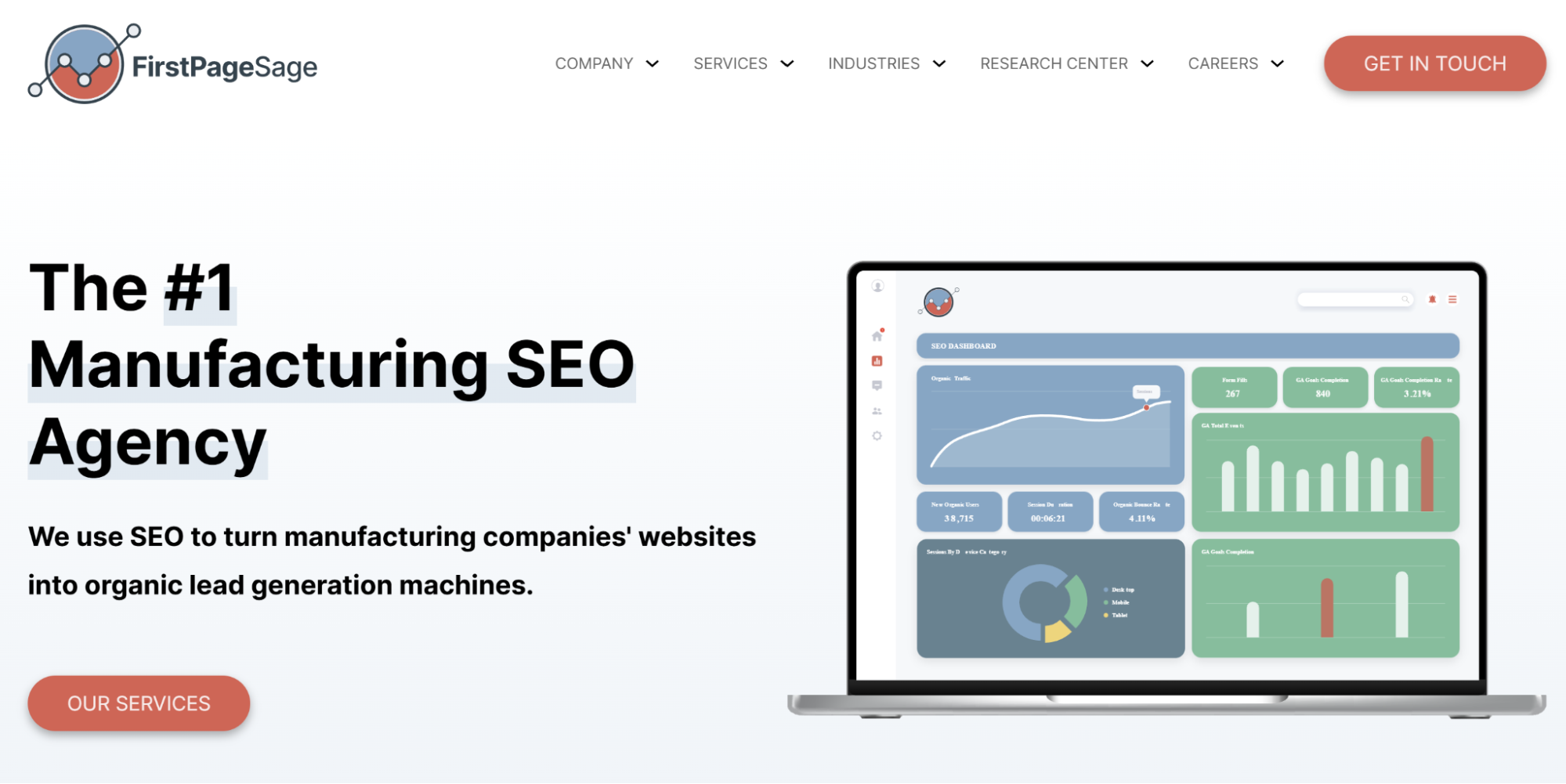
First Page Sage positions itself strongly around manufacturing SEO and thought-leadership style content. Their approach emphasises strategy plus authoritative assets like technical articles, case studies, and industry reports, with explicit attention to AI-driven discovery as well.
If you want SEO that builds brand credibility while driving compounding organic growth, their manufacturing positioning is clear.
3. Windmill Strategy
Windmill Strategy focuses on SEO for technical B2B brands, including manufacturing and industrial companies. Their positioning is built around long sales cycles, spec-driven buying, and turning search visibility into qualified leads.
They lean into strategy-first SEO, supported by technical cleanup, on-page improvements, and content that speaks to engineers and procurement teams. If you want an experienced partner that understands complex offerings and the reality of how manufacturing buyers research suppliers, they are a strong shortlist option.
4. Lform
Lform explicitly offers an SEO program for “digital manufacturers.” Their messaging focuses on getting products and services in front of engineers, procurement teams, and decision makers at the moment they search.
This makes them a fit for manufacturers that need SEO built around technical products, clear information architecture, and buyer-intent content that supports evaluation, not just traffic.
5. OuterBox
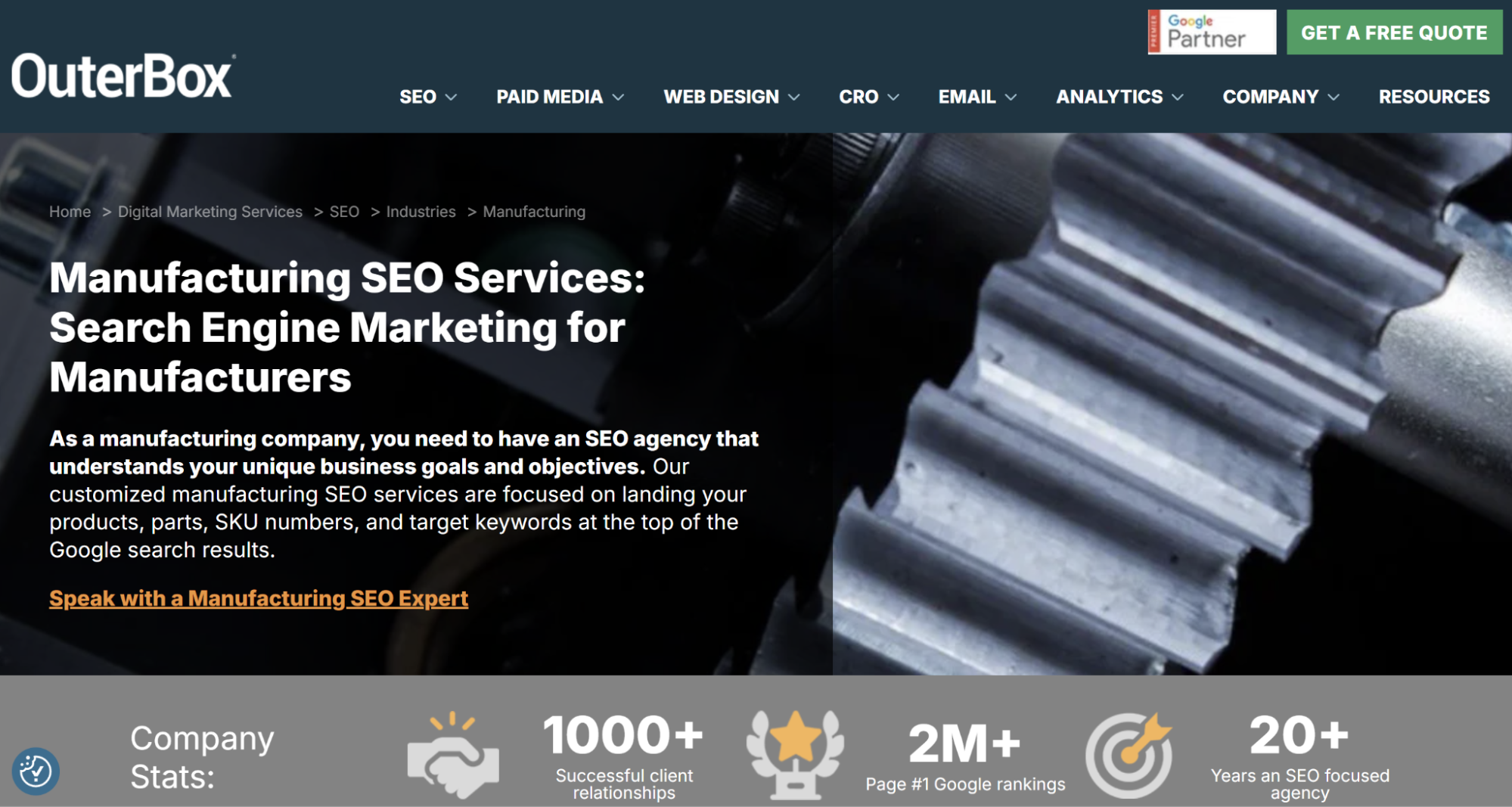
OuterBox offers industrial SEO services with a stated focus on spec-driven industries, including manufacturers, OEMs, and distributors. They highlight experience with large catalogs and long sales cycles, combining technical SEO and content execution to turn search into sustained lead flow.
If your site has complex product structures or needs scalable fixes across many pages, OuterBox is positioned for that type of work.
Measuring, Tracking & Iterating
SEO should support real sourcing decisions, not just rankings.
Start by mapping metrics to each stage of the buyer journey.
At the top of the funnel, track which educational pages attract the right audience. Monitor organic traffic from target industries, time on page, and scroll depth. Use Google Analytics to see which application-level pages bring in visitors from relevant sectors.
In the middle of the funnel, look for evaluation signals. Track downloads of spec sheets, visits to solution pages, or repeated views of compliance documentation. Set these actions up as events in GA4 so you can see which content supports supplier shortlisting.
At the bottom of the funnel, focus on outcomes tied to revenue. RFQ submissions, consultation requests, or contact form fills should connect back to specific landing pages or case studies. Review conversion rates by page to see which assets move buyers toward inquiry.
The usual SEO metrics also help. Track rankings for application-based queries or material-specific terms using tools like Ahrefs or Semrush.
Use attribution reports to understand how buyers move across resources before reaching out. Many interact with multiple pages over time.
SEO management for manufacturers improves when performance data connects directly to pipeline impact.
Wrapping Up
Manufacturing buyers now rely on digital research long before they contact suppliers. That makes SEO for manufacturing companies a long-term growth priority.
Strong results come from a balanced approach. You need solid technical foundations, clear on-page optimization, useful content, and credible authority signals.
Local visibility helps regional buyers find you. AI SEO and GEO are also shaping how supplier information is discovered and summarized.
Your goal is not just traffic. It is qualified visibility that leads to RFQs and supplier conversations.
SEO solutions for manufacturing companies work best when they support both discovery and trust over time.
If you want help building practical SEO strategies for manufacturing companies and turning search visibility into a consistent pipeline, Growfusely can help.
Schedule a strategy call to explore what growth through SEO could look like for your manufacturing business.


 About Growfusely
 White LabelMake us your (hidden) helping hand in delivering high-quality work to your SaaS clients.
 TeamCheck out the faces (and their backstories) behind our brand.
 Partner With UsJoin forces with us and earn a recurring monthly commission.
 Careers We're HiringJoin our growing team of passionate content marketing geeks.
 SEO & AI Search VisibilityBoost your search engine rankings with a blend of compelling content and technical tweaks.
 Content Strategy & ProductionFuel your brand awareness and user acquisition with strategic content creation and distribution.
 Authority & CitationsEarn relevant, high-quality backlinks from top websites in and around your niche.
 SaaS InfographicsLearn battle-tested best practices on all things SaaS marketing — visually.
 SaaS InterviewsRead our tête-à-têtes with SaaS marketing experts on achieving content-driven organic growth.