In the last decade, one startup decided to redefine the way goods moved across India. Not with fanfare or oversized billboards, but with code, spreadsheets, warehouses, and a stubborn belief that logistics could be better.
Today, this company is called Shiprocket, a SaaS business born out of the everyday friction of online sellers trying to get products into customers’ hands.
So, did Shiprocket start as a “big idea?” Not really. It began with a small team trying to solve a small problem: how to make shipping less painful for merchants who were juggling platforms, couriers, inventory, customer calls, returns, and so on.
What they built wasn’t just software, but a nervous system for thousands of eCommerce brands. Today, it has become a reliable way to move orders, manage customer expectations, and navigate one of the toughest parts of online selling.
On Shiprocket’s platform, data isn’t just numbers on a dashboard. It’s a continuous flow of actions, like predicting which courier will deliver on time, reducing returns, managing buyer messages, and more. With this infrastructure, brands could track and manage every part of the eCommerce journey on a singular platform.
Basically, what started as a solution for shipping soon grew into something bigger. Today, Shiprocket touches everything an online seller cares about: fulfillment, delivery, buyer communication, returns, and even insights that shape decisions. The company serves more than three lakh eCommerce customers, reaching over 19,000 unique pin codes in over 220 countries around the world.
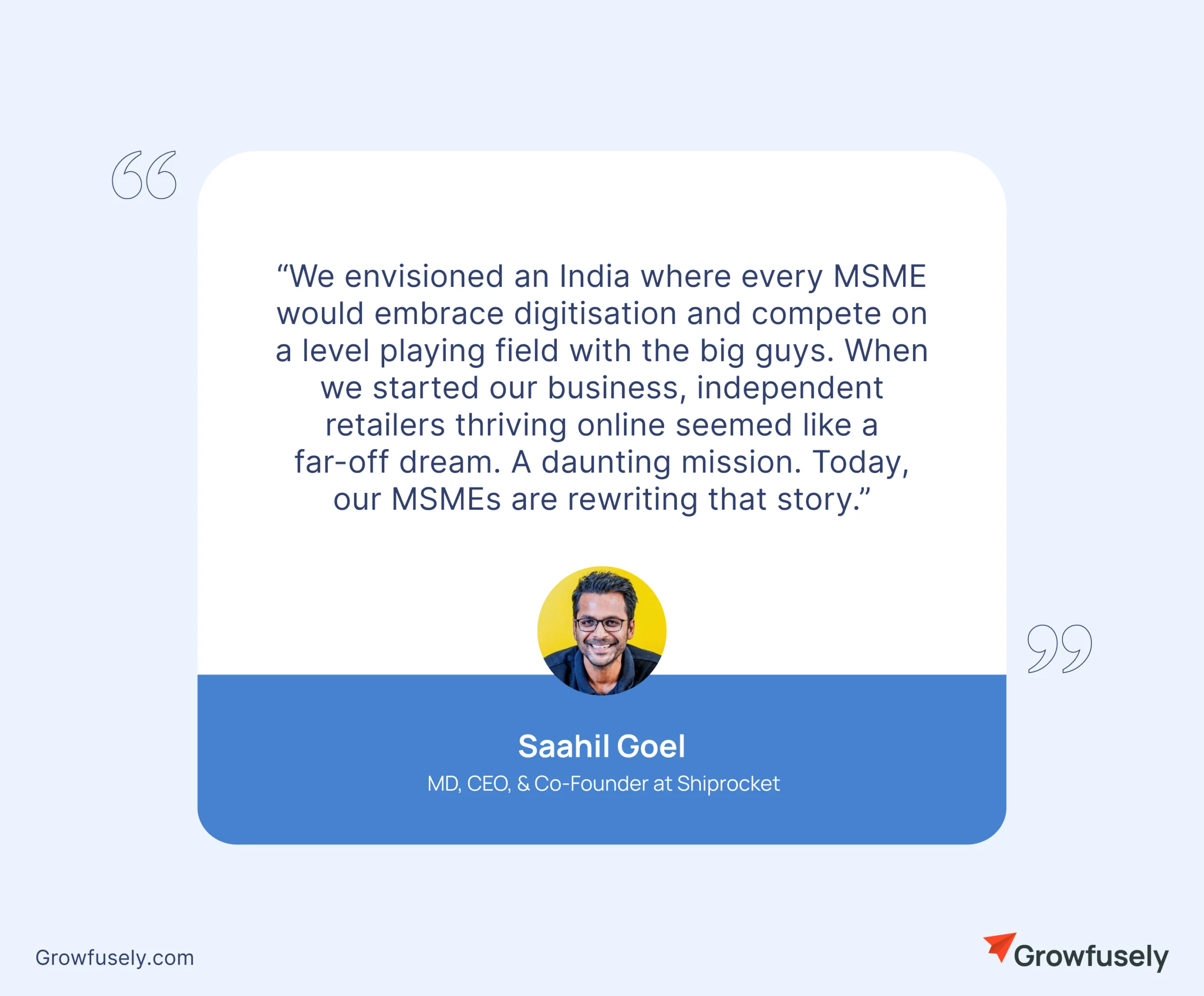
This is not a shiny success story told with glossy marketing language. It’s the tale of four founders who saw a boring problem no one else wanted to fix and fixed it anyway. It’s about determination, pivots, setbacks, and numerous small victories that added up to something real.
Let’s trace how Shiprocket came to be, the people behind it, the hurdles they faced, and the milestones they hit on their way to becoming one of India’s most talked-about SaaS platforms.
What Shiprocket Is and What It Does
Shiprocket is a technology platform built to take the pain out of selling online, especially the messy part no one likes thinking about: shipping, fulfillment, tracking, returns, and customer follow-ups. At its core, it’s a one-stop shop where eCommerce sellers can manage the entire backend of their business logistics without juggling screens, spreadsheets, and dozens of courier partners.
It works like this: you plug your online store (Shopify, WooCommerce, Amazon, Flipkart) into Shiprocket. New orders flow in automatically, while the platform lets you generate shipping labels with just a few clicks. You then choose the best courier for the job and track packages, from pick-up to delivery. If a buyer sends something back, Shiprocket helps you handle that too. And you get to manage all of this from one dashboard.
But Shiprocket doesn’t stop at shipping. It has grown into a suite of tools and services that touch nearly every part of the online selling journey:
Order Management: Sync orders from multiple sales channels and automate order workflows.
Shipping & Delivery: Choose from 17+ courier partners and cover almost every pin code in India, plus reach customers in 220+ countries if needed.
42+ Fulfillment Centers: Store inventory closer to buyers in strategically placed warehouses so deliveries are faster and cheaper.
AI-Driven Tools: Smart systems suggest the best courier, predict delivery issues, reduce failed deliveries, and help cut costs.
Customer Communication: Automated notifications and updates keep buyers in the loop, reducing complaints and improving trust.
Conversion & Checkout Tools: Optimized checkout pages and engagement tools help reduce abandoned carts and improve sales.
In other words, Shiprocket goes beyond shipping. It tries to remove the repetitive, unpredictable parts of selling online so sellers can dedicate their time to designing products, talking to customers, and growing their brand.
Shiprocket’s real value is in what those features let businesses do better:
Spend less time on busywork through automation of steps like cutting and pasting addresses, generating labels one by one, or juggling multiple courier accounts.
Save on shipping by comparing courier company prices and choose the one that suits your budget.
Warehouses and smart routing mean faster product deliveries, which increases repeat purchases.
AI-led courier selection and communication tools help reduce delivery failures.
Grow beyond local markets with international shipping tools to reach buyers abroad.
Understand performance with built-in analytics that show which parts of the shipping process are working well and which need attention.
This mix of automation, data, and integration means sellers using Shiprocket can handle complex logistics without a big team. For many businesses, moving from manual chaos to something predictable and manageable almost overnight is nothing short of a game-changer.
Why It’s Called Shiprocket
The name Shiprocket came from a simple idea the founders had early on: move things faster and make shipping smoother for small sellers.
Before Shiprocket existed, the team was building other tools for eCommerce, and what kept coming up again and again was the same hurdle: getting orders out the door was slow, confusing, and expensive.
People wanted something that felt flawless; like sending goods into the world without friction. The name Shiprocket struck a chord: combining “ship” (what every seller wants to do) with “rocket” (something quick, direct, and powerful). It was meant to signal speed and simplicity in an often slow, tangled logistics world.
Shiprocket is the product of four people who saw a gap, came together, and decided to keep working until they filled it.
1. Saahil Goel: MD, CEO, & Co-Founder
Saahil’s journey into Shiprocket started with his own frustrations as a seller and a tech guy. He studied computer science, then went on to get an MBA and MS in the U.S. Then, he worked in tech and consulting.
Early on, he co-founded KartRocket, a platform that helped small businesses build online stores. But pretty quickly he realized that merchants cared a lot more about shipping orders than building websites. That simple but sharp insight nudged him toward what became Shiprocket.
Saahil’s focus was always tech and product, i.e., making tools that actually work for sellers.
2. Gautam Kapoor: COO and & Co-Founder
Gautam brought structure and logistical know-how into the business. He studied business, worked in his family’s industrial distribution business, and got his hands dirty with operations long before Shiprocket. From managing supply chains to working with brands like Bosch, he knew how systems move things in the real world.
That practical experience was key when Shiprocket had to move from idea to reality. Gautam helped build processes, not just products.
3. Vishesh Khurana: Head of Growth & Co-Founder
Vishesh came in early as a consultant, then became a co-founder because the team saw how good he was at connecting with people, especially sellers. He studied marketing and had already run his own business. This meant he wasn’t just smart, he knew the seller’s language.
His role has largely been about growth: bringing more sellers in, understanding what they need, and shaping the part of the business that interacts with users daily.
4. Akshay Ghulati: Co-Founder
Akshay wasn’t there at the very beginning, but he became a co-founder soon after joining the team. He has a degree in economics from Wharton and an MBA from Harvard Business School. Before Shiprocket, he worked with Amazon and other big firms in operations, strategy, and supply chain roles.
At Shiprocket he’s been central to strategy, customer experience, and helping the company scale beyond India into international markets.
How They Built Shiprocket Their Own Way
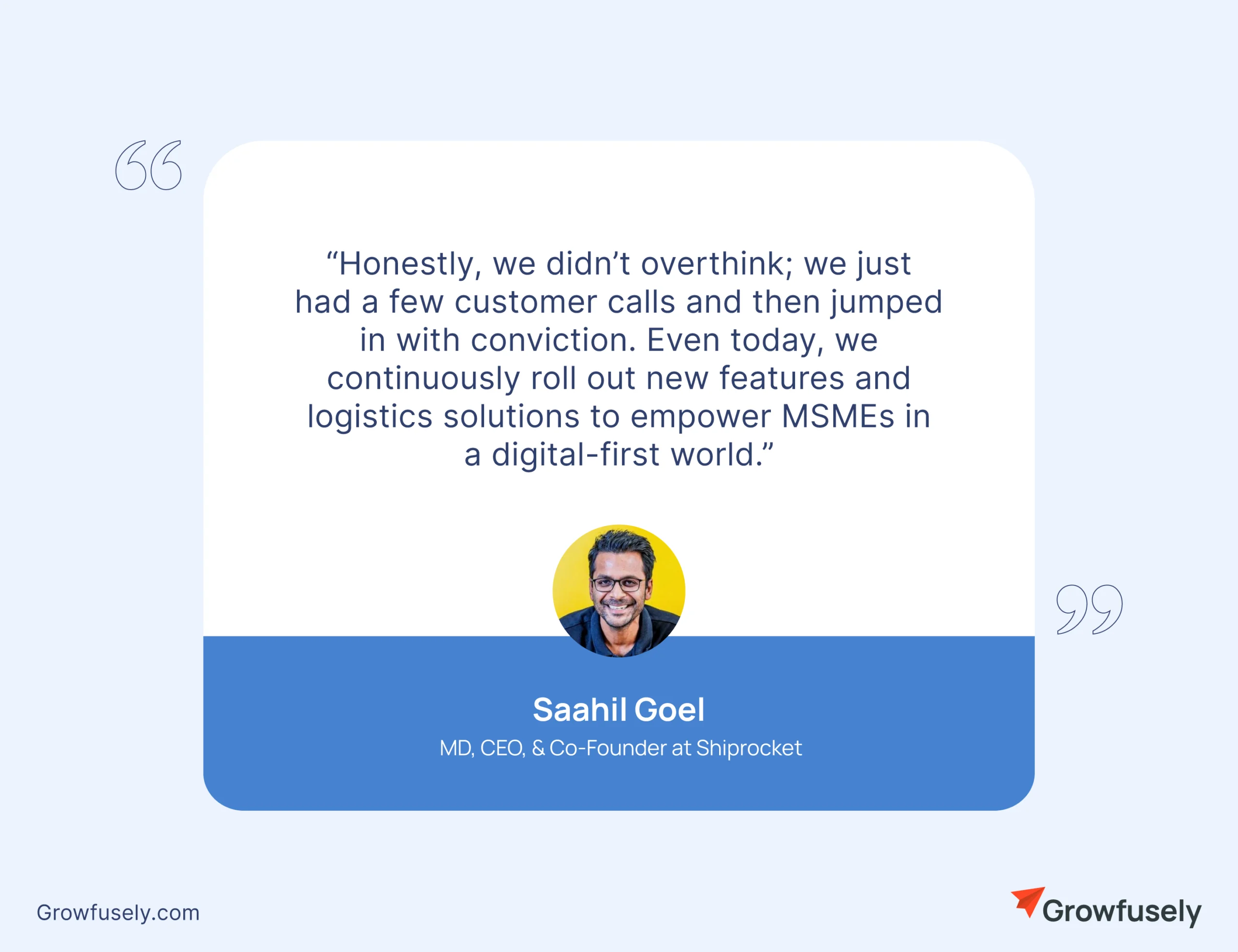
The founders didn’t have an elaborate plan to put in place when starting the company. They started simply with observation and friction. They watched small businesses struggle with online selling. They saw how a simple thing like shipping could derail an order. This became their problem to solve.
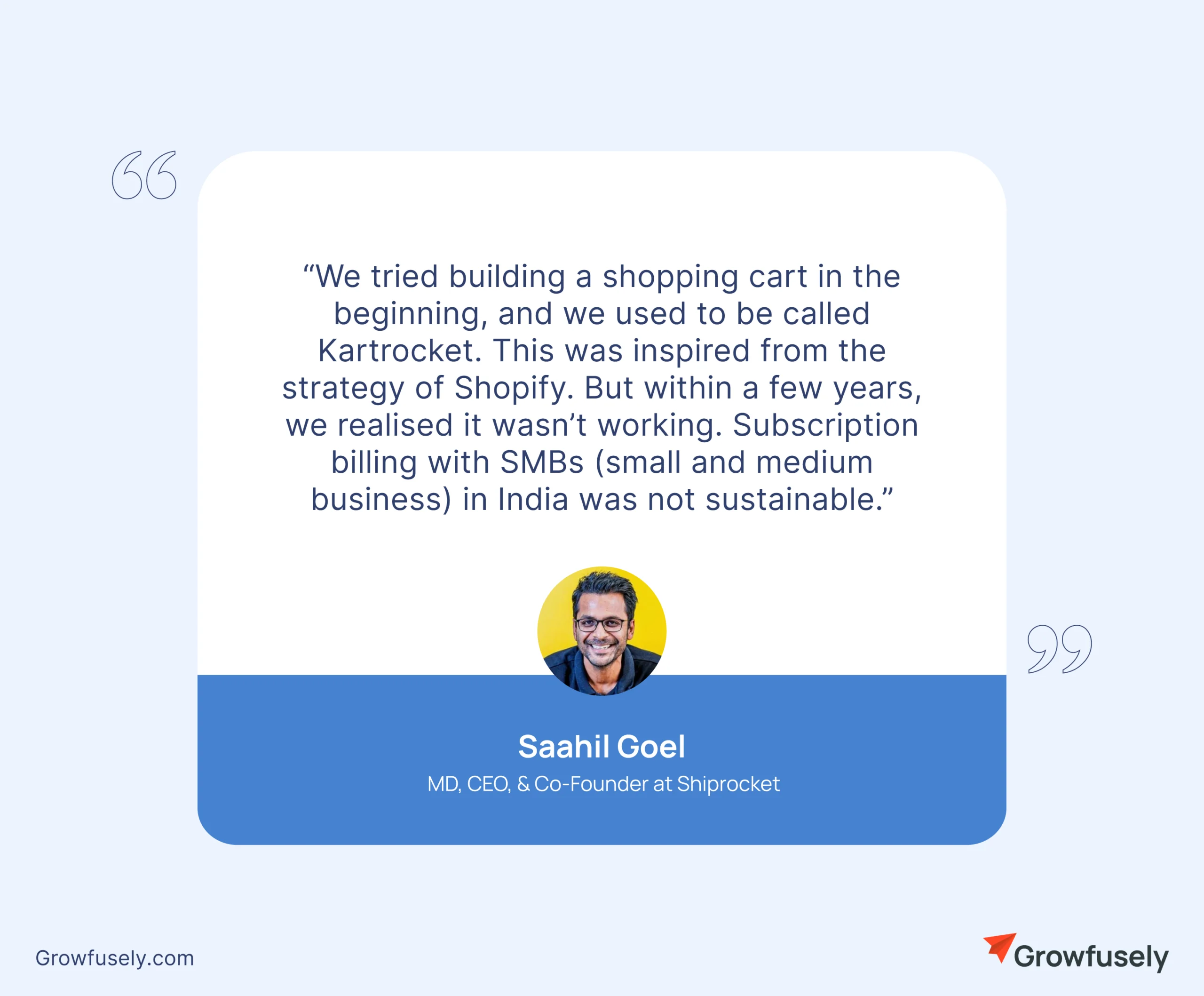
Before Shiprocket, they tried other things: building online stores for sellers (KartRocket), then a marketplace (Kraftly). Those efforts didn’t produce lasting results, but they taught the team where the real problem was: shipping and fulfillment. So, they focused on solving that.
Their early days were rough, and meant working out of rented office space, long hours of testing, and more than one pivot. But they stuck to what mattered: making logistics something sellers didn’t have to dread.
Today, the team still talks about useful technology and real problems. They want tools that help sellers handle orders faster, track shipments better, manage returns, and communicate with buyers without stress.
Their vision has grown too. A tool that was once meant only for shipping has become a platform for fulfillment, analytics, AI automation, and growth.
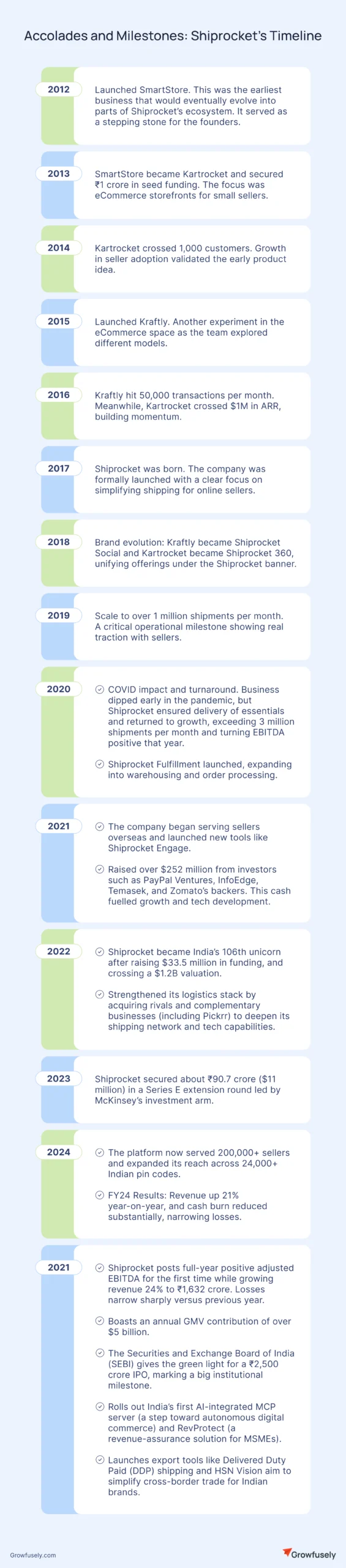
Accolades and Milestones: Shiprocket’s Timeline
Here’s a chronological look at the key moments that shaped Shiprocket’s journey from a small tech idea to a major player in eCommerce logistics and enablement.
What Shiprocket Teaches Us about Building a Business That Lasts
Shiprocket didn’t climb its way into India’s top SaaS companies overnight. It took patience, small experiments, and a steady ability to read the market. And hidden in their story are a few lessons worth remembering.
1.Pay attention to the boring problems
Most startups chase shiny ideas; but the Shiprocket team looked at something no one wanted to touch: shipping, returns, delays, and courier issues. And because the problem wasn’t glamorous but very real, the competition was thin. This gave them room to build something meaningful.
The lesson here is simple: boring problems often hide big opportunities.
2.Listen to your users even when their needs feel small
Sellers didn’t ask for dashboards or sleek interfaces. They only asked for reliability. They wanted a parcel to reach on time, with fewer returns, and updates that didn’t confuse their buyers. Shiprocket let those simple asks guide product decisions.
This focus helped them build something people not only used, but depended on.
3.Don’t be afraid to pivot
The company started as KartRocket, which became Kraftly. Then they shifted to shipping. After that, they expanded into fulfillment and AI-based tools. Basically, they let reality override their original plan.
If you’re building something, the path will rarely be straight. Pivot if the data, customers, and market pull you in a new direction.
4.Build long-lasting systems instead of temporary wins
Shiprocket scaled because they built infrastructure that could grow with sellers. This included fulfillment centers, courier partnerships, data models, AI features, and automated workflows. These aren’t overnight hacks, but long-term investments.
One of the biggest lessons here is that patience pays in logistics, SaaS, and pretty much any business where reliability is a promise.
5.Solve for the ecosystem rather than just the user
Shiprocket didn’t stop at shipping labels. They built tools that support the entire loop: checkout, communication, returns, analytics, cross-border trade, warehousing, and even fraud prevention.
By helping sellers run their entire backend, they didn’t just solve a problem. They built a whole channel.
6.Learn from the market
Every shift in the eCommerce world forced Shiprocket to adapt. GST changed workflows, the pandemic changed demand, and cash-on-delivery changed risk. But instead of resisting change, the company adapted.
The takeaway: Markets evolve whether you like it or not. The companies that learn fast, survive longer.
Wrapping Up
Shiprocket didn’t just ride India’s eCommerce wave. It learned the pulse of small sellers, read the chaos of everyday orders, and built a system that feels almost inevitable now. It’s the kind of success that comes from looking at the unglamorous parts of commerce and deciding that they matter.
From stitching fragmented shipping networks together to giving thousands of homegrown brands a fighting chance, the company proved that scale is born from relentless problem-solving. Shiprocket stands where it does today because it kept its eyes on the long game, trusted the process, and backed the people who power the market from the ground-up.


 About Growfusely
 White LabelMake us your (hidden) helping hand in delivering high-quality work to your SaaS clients.
 TeamCheck out the faces (and their backstories) behind our brand.
 Partner With UsJoin forces with us and earn a recurring monthly commission.
 Careers We're HiringJoin our growing team of passionate content marketing geeks.
 SEO & AI Search VisibilityBoost your search engine rankings with a blend of compelling content and technical tweaks.
 Content Strategy & ProductionFuel your brand awareness and user acquisition with strategic content creation and distribution.
 Authority & CitationsEarn relevant, high-quality backlinks from top websites in and around your niche.
 SaaS InfographicsLearn battle-tested best practices on all things SaaS marketing — visually.
 SaaS InterviewsRead our tête-à-têtes with SaaS marketing experts on achieving content-driven organic growth.