Quick answer: The top SaaS SEO agencies in 2026 combine classic search work with AI search visibility: earning citations in ChatGPT, Perplexity, and Google AI Overviews, not just rankings. Growfusely, Skale, Optimist, and Minuttia lead this list, and the right choice depends on your stage, budget, and how much of your pipeline already starts inside an AI answer.
Growfusely publishes this guide and appears in it. We’ve listed ourselves first with a transparent case for why, and we’ve profiled eight other agencies honestly enough that you can disagree with us.
Who this guide is for: SaaS founders, marketing leaders, and growth teams evaluating an external partner for organic growth, whether that’s your first agency, a replacement for one that underdelivered, or a specialist to add AI search visibility to working SEO.
What you’ll learn: how the nine agencies compare on specialization, pricing, and AI search capability; what engagements actually cost in 2026; the red flags that predict a bad engagement; and how to match an agency type to your specific bottleneck.
Your buyers changed how they find software vendors, and most agency listicles haven’t noticed. When a marketing lead asks ChatGPT which platforms to shortlist, the answer comes from a specific set of sources, and whoever appears in those sources wins deals nobody saw happen. Every firm on this list works with B2B SaaS companies, and most work with nothing else.
Choosing a search partner in 2026 means choosing a firm that understands both games: the rankings game that still drives qualified traffic, and the citations game that decides whether AI engines recommend you. And SaaS complicates both: trial and demo conversion paths, PLG versus sales-led motions, and comparison-heavy buying behavior make software search its own discipline, which is why every firm on this list specializes in it.
Definition: A SaaS SEO agency is a specialized firm that grows a software company’s organic pipeline across traditional search engines and AI answer engines, combining technical SEO, content strategy, authority building, and citation optimization for LLM-driven search.
What makes B2B SaaS SEO different
Most “best agencies” posts are assembled from other posts. This one has stated criteria, and one of them comes from our own research.
This month we analyzed 1,739 AI citations across 128 real B2B software buying queries on ChatGPT and Perplexity. Independent content and vendors’ own comparison pages drove roughly 79% of all citations. Review platforms, the G2s and Capterras that dominate most agencies’ “AI SEO” advice, accounted for 7.3%.
That finding shaped how we ranked this list. We weighted:
SaaS-dominant client rosters. Software companies have economics (free trials, ACV bands, PLG vs sales-led motions) that generalist agencies get wrong.
Documented results with numbers. Named clients and published case studies, since anonymized “300% growth” claims are unfalsifiable.
Real AI search capability. A methodology, published research, or verifiable citation results. A nav-menu rename from “SEO” to “AI SEO” doesn’t count.
A distinct specialization. Every agency here is best at something specific, and each entry includes one honest limitation.
You’ll also notice this list skips the names that appear on every other one. We reviewed the usual suspects and kept only the ones that earned a spot against these criteria.
The mistake most SaaS companies make with SEO
They optimize the smallest slice of the board. The default playbook says rank for your category keyword, stack G2 reviews, and wait. Our citation data says the recommendation layer works differently. Review platforms drove 7.3% of the 1,739 citations we analyzed, while independent content and vendor comparison pages drove roughly 79%. The companies winning AI recommendations are present in the sources engines actually cite: third-party roundups, expert comparisons, and their own well-structured comparison pages.
The practical consequence for agency selection: a partner still selling rankings-plus-reviews as the whole strategy is optimizing your 2021 funnel. The agencies worth hiring in 2026 can tell you which sources drive recommendations in your category and how they plan to get you into them.
The 9 best SaaS SEO agencies compared
Agency
Best for
Pricing signal
AI search capability
Notable clients
Growfusely
Citations, not just rankings, from a senior-led team
From ~$3.5K/mo
Proven: publishes original citation research
Murf AI, StratiFi, FreshBooks, DealHub
Skale
Growth-stage PLG SaaS measuring SEO in MRR and signups
From ~$5K/mo
Proven: published GEO case results
HubSpot, Typeform, Maze, Slite
Optimist
Startups wanting a lean senior team, full-funnel content-led growth
From ~$5K/mo
Proven: CORE framework spans SEO and AEO
ZoomInfo, Semrush, Superhuman, Gusto
Minuttia
Post-PMF SaaS wanting senior content strategy with AEO/GEO depth
Mid-tier, not published
Proven: dedicated AEO/GEO/LLMO lines
Toggl, ServiceTitan, Docebo, NordVPN
Omnius
Early-stage SaaS and fintech that want velocity
Partnership model, not published
Proven: GEO service plus internal AI tooling
ANNA Money, TextCortex, AuthoredUp
Ten Speed
SaaS with an existing content base that’s underperforming
$5K-$25K/mo
Emerging: GEO folded into core offer
Bitly, Calendly, Lattice, Workvivo
Flying Cat
SaaS expanding into European and multilingual markets
~$100-149/hr
Emerging
Softr, Operto, Stonly, Mixmax
Powered by Search
High-ACV SaaS with long, committee-driven sales cycles
From $7.5K/mo, 1-year min
Emerging: AEO inside demand gen system
Basecamp, Collibra, Varonis, Elastic
Kalungi
Post-PMF SaaS that needs a whole marketing function
~$15K-$45K/mo
Part of broader GTM stack
DataGuard, CASEpeer, Performio, Botdojo
Which agency type fits your bottleneck?
Nine firms, six distinct models. Start from your constraint, not from the brand names:
Citation and AI-visibility specialists (Growfusely, Minuttia): your rankings are fine but AI engines don’t recommend you, or you want both built together.
Revenue-metric SEO shops (Skale, Omnius): you need signups and MRR attribution, and velocity matters more than breadth.
Content-led growth partners (Optimist, Ten Speed): content is your engine but it’s under-strategized or underperforming.
Integrated demand-gen systems (Powered by Search): high ACV, long committee sales cycles, and you want paid and organic run as one system.
Full marketing function (Kalungi): the honest diagnosis is that you don’t have a search problem, you have a no-senior-marketing-leadership problem.
Market expansion specialists (Flying Cat): a working playbook that needs to cross languages and borders.
Pricing signal: Value band with senior execution; see the cost table below
What to watch: Covered honestly in when we may not be the right fit below
We’ll make the honest case rather than the humble one. Growfusely is the only agency on this list publishing original research on how AI engines actually cite software brands. Our study of 1,739 citations across ChatGPT and Perplexity is the evidence base for this list’s methodology, and it’s the same evidence base we use in client work.
The work is organized around TRACE, our framework for AI search visibility: Topical Authority, Reference-Grade Content, Authoritative Mentions, Corroboration, and Entity Clarity. Every engagement audits a brand against those five pillars, then builds the missing ones. When we tell a client which assets will earn citations, the recommendation comes from measured data, and we re-run the measurement to prove the result.
That approach shows up in outcomes. Mind the Graph grew organic traffic 217% in six months through a combined content and SEO program. JetOctopus doubled organic traffic in 10 months on a content-driven SEO strategy. For Whatfix we built 250+ high-authority citations, and for Document360 we placed 20+ organic PR stories that established the brand as a category reference.
2. Skale
Best for: Growth-stage and PLG SaaS teams that want SEO measured in signups and MRR, not sessions
Core services: SEO strategy, GEO, technical SEO, content development, link building, digital PR
Notable clients: HubSpot, Typeform, Maze, Slite
Pricing signal: Engagements reportedly start around $5,000/mo
What to watch: The GEO capability is newer than the SEO capability, so ask to see a citation trend across engines for a live client rather than accepting one published case as universal.
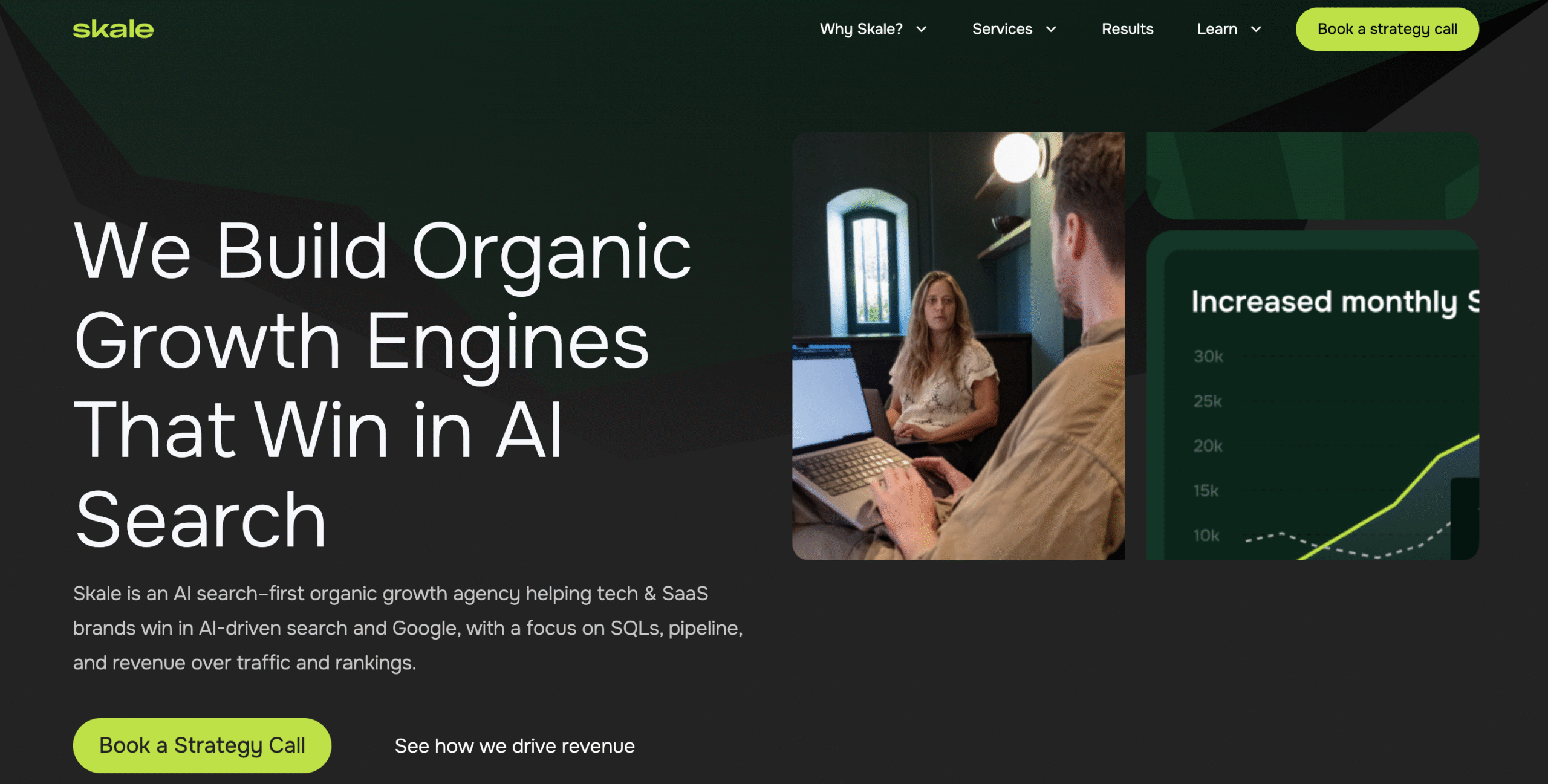
Skale is a UK-based organic growth agency working with B2B SaaS companies, with a focus on tying SEO output to revenue metrics rather than traffic. Their programs cover strategy, content, technical work, and link acquisition, and they have added GEO to the core offer over the past year.
The model suits growth-stage teams that already have product-market fit and want organic treated as an acquisition channel with pipeline reporting attached.
3. Optimist
Best for: Startups and scale-ups that want a lean, senior, content-led growth partner rather than a large account team
Core services: Content-led SEO and AEO strategy, editorial content, original data reports, full-funnel organic programs
Pricing signal: Engagements typically start around $5,000/mo
What to watch: The lean model is the point and also the constraint; principal-led means limited concurrent capacity, so if you need a large embedded team shipping daily, this is the wrong shape.
Optimist is a content-led growth agency founded in 2016, working primarily with B2B SaaS startups and scale-ups. Strategy is principal-led, with execution handled by a small network of senior specialists rather than a large in-house team.
Their approach centers on content as the primary growth engine, with SEO and AEO built around it. The lean structure suits companies that want senior attention on the account without paying for account management layers.
4. Minuttia
Best for: Post-PMF B2B SaaS that wants senior content strategy with genuine, productized AEO and GEO depth
What to watch: The center of gravity is strategy and content; if your engagement needs heavy technical implementation inside your codebase, confirm scope and ownership before signing.
Minuttia is a content and organic growth agency working with post-product-market-fit B2B SaaS companies. They run AEO, GEO, and LLMO as distinct service lines rather than folding them into a general SEO offer.
The center of gravity is content strategy and topical authority, which suits teams that have the technical side handled internally and need senior editorial direction on what to publish and why.
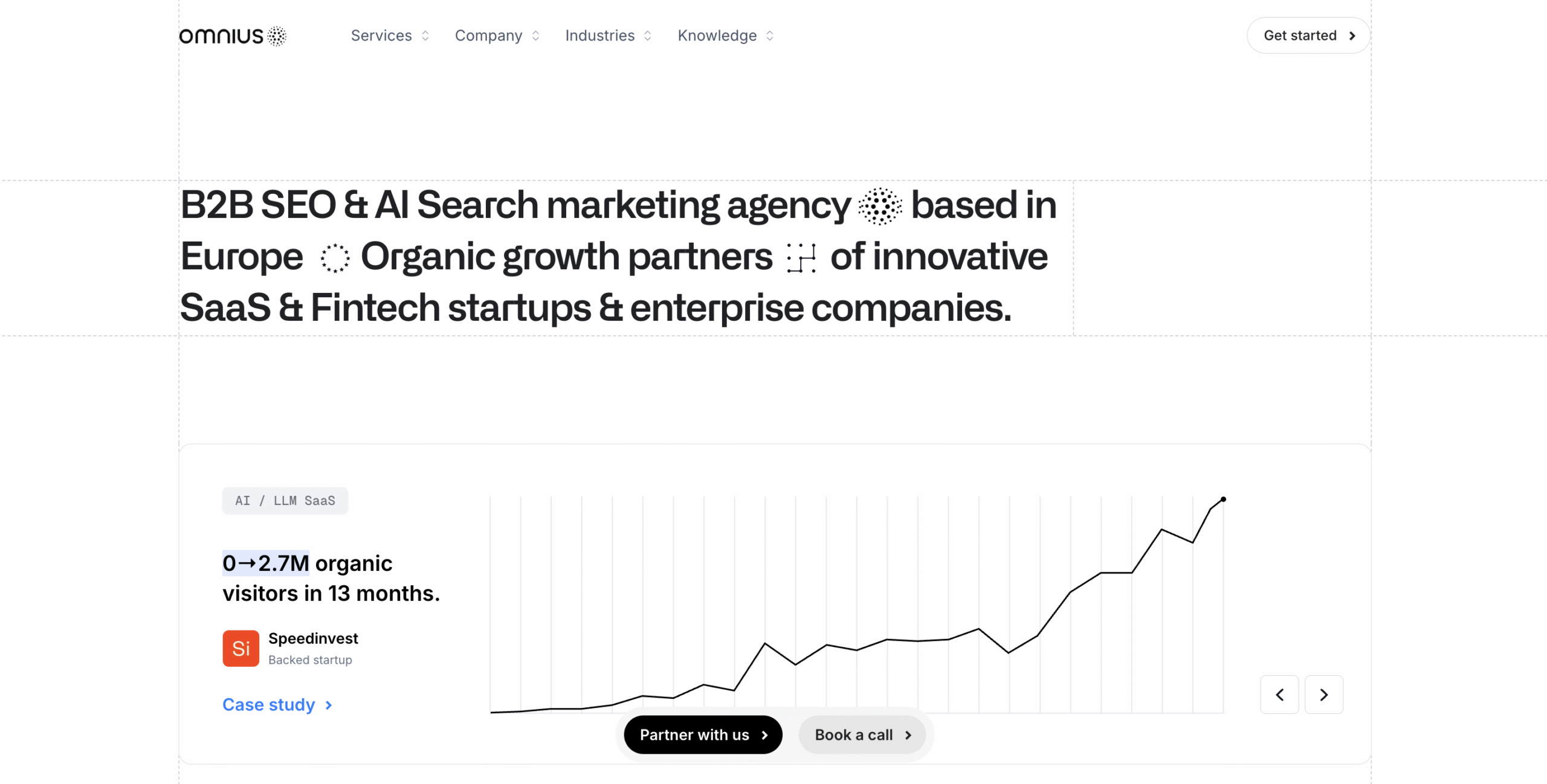
5. Omnius
Best for: Early-stage SaaS, fintech, and AI companies that want speed and a deeply integrated partner
Core services: SEO, GEO, programmatic SEO, content, CRO, technical optimization
Notable clients: ANNA Money, TextCortex, AuthoredUp
Pricing signal: Partnership model, not publicly published
What to watch: Capping at eight clients per year makes availability a real constraint, and the agency is younger than most others here.
Omnius works exclusively with SaaS, fintech, and AI companies, and limits the number of clients it takes on each year in favor of deeper engagement with each one. Services span SEO, GEO, programmatic SEO, content, and conversion work.
The model is built for speed and close integration, which suits early-stage companies that want a partner operating like an extension of the team rather than a vendor on a monthly reporting cycle.
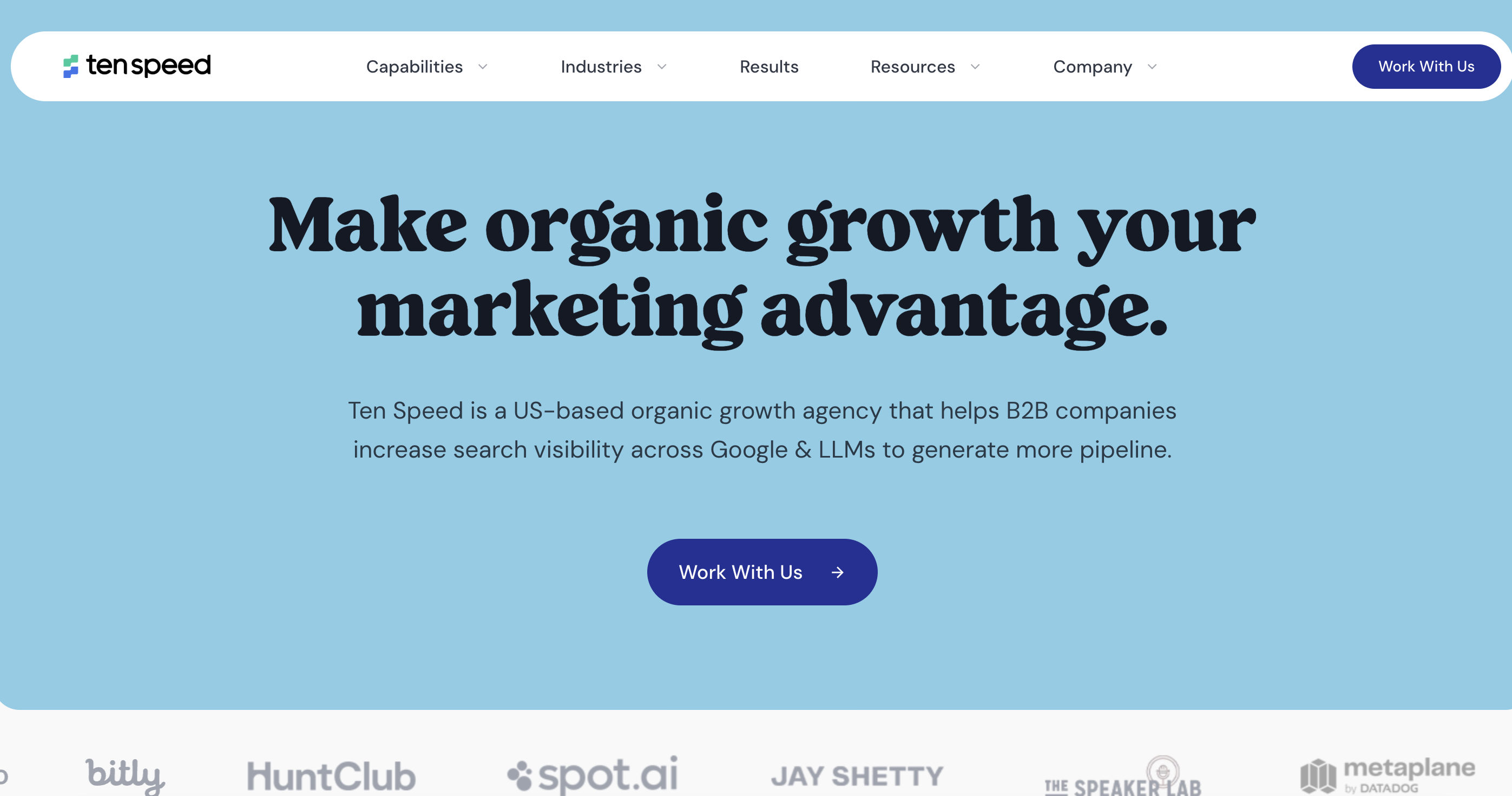
6. Ten Speed
Best for: SaaS companies with an existing content library that’s underperforming and needs to become a growth asset
Core services: Content strategy and creation, content refresh programs, SEO consulting, GEO, email and organic social distribution
Pricing signal: $5,000-$25,000/mo, no long-term contract required
What to watch: The refresh specialty cuts both ways; if you’re starting from zero content, a foundations-first agency may fit better than one whose superpower is upgrading what exists.
Ten Speed is a US-based content and SEO agency founded by former in-house marketers from the B2B software world. Their distinctive strength is content optimization and refresh work rather than net-new production.
They manage large existing content libraries for established SaaS brands, with GEO now part of the core offer and no long-term contract requirement. The fit is clearest for companies that have published consistently for years and suspect the archive is underperforming.
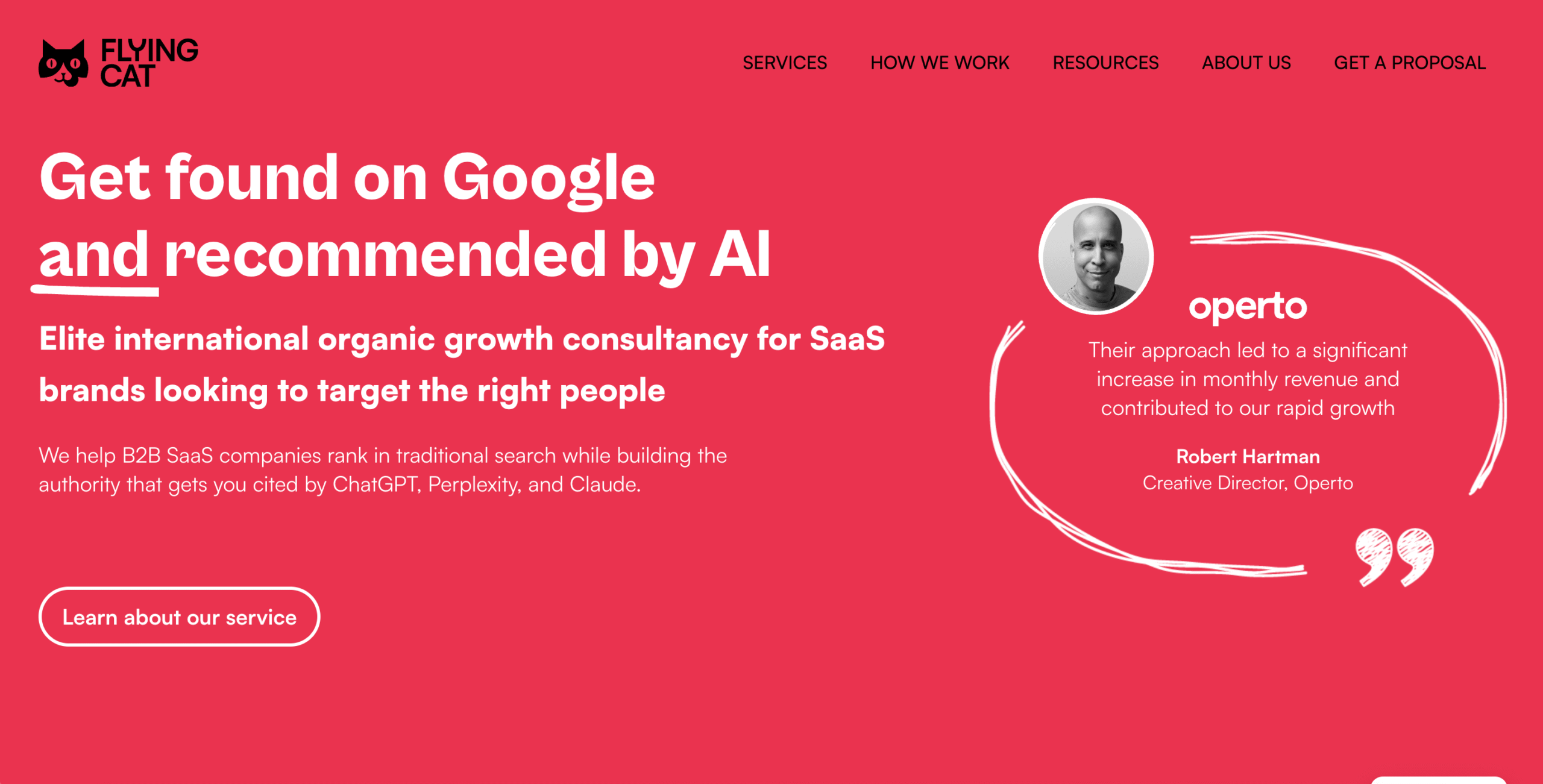
7. Flying Cat Marketing
Best for: SaaS brands expanding into European and multilingual markets that need localization, not translation
Core services: International SEO strategy, multilingual content, market-entry programs, technical international SEO (hreflang, site structure)
Notable clients: Softr, Operto, Stonly, Mixmax
Pricing signal: Roughly $100-149/hr
What to watch: If you operate in one English-speaking market you’d be paying for muscle you don’t need, and reporting depth has been noted as an improvement area.
Flying Cat is an international SEO and content agency specializing in multilingual growth for SaaS brands. They work with native-language specialists across French, Spanish, German, Portuguese, Italian, and Dutch markets.
The distinction in their approach is localizing strategy and search intent per market rather than translating existing English content, which matters for companies where European expansion is a real revenue priority rather than a side project.
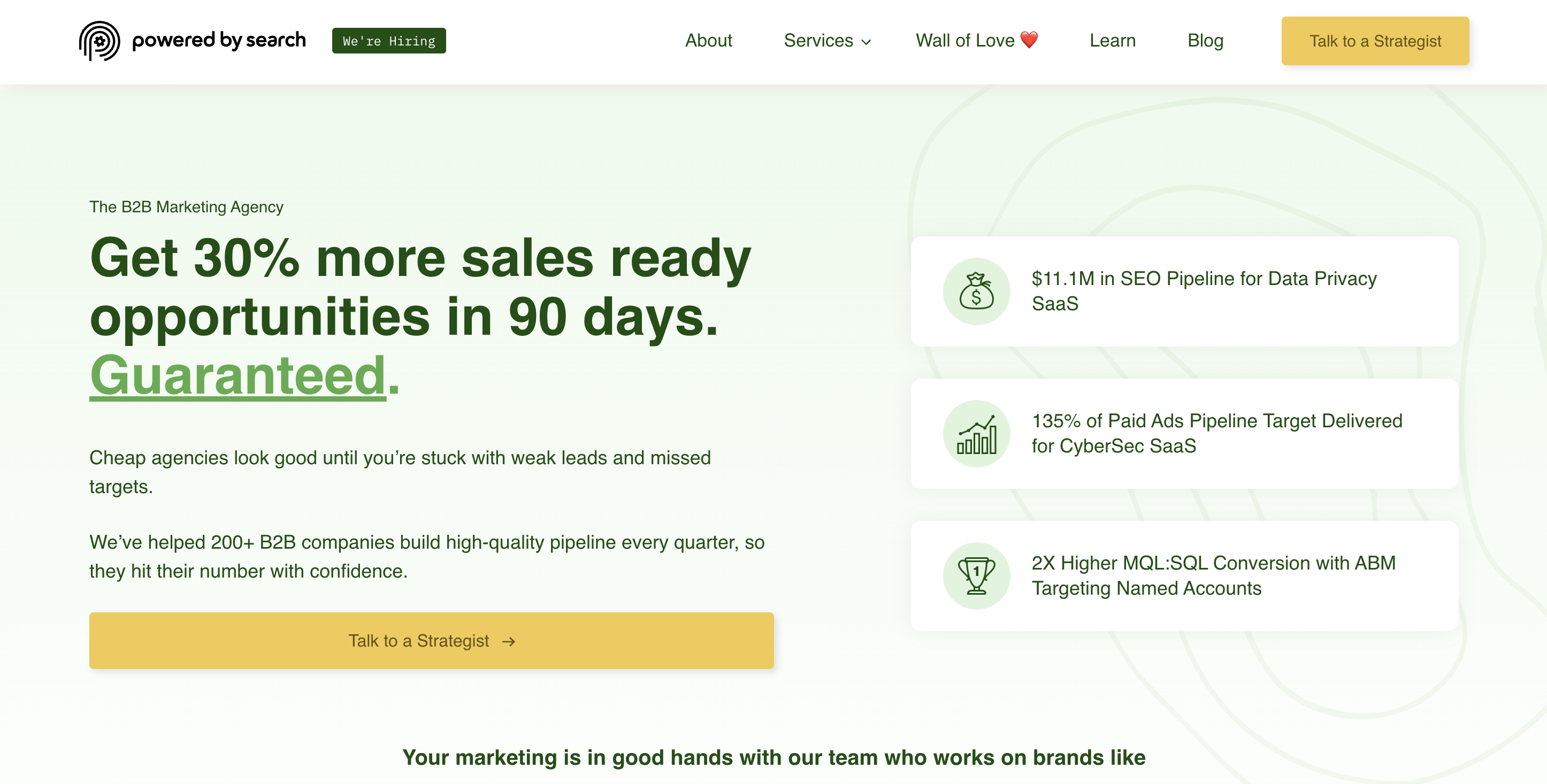
8. Powered by Search
Best for: High-ACV B2B SaaS with six-month-plus sales cycles and buying committees doing their own research
Pricing signal: From $7,500/mo with a one-year commitment
What to watch: The integrated paid-plus-organic model is the product, so if you want a pure organic specialist or can’t commit a year, the model works against you.
Powered by Search is a Toronto-based B2B SaaS agency running SEO, AEO, content, and paid demand generation as a single integrated system. Their programs are built around enterprise buying committees and long evaluation cycles.
The fit is high-ACV software companies where multiple stakeholders research independently before sales gets involved, and where organic and paid need to be coordinated rather than run by separate vendors.
9. Kalungi
Best for: Post-PMF SaaS (roughly $5M-$10M ARR) that needs an entire marketing function, with search as one lane inside it
Core services: Fractional CMO, full-stack marketing team, GTM strategy, ABM, content and SEO within the broader function
What to watch: You’re buying a marketing department, and depth follows breadth; for specialist search and citation work the agencies above go deeper.
Kalungi is a full-service B2B SaaS marketing agency built around fractional CMO leadership. Search is one lane inside a broader function that includes positioning, demand generation, ABM, and team building.
We include it because some readers evaluating agencies for SEO have a different problem: no senior marketing leadership at all. If that describes you, hiring a search specialist first is sequencing the fix wrong.
What SaaS SEO actually costs in 2026
Agencies hate publishing ranges, which is exactly why we will. Across the market, published data and our own observation put typical engagements here:
Engagement type
Typical monthly range
Boutique / offshore-hybrid specialist retainers
$3,000-$6,000
Specialist mid-market retainers (most of this list)
$5,000-$12,000
Integrated or enterprise programs (search + paid, high-ACV)
$12,000-$25,000+
Full marketing-function outsourcing
$15,000-$45,000+
One-time audits and diagnostics
$2,000-$10,000
What moves the number: content volume, link and digital PR intensity, technical scope, whether AI search visibility work is included as a genuine workstream, and how senior the people actually doing your work are. The most common overpayment we see is a mid-market retainer where senior strategists sold the deal and junior generalists execute it. Ask who touches your account weekly.
Growfusely sits in the value band of that table with senior-level execution.
Red flags when evaluating agencies
Take this list into your evaluation calls. Any single flag deserves a follow-up question, and two or more should end the conversation.
Guaranteed rankings or guaranteed citations. Nobody controls Google or ChatGPT. Guarantees signal either ignorance or dishonesty.
No SaaS-named case studies. “We work with tech companies” without named software clients means you’re the experiment.
“AI SEO” in the nav, nothing underneath it. Ask for their methodology, research, or a measured citation result.
Reporting that stops at traffic. If pipeline, signups, or citation share never appear in their sample reports, that’s what your reports will look like.
One-size packages. A PLG startup and a sales-led enterprise platform need different programs. Fixed bundles mean the strategy was written before they met you.
They can’t explain their own strategy simply. Complexity in the pitch usually hides thinness in the plan.
Link volume sold as authority. What earns AI recommendations is presence in independent content, and fifty directory links don’t create that.
When Growfusely is the right fit
Four situations where we’re the strongest choice on this list:
AI answers are already in your sales cycle. Prospects mention ChatGPT shortlists, or your category’s buying research visibly starts in AI engines, and you’re absent from the answers.
You rank but don’t get recommended. Positions look healthy while citations, mentions, and AI-sourced pipeline don’t exist. That gap is what TRACE was built to close.
You want strategy grounded in data. Our recommendations trace to measured citation research we publish openly, and we re-measure to prove movement.
You want senior people doing the work. Strategy and execution from the same senior team, without the pitch-team-to-junior handoff.
When Growfusely may not be the right fit
We’d rather disqualify you here than in month three.
You want paid media managed under the same roof. We don’t run paid. Powered by Search or Kalungi will serve you better.
You want 30 posts a month and no strategy. Volume shops exist and cost less. Our model is fewer, senior-made assets that earn citations.
You need a US-timezone team embedded in daily standups. We work globally with structured collaboration; if daily synchronous embedding is a hard requirement, choose a US-based team like Ten Speed.
Your economics can’t support a specialist retainer yet. If you’re pre-revenue or your ACV can’t sustain a $3K+/month retainer, don’t hire any agency on this list. Do this instead: publish one genuinely useful comparison page in your category, get your entity basics right (consistent name, description, and schema everywhere), and collect 10 honest customer reviews. That foundation costs time, not money, and it’s what we’d build first anyway.
How to choose from this list
Match the specialization to your actual situation. Expanding to Europe points to Flying Cat, an underperforming content library points to Ten Speed, no marketing leadership points to Kalungi, and citation-led growth points to the top of the list.
Demand SaaS-specific proof. Named clients, real numbers, and results in metrics you care about.
Ask how they’d get you cited, not just ranked. Two questions that separate real capability from a renamed nav item: “Which sources drive AI recommendations in our category, and how do you know?” and “Show me a citation result you measured for a client.”
Interrogate who does the work. Seniority of the pitch team predicts nothing. Seniority of the delivery team predicts everything.
Stage-match the pricing. Use the cost table above, and treat any quote wildly outside those bands as a question to ask rather than a bargain or a flex.
To Conclude
Nine agencies, nine different jobs. If your priority is being found and cited where software buying decisions increasingly start, that’s the work we’ve built Growfusely around, and it’s the work we publish research on.
Book a discovery call with Pratik, and he will walk you through where your brand currently stands in AI answers, what’s missing, and what a 90-day plan would look like.
Prefer to explore first? Start with the citation study this list is built on, or our full guide to SaaS SEO.
FAQs
What does a specialized SaaS agency do that a general SEO firm doesn’t?
It builds strategy around software economics: trial and demo conversion paths, PLG versus sales-led motions, competitor comparison intent, and the citation sources AI engines use for software queries specifically. General firms optimize pages; specialists optimize a pipeline.
How much do the best SaaS SEO agencies charge?
Most specialist retainers run $5,000-$12,000 per month, with boutique options from around $3,000 and integrated enterprise programs from $12,000 up. One-time audits run $2,000-$10,000. See the full cost table above.
How long does SaaS SEO take to show results?
Expect early signals (rankings movement, first citations) inside 90 days and meaningful pipeline contribution in six to twelve months. Anyone promising materially faster is answering a different question than the one you asked.
Should we hire an agency, a consultant, or build in-house?
It depends on stage and existing capability. Under roughly $1M ARR, a consultant or foundational DIY usually beats a retainer. Post-PMF with budget but no senior search capability, an agency compounds fastest. At scale, hybrid models win: in-house ownership with specialist agency depth.
How do we know if an agency actually understands AI search visibility?
Ask for evidence that exists outside their sales deck: published research, a measured citation trend for a named client, or a methodology you can interrogate. Our citation study found that most of what drives AI recommendations isn’t what most “AI SEO” packages sell.
When should a startup switch from DIY SEO to an agency?
When organic is working well enough that its ceiling is your bandwidth, or when you’re post-PMF and every month of delay has a pipeline cost. If DIY has produced nothing in a year, diagnose strategy before buying execution.
Do G2 and Clutch ratings matter when choosing an agency?
For diligence on the agency itself, yes, read them. For your own AI visibility, far less than commonly claimed: review platforms drove 7.3% of the 1,739 AI citations we analyzed, against roughly 79% from independent content and vendor comparison pages.


 About Growfusely
 White LabelMake us your (hidden) helping hand in delivering high-quality work to your SaaS clients.
 TeamCheck out the faces (and their backstories) behind our brand.
 Partner With UsJoin forces with us and earn a recurring monthly commission.
 Careers We're HiringJoin our growing team of passionate content marketing geeks.
 SEO & AI Search VisibilityBoost your search engine rankings with a blend of compelling content and technical tweaks.
 Content Strategy & ProductionFuel your brand awareness and user acquisition with strategic content creation and distribution.
 Authority & CitationsEarn relevant, high-quality backlinks from top websites in and around your niche.
 SaaS InfographicsLearn battle-tested best practices on all things SaaS marketing — visually.
 SaaS InterviewsRead our tête-à-têtes with SaaS marketing experts on achieving content-driven organic growth.